Iran Will Become A Top Arms Exporter Once Sanctions Lifted, Commander Says

The top military commander of the Islamic Republic says Iran will become one of the world's biggest arms exporters once sanctions are lifted.

The top military commander of the Islamic Republic says Iran will become one of the world's biggest arms exporters once sanctions are lifted.
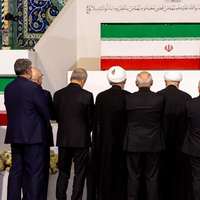
Chief of General Staff of the Iranian Armed Forces Major General Mohammad Bagheri made the remarks during a ceremony at the mausoleum of Ruhollah Khomeini, the founder of the Islamic Republic, on Monday.
Bagheri boasted about the power of Islamic Republic’s precision-guided missiles and drones with multiple applications.
“We don’t need anybody. We determine our strategy, policy and doctrine”, he said, adding that except for “three main superpowers in the world” no country can do this, “not even the Europeans”.
During recent days, while the government has been celebrating the revolution's anniversary, many officials have made such remarks about Iran’s military power.
IRGC Commander Hossein Salami said on Friday that “no world power is capable of confronting the Iranian nation” and the editor of a hardliner daily operating under the aegis of the supreme leader says Iran's precision missiles can target any spot in Europe.
Members of the US House of Representatives asked President Joe Biden last week to focus on Iran’s ballistic-missile capabilities, expressing concerns about attempts to develop an intercontinental ballistic missile which could “potentially put US allies in Europe as well as the US homeland in range.”
Lawmakers demanded written answers in 30 days to questions about the capability of CENTCOM defense systems against the missile threat and the administration’s measures to enforce sanctions on sectors of Iran’s economy that support the ballistic missile program.
The Iran Atrocities Tribunal investigating gross rights violations has charged 160 officials of the Islamic Republic with "committing crimes against humanity".
The tribunal was established in 2020 to investigate the killing of hundreds of protesters in nationwide protests in Iran in November 2019. Concluding its second round of hearings in London on Sunday released a list of the accused officials, which includes Supreme Leader Ali Khamenei.
Heads of the executive and judiciary branches of the government, ministers, commanders from the Revolutionary Guards and police as well as officials from provincial governors’ offices are named in the list.
The tribunal heard testimonies from 219 witnesses and examined evidence from 440 people related to crimes against humanity, extrajudicial killings and executions, torture, rape of prisoners, and harassment of the families of the victims.
Although the verdicts of the Tribunal are symbolic, the panel of the tribunal called on all those who have more documents and evidence about crimes by officials to submit them.
Earlier in the day, a senior IRGC member, identified as witness 600, said that Khamenei's office ordered the military and paramilitary forces to do whatever is necessary to end the chaos.
Reuters had reported in December 2019 that the order to end protests at any cost had come from Khamenei who was deeply concerned about preserving the clerical regime.
The IRGC officer claimed that 427 people were killed in Khuzestan province and 420 in Tehran alone during the crackdown, adding that about 8,000 people were also arrested in the capital.
Earlier estimates ranged from 300 to 1,500 civilians killed nationwide. The new figure offered by the witness would mean that the overall death toll was much higher.
Organizers of the tribunal say an extensive systematic state policy was behind suppressing protesters with help from Iran’s proxy militia forces from the regional countries.
One of the witnesses said on Saturday that as a member of Iran’s ‘Imam Ali’ anti-riot brigades he had seen the deployment of “violent criminals” as well as members of the Iraqi Popular Mobilization Forces, and the Afghan Fatimiyoun militia, organized and commanded by the Revolutionary Guard (IRGC).
He added that Imam Ali brigades had set gas stations ablaze to blame the fires on the protesters and to justify suppression and had been authorized to shoot protesters in the torso and head to end the unrest.
The tribunal − also known as Aban Tribunal after the Iranian calendar month of Aban when the atrocities took place− was established by the Oslo-based Iran Human Rights (IHR), and the international anti-capital punishment organization Ensemble Contre la Peine de Mort (Together Against the Death Penalty).
The protests were the bloodiest in Iran’s history with security forces opening fire with military weapons on demonstrators in many cities. Thousands were arrested and jailed without due process of law and there were numerous reports of torture in prison.

An Iranian official has said that the government doesn’t have information about the exact value of its assets, which hinders efforts for their capitalization.
In an interview with Khabar Online website in Tehran published on Sunday, the head of the Iranian Privatization Organization, Hossein Ghorbanzadeh, said that the government seeks to solve its budget deficit and liquidity issues through privatization of state properties and companies but cannot do so because it does not exactly know their value.
US sanctions since 2018 have drastically cut government revenues from oil exports and trade, leaving a higher-than 50 percent budget deficit.
He said the government has a portfolio of assets that includes physical assets such as real estate and financial assets such as shares of state-owned enterprises.
Ghorbanzadeh also proposed the establishment of an emergency taskforces to investigate the assets, adding that the government has opened a website to gather data from officials and entities.
He said the current estimates of the value of the assets are in a wide range from $260 to $670 billion in today’s exchange rates.
Earlier in December, the head of a government chamber of commerce, Gholam-Hossein Shafei said that the country had zero economic growth in the past decade, adding that the private sector in Iran has been dealt a bad hand by politically well-connected elites who took advantage of privatization to enrich themselves.

US Middle East Commander General Frank McKenzie arrived in the United Arab Emirates Sunday for talks to bolster the Gulf state's defenses after missile attacks by Houthi fighters in Yemen.
In recent weeks, the Iran-backed Houthis have waged an unprecedented string of largely failed missiles strikes on UAE targets that have triggered Emirati and US air defenses and seen American troops briefly taking shelter.
McKenzie, who is head of Central Command, said he moved up his planned visit in response to the Houthi attacks, hoping to underscore the US commitment to UAE’s defense.
"I think it's a very worrisome time for UAE. They're looking for support. We're here to help them to provide that support," McKenzie told reporters.
The Pentagon has announced a US deployment of advanced F-22 fighter jets and a guided missile destroyer, the USS Cole, to partner with the UAE navy ahead of a port call in Abu Dhabi.
McKenzie said the F-22s would provide the UAE with "one of the best look-down radars in the world," capable of identifying targets including land attack cruise missiles and drones.
Washington accuses Tehran of supplying high-end weaponry to the Houthis.
"Medium range ballistic missiles that were fired from Yemen and entered UAE were not invented, built, designed in Yemen," McKenzie said. "All that happened somewhere else. So, I think we certainly see the Iranian connection to this."
Reporting by Reuters

Iran’s police have distributed thousands of new cars, anti-riot “tactical vehicles”, motorcycles and boats to units, costing tens of millions of dollars.
The commander of the police, General Hossein Ashtari, a senior Revolutionary Guard officer, said Sunday that 1,800 cars, 700 motorcycles, 250 “tactical vehicles” and 85 boats were procured and distributed.
Fars news that published the report gave no details about the kind of cars purchased by the police, but Iran uses a mix of domestically assembled cars as well as imported models, such as Toyota SUVs and Mercedes cars in the past. But 1,800 cars alone would cost tens of millions of dollars.

Motorcycles are mainly used to disperse protesters when special anti-riot personnel, two per motorcycle, show up in groups of 20 or more and drive toward small or large crowds. The men sitting in the back use sticks or even chains to attack civilians.
Tactical vehicles are a variety of heavy, armored semi-trucks and trucks, designed to confront and disperse protesters. They are assembled in Iran, but engines and other parts are imported. Some are used as powerful water trucks and others have special devices to fire tear gas.

The special anti-riot forces have been instrumental in the past to stop nationwide protests. Civilians have no way to protect themselves against swarming motorcycles or armored vehicles, while often these forces have permission to open fire on protesters.
In November 2019, a variety of forces were used to put down nationwide protests, including armed vigilante-type groups, riot police and according to some accounts, even Iraqi and Afghan militiamen. As a result, hundreds were killed in the streets. Reuters put the figure at 1,500, while Amnesty International has conformed 304 deaths.

The news of the large procurements comes as the Islamic Republic leadership call for more support for the police after an officer was stabbed to death by an alleged criminal this week. Iran’s parliament has vowed to relax current laws on use of firearms by the police, although during protests security forces have felt to inhibition on opening fire on civilians.
Police chief Ashtari presented the news of procurements as giving more mobility to security forces that are under the umbrella of the armed forces, with the leadership of the Revolutionary Guard, IRGC. He said the move will strengthen security on borders and for ordinary people.
He called on political leaders to support police requests for more support in next year’s budget. Already this year, security forces have received several raises amid high double-digit inflation, while other government employees receive half of what is needed for minimum expenses, estimated to be more than $400 a month for a family of 3.3.
Teachers and even court workers and prison guards have been protesting for pay raises to partially redress the impact of inflation that has seen food prices rise by 60 percent in the past year.

An officer of Iran’s Revolutionary Guards says about 850 people were killed in two provinces alone in the first two days of the bloody November 2019 protests.
During the Sunday session of the Iran Atrocities Tribunal, underway behind closed doors in London, “witness 600”, who identified himself as a former senior IRGC officer, claimed that 427 people were killed in Khuzestan province and 420 in Tehran during the crackdown, adding that about 8,000 people were also arrested in the capital.
Earlier estimates ranged from 300-1,500 civilians killed nationwide. The new figure offered by the witness would mean that overall death toll was much higher.
“We were losing Tehran and Vahid Haghanian (supreme leader’s chief personal aide) from Khamenei's office ordered us to do whatever is necessary to end the chaos”, he said. Reuters had reported in December 2019 that the order to end protests at any cost had come from Khamenei.
He added that Basij paramilitary forces were also allowed to fire directly at people, noting they “fired the most and killed the most".
He said this crackdown was the only case in which military forces were not required to report on how many times or where they fired.
The tribunal − also known as Aban Tribunal after the Iranian calendar month of Aban − was established on the first anniversary of the 2019 protests by several human rights groups.