• العربية
  • فارسی
BrandBrand
  • Iran Insight
  • Politics
  • Economy
  • Analysis
  • Special Report
  • Opinion
  • Podcast
  • Live TV
  • Iran Insight
  • Politics
  • Economy
  • Analysis
  • Special Report
  • Opinion
  • Podcast
  • Live TV
  • Theme
  • Language
    • العربية
    • فارسی
  • Iran Insight
  • Politics
  • Economy
  • Analysis
  • Special Report
  • Opinion
  • Podcast
  • Live TV
All rights reserved for Volant Media UK Limited
volant media logo
ANALYSIS

US military support against Houthis risks widening Iran war, expert says

Kambiz Tavana
Kambiz Tavana

Iran International

Oct 13, 2026, 02:01 GMT+1
Iran-aligned Houthi fighters move next to a destroyed vehicle following what the source described as an attack on Saudi-backed forces in the location given by the source as al Jawf governorate, Yemen, in this screengrab taken from a video released by Houthi Military Media on September 15, 2026

Washington could support the Saudi campaign against the Houthis at little direct cost by lifting political objections to its operations, but deeper military involvement risks appearing to widen the Iran war, senior Middle East analyst Ryan Bohl told Iran International.

Recent Houthi attacks on Saudi Arabia, including Riyadh’s international airport, have sharpened questions about how far Washington and other governments are prepared to go in supporting the kingdom.

Bohl, a senior analyst at the risk intelligence firm RANE, said the least costly US option would be to drop objections similar to those Washington raised over Saudi-led military operations before the 2022 truce. Those concerns included civilian casualties from airstrikes and the humanitarian consequences of an offensive on the Red Sea port city of Hudaydah.

Washington helped push for a halt to the offensive on Hudaydah in 2018. The UN-brokered Stockholm Agreement established a ceasefire there later that year.

“That will cost the United States virtually nothing,” Bohl said of lifting political objections, referring to munitions, troops and additional spending.

Greater intelligence support, assistance in targeting Houthi forces or direct American airstrikes would carry military, economic and especially political costs, he said.

“It will look like President Trump is now expanding the war that he seems to be trapped in with the Iranians.”

Air power has limits

Air power alone is unlikely to defeat the Houthis, Bohl said, but could help capable ground forces advance and hold territory.

He pointed to Yemeni units backed by the Saudi-led coalition, including the Giants Brigades, whose ability to capture and retain territory could depend heavily on tactical air support.

The question is whether those forces have recovered sufficiently from recent Houthi advances to mount a sustained counteroffensive.

Bohl said forces aligned with Yemen’s internationally recognized government had appeared disorganized after a Houthi advance toward the southern end of the Red Sea coast. Some units were now regrouping and resuming offensive operations, he said, but their ability to coordinate remained uncertain.

“The big question is, will they gain enough coherence in order to push back the Houthi advances around Taiz, and more importantly, push up the Red Sea coast towards Hudaydah.”

More support for defense than offense

Foreign governments are more willing to help defend Saudi Arabia than to support a campaign to recapture Houthi-held territory, Bohl said.

He cited Pakistani military support and Turkish preparations to provide defensive assistance as examples of efforts to protect the kingdom. Such support, he said, was primarily aimed at defending Saudi airspace and preventing further attacks.

An offensive inside Yemen would be a harder commitment to secure.

Israeli Prime Minister Benjamin Netanyahu is seeking Saudi consent through US mediation for Israel to join the campaign against the Houthis, Haaretz reported on Monday.

Saudi Crown Prince Mohammed bin Salman opposes Israeli participation over concerns about a public backlash, the newspaper said. Netanyahu reportedly hopes cooperation would strengthen ties with Riyadh and help advance normalization.

Many governments see the country as “a geopolitical black hole that their forces will disappear into and that they’ll never achieve victory,” Bohl said.

They also look to Washington to provide military capabilities they cannot deploy at comparable scale. Turkey could influence events in its neighborhood, he said, but would face greater constraints in sustaining an extensive campaign as far away as Yemen.

Whether an effective offensive coalition emerges will depend heavily on Washington’s objectives, Bohl said. Those could range from reversing recent Houthi gains to supporting a broader effort to recapture territory, potentially including Sanaa.

The United States’ 2025 air campaign ended with an Oman-brokered ceasefire with the Houthis in May that year. A campaign supporting territorial advances would raise a different question: how far Washington was prepared to help allied ground forces go.

“America’s role in it will be instrumental in us understanding whether or not a coherent offensive coalition can actually be put together and have an impact on conditions on the ground.”

Most Viewed

Tehran seizes on Rubio’s Xerxes remarks to champion a past it once disparaged
1
INSIGHT

Tehran seizes on Rubio’s Xerxes remarks to champion a past it once disparaged

2

Iran officials hinted at land incursions if US resumes strikes - WSJ

3

Iran hardliners back threats to strike Persian Gulf digital infrastructure

4

Meta, Google remove Iran matchmaking app after child marriage report

5

Iran-US diplomacy stalls as Houthi attacks on Saudi Arabia intensify

Spotlight

  • Tehran raises the stakes, betting Washington will blink
    ANALYSIS

    Tehran raises the stakes, betting Washington will blink

  • Houthi airport strikes carry echoes of Iran’s aviation threats, experts say

    Houthi airport strikes carry echoes of Iran’s aviation threats, experts say

  • Iran hardliners back threats to strike Persian Gulf digital infrastructure

    Iran hardliners back threats to strike Persian Gulf digital infrastructure

  • Can US sanctions derail Iran’s China trade route?
    ANALYSIS

    Can US sanctions derail Iran’s China trade route?

  • Machete-wielding men at IRGC-backed rally revive scrutiny of crackdowns
    ANALYSIS

    Machete-wielding men at IRGC-backed rally revive scrutiny of crackdowns

Banner
Banner
Banner
Banner
•
•
•

More Stories

Iran hardliners back threats to strike Persian Gulf digital infrastructure

Oct 12, 2026, 23:59 GMT+1
•
Maryam Sinaiee
100%
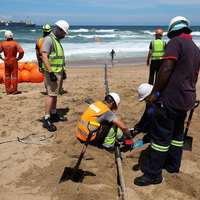
File photo shows workers toil on the 2Africa undersea cable project carried out by France’s Alcatel Submarine Networks in Amanzimtoti, South Africa on Feb. 7, 2023.

Iranian hardliners have backed security chief Mohsen Rezaei’s threat to strike data centers, undersea internet cables and artificial intelligence facilities in the Persian Gulf if the United States and Israel resume hostilities.

Rezaei, secretary of Iran’s Supreme National Security Council, told state-owned Press TV on Sunday night that Tehran was prepared for renewed conflict and could target critical technology infrastructure across the Middle East.

He said valuable American assets in the United Arab Emirates and around the Strait of Hormuz had not yet been included among Iran’s targets, but Tehran was prepared to demonstrate new capabilities to strike them. He claimed those assets and the region’s digital infrastructure were worth more than $2 trillion.

“Every miscalculation by the enemy against Iran has resulted in a heavy defeat for them; the next mistake will bring new fronts and greater surprises,” Rezaei wrote on X on Monday.

Hardliners urge pressure on US technology interests

Tasnim News Agency, which is affiliated with the Islamic Revolutionary Guard Corps, argued in an article titled “Why Is Artificial Intelligence on the Target List?” that attacks on AI centers could undermine US technological competition with China, deter investment and put pressure on US stock markets.

  • Iran finds a new weapon beneath Hormuz

    Iran finds a new weapon beneath Hormuz

Hossein Shariatmadari, editor-in-chief of the hardline Kayhan newspaper and the supreme leader’s representative at the publication, welcomed Rezaei’s threat in an article titled “Well Done, Brother Mohsen!”

He called for using fiber-optic cables running through the Persian Gulf and the Strait of Hormuz to pressure Washington and its allies. He claimed that nearly seven major international cable systems pass through the region and that damage to them could disrupt more than 80 percent of commercial, banking, military and AI-related communications.

Kayhan also accused what it called “Western-oriented” political factions of double standards over internet access. It quoted Shariatmadari as predicting that politicians and parties “not fully aligned with the revolution” would oppose Rezaei’s threat and portray it as fueling war.

“The reformists had previously described internet shutdowns [in Iran] as a cause of deep dissatisfaction and called for stable, free and secure internet access for the public. But now that this same internet has become a strategic weapon for Iran against the United States, they have either remained silent or opposed it in the language of peace,” the article said.

Political analyst Ruhollah Rahimpour, however, told Iran International that while Iran could technically and operationally damage data centers and communications infrastructure in the Persian Gulf, the impact would primarily fall on regional networks rather than seriously affect the global internet.

Such attacks could raise the cost of war for other countries, he said, but also widen the conflict and impose greater security and economic costs on Iran.

Mohsen Zanganeh, a member of parliament’s knowledge-based companies and technology faction, endorsed Rezaei’s warning in an interview with ANA news agency, saying it reflected technological realities.

He said many data centers operated by major technology companies, most of them American, and the main communications routes connecting them were located in countries along the southern coast of the Persian Gulf.

Attacks could damage equipment, cloud networks and processing systems while disrupting US military operations, Zanganeh argued. Because Arab countries host both US bases and American technology infrastructure, he said, the consequences could spread to other countries and increase the global economic cost of war, as had happened in the energy sector.

WANA News described Rezaei’s remarks as an attempt to deter military action by raising its potential cost, saying a declaration of readiness did not necessarily signal a decision to launch operations.

Warnings amid strained diplomacy

Rezaei’s threats came alongside indications of continued differences between Tehran and Washington.

In a separate post on X on Sunday, he said the United States had accepted some of Iran’s seven conditions, but Tehran considered its response insufficient.

“Iran’s diplomacy has changed, and we will not return to the previous situation,” he wrote.

Mostafa Najafi, a commentator supportive of Rezaei, interpreted the remarks as a sign that the two sides remained far from an agreement.

“This position by the secretary of the Supreme National Security Council means that negotiations between Iran and the United States are a long way from an agreement and much closer to tensions,” he wrote on X.

The infrastructure threats also drew criticism on social media.

One user, Mohammad Nikbakht, questioned why Rezaei was announcing potential targets and argued that attacks would encourage Arab countries to unite against Iran.

Another commenter warned that threats without the capability to carry them out could backfire, drawing a comparison with Iran’s efforts to close the Strait of Hormuz, which the commenter said had resulted in a naval blockade of Iran.

“We are much more worried about miscalculations by our country’s executive officials than about miscalculations by the enemy,” a different user wrote.

UK blames IRGC for RAF plot, vows crackdown on Iranian networks

Oct 12, 2026, 17:28 GMT+1
100%
A B-1 bomber takes off from RAF Fairford airbase, as the US removes its B-1 bombers one week after several men were arrested on suspicion of offences under the Explosives Act, in this screengrab obtained from a social media video in Fairford, Gloucestershire, Britain October 4, 2026.

Britain said on Monday that Iran’s Islamic Revolutionary Guard Corps had “almost certainly” directed a suspected plot targeting RAF Fairford, as it vowed to crack down on Iranian criminal networks, sanctioned two Iranian nationals and summoned Iran’s ambassador.

RAF Fairford in southwest England, which had been used by US bombers to carry out strikes on Iran, became the focus of a major security operation after five British men were arrested nearby in the early hours of Sept. 27 on suspicion of terrorism and explosives offences.

US officials have said the suspected plot involved a drone attack. President Donald Trump said last week that an Iran-linked threat had prompted the United States to withdraw its bombers from the base.

“I can confirm our assessment that it is highly likely to have been coordinated in Iran, almost certainly directed by Iran’s Islamic Revolutionary Guard,” Prime Minister Andy Burnham told parliament.

Iran has denied involvement. Iran’s ambassador to Britain, Seyed Ali Mousavi, on Monday rejected any Iranian role in the suspected plot and said Tehran was willing to cooperate with British authorities investigating the incident, state news agency IRNA reported.

Details of the suspected plot remain limited. The five British men were later released on police bail under what authorities described as stringent conditions. Two other arrested men, including a British-Iranian national, were also released.

Police said petrol was found in vans seized during the investigation but no viable explosive was discovered.

“We will not tolerate these threats on our soil,” Burnham said. “We will crack down on Iran's use of criminal networks, using our full range of powers to target them and their funding streams, and we will bring further sanctions to restrict the capacity of Iran and the IRGC to do us harm.”

Sanctions and diplomatic summons

Foreign Secretary Ed Miliband said he had instructed his department to summon Iran’s ambassador.

“Iran’s continued attempts to undermine the security of the United Kingdom and international partners through its criminal networks, proxy groups and state-backed malign activity is unacceptable,” Miliband said.

Britain also sanctioned Ruhollah Bazghandi and Shahram Ali Reza Tamarzadeh Jakki under its Iran sanctions regime.

The UK’s Foreign, Commonwealth & Development Office said Bazghandi, whom it identified as the IRGC’s head of counterespionage operations, was suspected of planning or conducting espionage for Iran and of involvement in threatening, planning or conducting attacks against people and assets in Britain or other countries.

Jakki was sanctioned for allegedly supporting or assisting activity involving threats, plans or attacks against people outside Iran. Britain described him as a facilitator for the already sanctioned Zindashti criminal network, which it says has been involved in plots targeting Iranian dissidents.

Joint condemnation

Foreign ministries from nearly 30 countries, including the United States, Canada, France and Germany, issued a joint statement condemning “Iran’s use of violent attacks, including the acts of lethal plotting, arson, sabotage, cyber-attacks, and other hybrid activities against us and our partners.”

“The UK has also concluded this event demonstrates the IRGC’s continued willingness to project hostile activity beyond its borders through covert networks and proxy actors,” the statement said.

British authorities have for years accused Iran of involvement in plots and attempted assassinations in Britain using criminal networks and proxies, allegations Tehran has repeatedly denied. Britain said last year that it had identified 20 credible Iran-backed threats to kill or kidnap people based in the UK.

In July, Britain used new state-threat powers to ban support for the IRGC and Harakat Ashab al-Yamin al-Islamiya, or HAYI, a linked group that had claimed responsibility for seven attacks earlier this year targeting sites connected to Jewish and Israeli communities and Persian-language media.

Iran warns of wider risks as regional attacks intensify

Oct 12, 2026, 11:50 GMT+1
100%
A cargo ship docked at the Port of Fujairah, as the Iran war limits marine traffic in the Strait of Hormuz, in Fujairah, United Arab Emirates, on May 6, 2026.

Two commercial vessels were attacked near Oman on Sunday, two Indian sailors were left missing, and a drone struck an Iranian Kurdish opposition camp in Iraq on Monday, as Iranian officials warned that a renewed war could put regional infrastructure at risk.

The tanker incidents underscored the threat to shipping beyond the waterway itself. The Nicaragua-flagged Petro Dolphin was hit by a drone at Sohar anchorage off Oman, India’s shipping minister said. Nine of its 11 Indian crew members were rescued, while two remained missing.

Separately, the Marshall Islands-flagged Valthera was struck by an unidentified projectile in the Strait of Hormuz, setting off a fire onboard; all 11 Indian crew members were safe, India’s foreign ministry said. The ministry condemned the attacks, and India’s embassy in Muscat was coordinating with Omani authorities to help locate the missing sailors.

The latest incidents followed repeated attacks on commercial vessels in the region, but the statements from India did not identify who was responsible for Sunday’s strikes.

Separately, a drone struck a camp belonging to an Iranian Kurdish opposition group in Koya, east of Erbil in Iraq’s Kurdistan Region, Reuters reported, citing two security sources. No casualties were immediately reported.

Kurdistan-based website Rudaw published video showing a drone in the sky over Koya, but said it was not yet clear whether it had hit a target. No responsibility for the reported strike was established.

The incidents came as Mohsen Rezaei, secretary of Iran’s Supreme National Security Council, warned that a renewed war could put infrastructure across the region within range.

“If war breaks out, many cables, data centers and artificial intelligence facilities, valued at $2 trillion, will be within range,” he said, according to state media. Rezaei added that Iran would continue resisting until its adversaries accepted its rights.

Iranian officials also continued to issue warnings to Washington and regional governments. Acting Defense Minister Majid Ebn al-Reza said the armed forces were ready to respond to threats and urged neighboring countries to leave what he called the US security umbrella.

His remarks followed a statement by armed forces spokesman Abolfazl Shekarchi that Iran would not allow the United States and Israel to re-establish their preferred regional order.

At the same time, diplomatic contacts had not stopped. Foreign Ministry spokesman Esmaeil Baghaei said Tehran was reviewing Washington’s latest proposal and that messages between the two countries continued through mediators.

Baghaei gave no indication of a breakthrough, saying Iran’s position on the Strait of Hormuz remained tied to the US naval blockade.

The developments pointed to risks spreading across shipping routes, Iraqi Kurdistan and potentially digital infrastructure, even as intermediaries continued trying to keep US-Iran diplomacy alive.

Can US sanctions derail Iran’s China trade route?

Oct 12, 2026, 03:57 GMT+1
•
Umud Shokri
100%
File photo: The inaugural double-stack container train linking Iran and China, July 2024

Washington’s new sanctions are unlikely to stop a China–Iran freight train at the border, but may make the route Tehran has turned to under pressure from the US naval blockade costlier and less reliable.

The blockade has sharply restricted maritime trade, while years of sanctions have squeezed Iran’s access to international finance. But not every trade channel had already closed.

Trains carrying goods from China were still reaching Iran before the latest US measures. The question now is whether sanctions on Iran’s railway companies will narrow that remaining route and complicate the flow of goods, including auto parts, carried on it.

Last week, the US Treasury designated three Iranian rail companies: the state-owned Islamic Republic of Iran Railway Company, known as RAI; Raja Passenger Trains Company; and private freight operator Railway Transportation Company.

The department said Iran had turned to rail to sustain trade and transport oil as the maritime blockade took hold.

The sanctions block the US-based property of the designated companies and prohibit US persons from dealing with them, while separate sectoral determinations give Washington wider scope to impose future designations. They do not automatically block every foreign railway, freight company or shipment connected to Iran.

The more immediate effect may be caution among companies involved in the trade. Banks may reject payments. Insurers and equipment suppliers may refuse to handle business involving designated companies. Others may charge higher fees or take longer to process shipments.

None of this would close the railway, but together it could make the route less dependable.

A useful route, with clear limits

The China–Iran rail connection is no longer just a proposal. In September, a block train bound for Iran was reported traveling through Kazakhstan, Uzbekistan and Turkmenistan before entering at Sarakhs.

A train from Xi’an to Iran’s Aprin dry port in 2025 was reported to have taken about 15 days, compared with an estimated 30 to 40 days by sea. Iranian railway officials also reported that 43 freight trains arrived from China in the first nine months of 2025.

Those figures show a route in use, although they do not indicate how much of Iran’s overall trade moves by rail.

Rail can move selected goods, industrial inputs, equipment and containerized cargo faster than shipping by sea. But it cannot replace the volume carried by tankers or bulk freighters.

Treasury says Iran is using rail to help transport oil, but its announcement provides no figures for oil moved this way. There is therefore little evidence that rail is a meaningful substitute for seaborne oil exports.

The new designations could nevertheless complicate the China route. Freight must be coordinated among operators, border agencies and terminals in several countries, making the response of Chinese and Central Asian companies important to how disruptive the sanctions ultimately prove.

Auto parts show where the sanctions overlap

The automotive sanctions create a second pressure point because auto parts from China have traveled to Iran by rail.

In 2025, Iran Khodro reportedly received an all-rail shipment through Sarakhs. The head of the local special economic zone said the route reduced transit and stockpiling time from about 50 days to 15.

Sanctions on automakers and rail operators could therefore put pressure on the same supply chain from two directions.

Procurement and payment may become harder, while freight companies and intermediaries may avoid shipments linked to designated firms.

The impact on car production, however, will depend on what parts are affected, how much stock manufacturers have and whether other suppliers or routes are available.

The trains may run, but at a price

The blockade has squeezed Iran’s maritime options; the rail sanctions raise the risks attached to an overland alternative.

They may not stop the China–Iran connection, but could make it costlier and less predictable by deterring the banks, insurers and logistics firms that keep shipments moving.

How much traffic falls will depend largely on the response of Chinese and Central Asian operators.

For now, the railway remains open. But as Iran leans more heavily on the trade routes still available to it, Washington is trying to make those routes harder to use.

Iran-US diplomacy stalls as Houthi attacks on Saudi Arabia intensify

Oct 12, 2026, 00:40 GMT+1
100%
A vessel sails through the Strait of Hormuz, seen from the Suro coast in Bandar Abbas, southern Iran, October 6, 2026. (ISNA)

Efforts to end the war with Iran and restore normal shipping through the Strait of Hormuz remained deadlocked Sunday, as military pressure continued at sea and the Iran-backed Houthis carried out increasingly deadly attacks inside Saudi Arabia.

Iran said the United States had accepted some of seven conditions it presented for reopening the strait but that Washington's response was insufficient, leaving the two sides without agreement on renewed negotiations or unrestricted passage through the waterway.

“The US has agreed to some of Iran’s seven conditions, but we consider its response INADEQUATE,” Iran’s Supreme National Security Council Secretary Mohsen Rezaei said in a post on X. “Iranian diplomacy has changed and there will be no return to the status quo ante.”

Iran presented the seven-condition proposal during the UN General Assembly, offering to restore normal maritime passage through the Strait of Hormuz within seven days if its conditions were met. The United States later responded through Qatari intermediaries.

The latest exchange comes days after Axios reported that the Pentagon had instructed US Central Command to complete preparations for the possible resumption of major combat operations against Iran. President Donald Trump subsequently said the United States would not attack Iran before the November 3 midterm elections and described talks with Tehran as “productive.”

Rezaei, however, said Washington still needed to clarify parts of its response and that Iran would not reopen the strait to the United States or resume negotiations until its conditions were met.

Pressure builds around Hormuz

The diplomatic impasse is playing out most directly at sea, where Washington is enforcing its blockade of Iran as Tehran maintains restrictions on passage through the Strait of Hormuz.

US Central Command said a US fighter jet struck the stern of the Panama-flagged M/V Ocean Molica, also known as the Arika Sun, after the vessel left an Iranian port and ignored repeated warnings as it attempted to breach the blockade.

The strike fully disabled the vessel's propulsion without harming its crew, according to CENTCOM, which warned other commercial vessels approaching Hormuz to comply with blockade instructions.

Iran, for its part, has continued restricting passage through the strait. The IRGC Navy said Sunday that a tanker carrying 750,000 barrels of crude struck a naval mine and caught fire after attempting to use what it described as an unauthorized route despite warnings.

The IRGC-affiliated Tasnim news agency described it as the third tanker to strike a mine in the strait that day.

The incidents come amid a sharp deterioration in shipping security this month. UK Maritime Trade Operations recorded 11 attacks on commercial vessels in the week ending October 9, including 10 in the Strait of Hormuz and one in the Persian Gulf.

Seven of the vessels attacked in the strait sustained only minor damage and continued their transit, UKMTO said. Vessel traffic through Hormuz remained about 75% below pre-conflict levels.

Separate shipping data this week showed tanker attacks had reached their highest weekly level since the Iran war began, with the number of vessels transiting Hormuz falling to its lowest in more than two months.

The disruption has extended well beyond the waterway, pushing up global fuel costs and prompting Washington to seek additional supplies as the Trump administration faces pressure over diesel prices ahead of the November 3 midterm elections.

Trump said Friday that Russia had agreed to immediately supply more than 300,000 metric tons of diesel to US and global markets, with further supplies to follow. His administration also temporarily eased sanctions on Russian fuel to facilitate the arrangement.

Treasury Secretary Scott Bessent defended the deal Sunday and explicitly linked it to the confrontation with Iran, saying Tehran was the “biggest loser” because its attempts to create choke points in the Strait of Hormuz and diesel supplies had failed.

“We're going to do it with all the legal authorities we have,” Bessent told Fox News, saying the agreement would help bring diesel prices down.

Fighting intensifies between Saudi Arabia and Houthis

The Iran war's Yemen front has intensified as Saudi Arabia expands military operations against the Iran-backed Houthis and the group carries out increasingly deadly attacks inside the kingdom.

A Houthi attack on King Khalid International Airport in Riyadh Saturday killed 13 people and wounded more than 300, the deadliest attack in Saudi Arabia in more than a decade. The airport was attacked again Sunday, when a projectile struck Terminal 4, killing a Pakistani resident and injuring 11 people, according to Saudi aviation authorities. Saudi air defenses also intercepted a cruise missile near the airport.

Saturday's strike followed two earlier attacks on the Riyadh airport during the week that killed four people, one of which also heavily damaged a Saudi commercial aircraft parked on the tarmac.

The latest escalation followed a Houthi offensive last month that seized strategic territory along Yemen’s Red Sea coast near the Bab al-Mandab strait, a critical shipping route and an alternative to the Strait of Hormuz.

Saudi-backed forces have since intensified their campaign against the Houthis. The Saudi-led coalition said it had struck 136 Houthi targets, including sites linked to the group’s ballistic missile capabilities. Yemen’s internationally recognized government forces separately said they had carried out 1,732 strikes and “neutralized” more than 900 Houthi fighters during Operation Dawn of Yemen.

The escalation has also raised the prospect of deeper US involvement. Trump said Saturday that Washington was considering joining Saudi strikes against the Houthis. The United States is already providing Saudi Arabia with intelligence support but has stopped short of the direct military assistance sought by Riyadh and its Yemeni allies.

The attacks have spread beyond the capital. The Houthis said Sunday they also targeted King Fahd International Airport in Dammam and two Saudi Aramco facilities. There was no immediate Saudi confirmation of those attacks.

The intensified attacks have come as Saudi Arabia steps up its military involvement in Yemen. The Saudi-led coalition has carried out large-scale strikes against Houthi positions, while Saudi-backed Yemeni government forces have launched a ground offensive against the group.

The coalition said earlier that 136 Houthi targets had been struck, including sites linked to the group's ballistic missile capabilities. Yemen's internationally recognized government forces separately said they had carried out 1,732 strikes and “neutralized” more than 900 Houthi fighters during Operation Dawn of Yemen.

The growing threat to Saudi aviation has begun prompting wider precautions. The US Federal Aviation Administration warned American airlines Sunday to exercise caution when flying to or over Saudi Arabia because of military activity and navigation-system interference, while the Houthis renewed warnings against using Saudi airports.

Diplomatic channels between Tehran and Riyadh have nevertheless remained open. Saudi Foreign Minister Faisal bin Farhan and Iranian Foreign Minister Abbas Araghchi spoke Sunday about the fighting and efforts to reduce the confrontation, with Araghchi saying Iran was prepared to help facilitate dialogue between Saudi Arabia and Yemen.

That contact has not altered the broader Iran-US impasse. Washington and Tehran remain divided over the conditions for reopening the Strait of Hormuz, leaving restrictions on shipping and fighting on the Saudi-Yemen front unresolved despite continuing diplomatic contacts.