• العربية
  • فارسی
Brand
  • Iran Insight
  • Politics
  • Economy
  • Analysis
  • Special Report
  • Opinion
  • Podcast
  • Iran Insight
  • Politics
  • Economy
  • Analysis
  • Special Report
  • Opinion
  • Podcast
  • Theme
  • Language
    • العربية
    • فارسی
  • Iran Insight
  • Politics
  • Economy
  • Analysis
  • Special Report
  • Opinion
  • Podcast
All rights reserved for Volant Media UK Limited
volant media logo

Khamenei’s coffin flown from Iraq’s Najaf to Mashhad

Jul 9, 2026, 07:16 GMT+1

A plane carrying the coffin of Iran’s former Supreme Leader Ali Khamenei left Najaf in Iraq for Mashhad in northeastern Iran on Thursday, Iranian media reported.
Most Viewed

Iran bears biggest economic cost of Hormuz closure
1
ANALYSIS

Iran bears biggest economic cost of Hormuz closure

2

Ali Khamenei was killed at meeting on protest crackdown - security-linked outlet

3

Iran uses migrant smuggling routes to place operatives in Britain - Telegraph

4

Hormuz traffic falls to one as US-Iran fighting escalates

5
INSIGHT

Cafés close, tolerance ends: Iran’s post-war shift on compulsory hijab

Banner
Banner
Banner

Spotlight

  • Iran is living through America’s 2022 inflation shock almost every month
    ANALYSIS

    Iran is living through America’s 2022 inflation shock almost every month

  • Is Iran using the US war to accelerate executions and silence dissent?
    PODCAST

    Is Iran using the US war to accelerate executions and silence dissent?

  • Tehran braces for possible new phase of war
    INSIGHT

    Tehran braces for possible new phase of war

  • Cafés close, tolerance ends: Iran’s post-war shift on compulsory hijab
    INSIGHT

    Cafés close, tolerance ends: Iran’s post-war shift on compulsory hijab

  • Iran bears biggest economic cost of Hormuz closure
    ANALYSIS

    Iran bears biggest economic cost of Hormuz closure

  • Russia’s gasoline imports add pressure to Iran’s strained fuel market
    ANALYSIS

    Russia’s gasoline imports add pressure to Iran’s strained fuel market

•
•
•

More Stories

Hamas gives up Gaza government, but not Iran ties

Jul 8, 2026, 16:05 GMT+1
•
Negar Mojtahedi
100%
A senior Hamas official meets Iran's parliament speaker Mohammad Bagher Ghalibaf on the sidelines of the funeral ceremonies for slain supreme leader Ali Khamenei, July 4, 2026

Hamas says it is stepping away from governing Gaza. But is it actually giving up power or turning away from its longtime backers in Tehran?

The group’s announcement that it is dissolving the governing body that administered Gaza for nearly two decades has been presented as a significant political concession under a US-backed roadmap for the enclave’s future.

But analysts who spoke to Iran International say the move is largely cosmetic, leaving Hamas’s military structure intact and doing little to alter its long-standing relationship with Iran.

Rather than abandoning Hamas, Iran has simply shifted its priorities, they argue, placing Hezbollah and Lebanon ahead of Gaza while quietly maintaining ties with the group.

"It's not even symbolic, it's a lie," said Beni Sabti, an Iran researcher at the Institute for National Security Studies (INSS). "The real thing is not even the disarmament. The ideology is still there."

The announcement dissolves Hamas’s civilian governing body, but leaves unanswered whether the group is willing to surrender its weapons and relinquish control over Gaza’s security apparatus.

For Sabti, that omission is the entire story.

"Iran is acting behind the curtains, also for Hamas," he said.

Recent developments suggest the relationship remains active despite Tehran’s muted public rhetoric.

Before the Iran-US memorandum was signed, a Hamas military spokesman said Iranian officials had pledged to help secure a ceasefire in Gaza.

Hamas representatives also traveled to Tehran for Ali Khamenei’s funeral, where they met senior Iranian officials, including Parliament Speaker Mohammad Bagher Ghalibaf.

To Sabti, those contacts suggest Tehran has not changed its long-term strategy. Instead, it has temporarily reordered its priorities.

"Hezbollah is the most important," he said, arguing Iran has historically never abandoned its proxy groups.

The timing of Hamas’s announcement also reflects mounting pressure on the group.

It comes amid a US-backed political process for Gaza’s future, sustained pressure from Egypt and Qatar, renewed political competition from Palestinian Authority President Mahmoud Abbas and growing anti-Hamas protests inside Gaza itself.

Dalia Ziada, a Middle East analyst with ISGAP, argues Hamas’s announcement was designed to respond to those pressures without making the one concession demanded by Israel and much of the international community.

"They were forced to say something, not to do something," she said.

According to Ziada, Hamas has not agreed to disarm, dismantle its military wing or remove the network of loyalists embedded throughout Gaza’s civilian institutions.

"The international community is dealing with Hamas as a political entity," she said. "But no. This is a terrorist militia."

Ziada believes Tehran’s current restraint reflects pragmatism rather than a strategic break.

"Hamas is not profitable anymore," she said, arguing the group has become more of a liability than an asset following Israel’s campaign against its leadership. "If Hamas survives this situation... of course Iran will snap back."

Former Israeli intelligence official Avi Melamed agrees Hamas’s announcement should not be mistaken for a genuine transfer of power.

"I don't think that anyone really takes it seriously," he said.

Melamed argues Iran views Hamas primarily as a strategic instrument rather than an ideological partner.

"The relationship has been always clear. Hamas is a useful servant for the Iranian regime."

For Tehran, he says, Hezbollah remains the crown jewel of its regional network, while Hamas occupies a lower place in what he describes as the "food chain."

"Hamas and Islamic Jihad know their place in the food chain," Melamed said.

That hierarchy helps explain why Lebanon featured prominently in the Iran-US memorandum while Gaza did not.

The announcement may ease diplomatic pressure and create space for negotiations over Gaza’s future. But without disarmament, analysts argue, it changes little about the balance of power on the ground.

Hamas may be stepping away from civilian administration. Its military structure remains intact. And despite Tehran’s public silence, few expect Iran’s relationship with Hamas to disappear.

Twelve prisoners at risk of execution in Isfahan protest case, lawyer says

Jul 8, 2026, 12:47 GMT+1
100%

Twelve protesters in Isfahan face imminent execution after Iran’s Supreme Court upheld death sentences in a case built around the alleged killing of four Basij members, a lawyer familiar with the case told Iran International.

The case stems from protests on January 8 at Alikhani Square in Isfahan, where authorities said four Basij members were killed.

According to the lawyer, 59 people were initially arrested after the incident.

The lawyer said 23 of those detained were sentenced to between five and 10 years in prison, even though they were not accused of directly taking part in the deaths and appeared to have been added to the case to strengthen the prosecution’s broader narrative.

Twelve others were sentenced to death.

The lawyer said the Supreme Court upheld the death sentences on July 5 and the case has now been sent to the sentence enforcement branch of the Isfahan Revolutionary Court, raising fears that the executions could be carried out soon.

The prosecutor in the case is Mohammad Nakhjavan, according to the information received. The judges are Mohammad Barati-Dorcheh and Mohammad Tavakoli, also known as Vakili.

Tavakoli previously served as a judge in the “Khaneh Isfahan” (Isfahan House) case, another protest-linked case in Isfahan that ended with the execution of Saleh Mirhashemi, Majid Kazemi and Saeed Yaghoubi in May 2023.
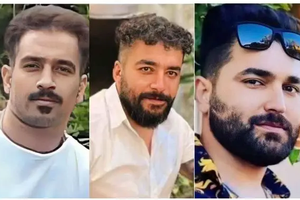
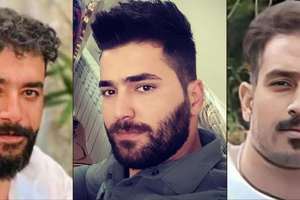
  • Iran Executes Three Political Prisoners After Sham Trial

    Iran Executes Three Political Prisoners After Sham Trial

  • Don’t Let Us Die, Plead ‘Esfahan House’ Prisoners Facing Execution

    Don’t Let Us Die, Plead ‘Esfahan House’ Prisoners Facing Execution

The lawyer said the defendants in the Alikhani Square case were denied access to independent lawyers during the trial stage and were represented by court-appointed attorneys.

The lawyer also said the court blocked defense lawyers from accessing the full case files.

The 12 protesters sentenced to death are mostly very young men. Three were born in 2007 and were around 17 or 18 at the time of the January 2026 protests. Several others were born between 2004 and 2006, and one is an Afghan national. Two brothers are among those facing execution.

The judiciary has not publicly responded to the allegations about denial of access to independent counsel and case files.

The case fits a pattern seen in several protest-linked capital cases in Iran, where the reported deaths of security personnel or pro-government forces have been followed by broad arrests, charges carrying the death penalty and claims by families, lawyers and rights groups that defendants were denied fair trial guarantees.

Rights groups have warned that Iran’s use of death sentences in protest cases has become a tool of intimidation, particularly after periods of unrest, with executions used to send a message far beyond the individual defendants.
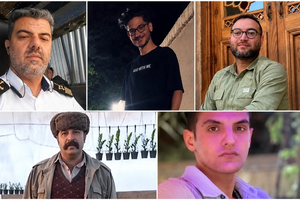
  • Five more protesters sentenced to death in central Iran

    Five more protesters sentenced to death in central Iran

  • Iran executes two January protesters as post-war crackdown continues

    Iran executes two January protesters as post-war crackdown continues

Amnesty International said in February that at least 30 people were facing the death penalty over alleged offences linked to the January 2026 protests, including eight people sentenced to death after expedited and “grossly unfair” trials.

The Center for Human Rights in Iran said in April that at least 22 political prisoners had been executed in six weeks, including 10 people detained during the January protests, in cases it said were marked by secretive proceedings, torture, forced confessions and lack of due process.

Human Rights Watch said the January unrest was met with mass killings, arbitrary arrests and severe communications restrictions, with thousands of protesters and bystanders believed to have been killed after protests escalated on January 8.

The new Isfahan case raises the number of protest-linked prisoners facing imminent execution and adds to fears that Iran’s judiciary is accelerating capital punishment in cases tied to the January uprising.

Khamenei funeral lays bare deep political divisions in Iran

Jul 8, 2026, 09:23 GMT+1
•
Maryam Sinaiee
100%
Participants in Ali Khamenei's funeral in Tehran are carrying red flags symbolizing vengeance. July 6, 2026

Ali Khamenei's funeral was intended to project national unity, but hardline attacks on the president and Iran's negotiators, the absence of former presidents, and renewed calls for revenge exposed deep divisions within Iran's political establishment.

The funeral processions in Tehran and Qom were overshadowed by hardline supporters chanting slogans against President Masoud Pezeshkian and Foreign Minister Abbas Araghchi, a sign of growing tensions over the government's diplomatic course.

Videos circulating on social media showed Pezeshkian being escorted through crowds by his security detail as mourners shouted "Death to the compromiser." Another video captured an even more hostile reception for Araghchi, with chants including "Death to the traitor," and "Shameless."

Yousef Pezeshkian, the president’s son and adviser, condemned the incident, writing: "If anger is directed against our own forces, targets Muslim unity and undermines domestic cohesion, it means we have become a tool in the enemy's hands and opened a window of hope for it to inflict further blows."

The attacks prompted strong criticism from reformists as well as some conservatives who support parliamentary speaker Mohammad-Bagher Ghalibaf's cooperation with the government and negotiations with the United States.

Conservative journalist Mohammad Mohajeri criticized senior officials, particularly Supreme National Security Council Secretary Mohammad-Bagher Zolghadr and some members of the Supreme National Security Council, for remaining silent. "Their silence is itself creating an even greater sedition."

Reformist journalist Ali Asghar Shafieian argued that the slogans damaged Iran's national interests. "On the day of the funeral, when even critics wore black out of respect for Iran and its leader, slogans against the state's decision to end the war and against negotiators seeking sanctions relief dealt a blow to national dignity and security."

Notable absences

The funeral also drew attention for the absence of former presidents Mohammad Khatami and Hassan Rouhani, despite official expectations that the ceremonies would showcase unprecedented national solidarity. Former foreign minister Mohammad-Javad Zarif was also absent, while images showed former president Mahmoud Ahmadinejad attending the public procession.

Authorities have not explained whether the former officials chose not to attend or were prevented from doing so.

Unlike Pezeshkian, Ghalibaf, and Hassan Khomeini – the grandson of Islamic Republic founder Ruhollah Khomeini – attended only the tightly controlled farewell ceremony at Tehran's Mosalla rather than the public street procession.

Political analyst Ahmad Zeidabadi argued that the hostile atmosphere explained the absences. "[The behaviour of] those who ignored the sanctity of the funeral by insulting the president and foreign minister clearly explains why figures such as Mohammad Khatami and Hassan Rouhani did not attend."

He added: "If they showed no mercy even to Pezeshkian, who enjoyed Khamenei's full trust and respect, it is obvious what they would have done had Khatami or Rouhani appeared."

The reformist-leaning website Rouydad24 described the absence of former presidents as "not merely a ceremonial issue, but the loss of an opportunity to demonstrate political consensus at one of the country's most sensitive moments."

Calls for revenge dominate messaging

During the mourning ceremonies, some participants repeatedly called for retaliation against the United States, Israel, and particularly US President Donald Trump, whom they blamed for Khamenei's death. Many mourners carried red flags symbolizing vengeance.

One supporter wrote: "Officials, do you see these flags of revenge? People will be calmed by revenge against the enemy – not by negotiations."

Hardline journalist Parisa Nasrabadi argued: "Avenging the martyred leader is a decisive step toward restoring lost deterrence, a duty to prevent future assassinations of leaders, and an absolute necessity to protect the position of Iran's young leader."

Hossein Shariatmadari, editor of the hardline Kayhan newspaper, called on the government to officially declare Trump and even the pilots allegedly involved in Khamenei's killing worthy of death wherever they are found, and proposed offering a bounty for anyone who kills Trump.

Another commentary published by Tabnak argued that the massive turnout and chants demonstrated that Iranian authorities had "no option but to exact retribution against the killers of the martyred leader."

Was the funeral a referendum?

Several pro-government figures portrayed the turnout as a public referendum endorsing the Islamic Republic.

Lawmaker Jafar Ghaderi described it as "the revolution's largest popular referendum," arguing that the government should now respond by addressing economic concerns and rewarding public loyalty.

Zeidabadi challenged the analogy, writing: "It would be good to explain exactly what this referendum is about and in which law a 'street referendum' is defined."

A social media user similarly argued that authorities have long portrayed public gatherings as proof of popular endorsement without specifying either the subject of the alleged referendum or its legal basis.

Foreign influencers welcomed

The funeral also featured several foreign journalists and pro-Iran commentators, including American media personality Jackson Hinkle, The Grayzone editor Max Blumenthal, and British journalist and blogger Bushra Sheikh, all of whom are known for criticizing Western policy toward Iran. Their presence was widely celebrated by government supporters online.

A widely shared video showed Hinkle standing on a stage in Tehran’s Enghelab Square, leading mourners in chants of “Death to Zionists,” “Death to Israel” and “Death to America,” with the crowd repeating the slogans after him.