• العربية
  • فارسی
Brand
  • Iran Insight
  • Politics
  • Economy
  • Analysis
  • Special Report
  • Opinion
  • Podcast
  • Iran Insight
  • Politics
  • Economy
  • Analysis
  • Special Report
  • Opinion
  • Podcast
  • Theme
  • Language
    • العربية
    • فارسی
  • Iran Insight
  • Politics
  • Economy
  • Analysis
  • Special Report
  • Opinion
  • Podcast
All rights reserved for Volant Media UK Limited
volant media logo

Saudi-flagged tanker damaged near Hormuz – Reuters

Jul 7, 2026, 10:18 GMT+1Updated: 13:27 GMT+1

A Saudi-flagged crude oil tanker was damaged near the Strait of Hormuz off Oman after a Qatari liquefied natural gas tanker was struck in the same area, Reuters reported on Tuesday, citing maritime security sources.

The cause of the blast was not known, and the crude tanker was believed to be the supertanker Wedyan, the sources said.

Ship-tracking data on MarineTraffic showed the Wedyan’s last position was inside the Persian Gulf on July 3, according to Reuters.

Most Viewed

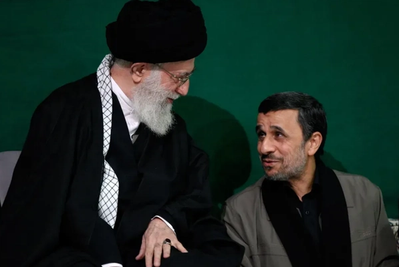
Mossad recruited Ahmadinejad for Iran regime-change plot - report
1

Mossad recruited Ahmadinejad for Iran regime-change plot - report

2
INSIGHT

Can Tehran seek revenge and negotiate with Washington?

3

UK says support for Iran's IRGC outlawed under new state threats law

4

Plastic waste becomes major environmental challenge in Iran

5

Diplomacy fades as US and Iran escalate over Hormuz

Banner
Banner
Banner

Spotlight

  • Iran parliament drops two hardline critics of US talks from security panel posts

    Iran parliament drops two hardline critics of US talks from security panel posts

  • Did Mossad recruit Iran’s Holocaust-denying president?
    ANALYSIS

    Did Mossad recruit Iran’s Holocaust-denying president?

  • Iran risks its most valuable Arab partner over Hormuz
    INSIGHT

    Iran risks its most valuable Arab partner over Hormuz

  • Why so few Iranians have jobs despite low unemployment
    ANALYSIS

    Why so few Iranians have jobs despite low unemployment

  • January protesters trapped in 'hell' of Greater Tehran prison, inmates say
    EXCLUSIVE

    January protesters trapped in 'hell' of Greater Tehran prison, inmates say

  • Iran faces region’s harshest mix of wartime contraction and inflation

    Iran faces region’s harshest mix of wartime contraction and inflation

•
•
•

More Stories

Iran war gives European chemical firms brief debt window – Bloomberg

Jul 7, 2026, 10:02 GMT+1

European chemical makers are using a brief refinancing window opened by the Iran war to extend debt maturities, Bloomberg reported on Tuesday, citing Lazard’s Katja Ksoll.

Ksoll said supply chain disruptions caused by the war had temporarily improved sentiment toward European producers, which are less exposed to feedstock shortages than Asian rivals.

She said strong liquidity in credit markets had also boosted investor demand for new debt deals, giving cash-strapped chemical companies a chance to refinance even as the sector’s broader downturn continues.

Iran lawmaker says any Hormuz move without Tehran will fail

Jul 7, 2026, 07:36 GMT+1

Any move related to the Strait of Hormuz without coordination with Iran is doomed to fail, a senior Iranian lawmaker said on Tuesday.

Alaeddin Boroujerdi, a member of parliament’s national security and foreign policy committee, said a decision to change the governing regime of the Strait of Hormuz had been made at the highest levels of the Islamic Republic in response to the latest war.

He said legislation on managing the strait would be approved by parliament at the earliest opportunity and that relevant bodies would be required to fully implement it.

The MP said Iran would pursue any action related to the Strait of Hormuz within the framework of its national interests and security.

Iran says final deal talks will not start if threats continue

Jul 7, 2026, 06:13 GMT+1

Iranian Foreign Minister Abbas Araghchi said on Tuesday that negotiations with the United States on a final deal would not begin if threats against Iran continued.

Araghchi said in a post on X that part 13 of the Tehran-Washington memorandum of understanding was clear, adding that, "Negotiations on final Deal will not commence if threats continue.”

He also addressed the other side to “honor your signature.”

He said millions of Iranians had rallied to honor former Supreme Leader Ali Khamenei and that neither the public nor Iran’s armed forces were moved by threats.

Iran state media says tanker attacked after ignoring warnings

Jul 7, 2026, 04:32 GMT+1

Iran’s state broadcaster IRIB, citing anonymous sources, said an oil tanker attacked in the Strait of Hormuz was targeted after attempting to pass through the Omani route with support from the US Navy.

The vessel was attacked after “ignoring repeated warnings,” IRIB reported.

The broadcaster added that no Iranian official has yet confirmed or denied the account.

Iran has warned ships against transiting the Strait of Hormuz through the southern route in Oman’s waters, insisting that all passage through the strategic waterway must be coordinated with its military.

Khamenei funeral struggles to stay on script

Jul 7, 2026, 04:14 GMT+1
•
Behrouz Turani
100%
A child places a picture of Ali Khamenei among handwritten messages left by mourners on a memorial wall set up during funeral ceremonies in Tehran, July 5, 2026

The weeklong funeral ceremonies for Iran’s slain Supreme Leader Ali Khamenei have been mired in chaotic planning, last-minute changes and political controversy.

Even state-aligned media hinted at organizational problems during one of the Islamic Republic’s most significant public ceremonies in decades, while social media reflected sharp divisions over the scale and meaning of the events.

The problems began almost immediately. Although state media had repeatedly announced that ceremonies would begin on Saturday, July 4, organizers abruptly moved the start forward by one day after realizing that foreign dignitaries had already arrived in Tehran on July 3 because of confusion over invitations.

A major disruption involved the movement of the coffins.

IRGC commander Hassan Hassanzadeh, who oversaw parts of the ceremony, initially announced that designated trucks would carry them from the east toward the west of Tehran, where they would be airlifted to Qom and later transferred to Iraq.

Hours after the scheduled start, state television reported that the plan had been reversed and the coffins would instead move from west to east.

Hassanzadeh later apologized to people who had gathered in eastern Tehran, according to IRGC-linked Fars News, explaining that the change was necessary because the “very large and early presence of people” and the closure of roads made the original route impossible.

Earlier reports also cited concerns that some bridges along the route might not withstand the weight of the crowds, potentially causing a catastrophe.

Hundreds of users on X and Telegram complained that they had arrived in eastern Tehran as early as 5 a.m. on organized tours, unaware of the change.

Critics noted that such logistical issues could have been assessed before the ceremony.

Questions were also raised about official crowd estimates, with social-media users comparing images of gatherings at Tehran’s Grand Mosalla with historic mass events such as the 72,000-person Freddie Mercury concert at Wembley Stadium in 1985.

Some questioned official claims that “millions” had attended the funeral.

Online narratives on X and Telegram were sharply divided.

Pro-government accounts and some Western commentators amplified footage showing a “festival-like” atmosphere outside the Grand Mosalla, with electronic religious music and free drinks.

Others inside Iran expressed frustration over state-mandated disruptions to daily life, rising economic concerns and heavy security measures during a period of national uncertainty.

Reports also emerged of pressure to mobilize participation.

Tehran residents described receiving orders from trade and real-estate unions requiring businesses including gyms, offices and parts of the Grand Bazaar to remain closed.

Basij members reportedly warned some shopkeepers that failing to comply could result in their stores being sealed.

In provinces such as Hamedan, charitable organizations were allegedly pressured to contribute funds, while restaurants in industrial towns near Tehran were reportedly ordered to prepare thousands of free meals for mourners or face closure.

Despite these pressures, videos circulated online appearing to show government officials—including Tehran’s mayor—being served expensive meals from well-known restaurants, while many participants received simple lunches such as egg sandwiches.

Media outlets also noted that the 12-hour procession through Tehran to Mehrabad Airport—and the subsequent transfer of the body to Qom, Najaf, Karbala and finally Mashhad for burial—created immense logistical challenges.

Analysts have compared the extreme caution surrounding Khamenei’s burial to memories of Ayatollah Khomeini’s chaotic 1989 funeral, when crowds overwhelmed security, tore the burial shroud and forced officials to remove the body by helicopter.

But for many observers, the most striking aspect of the ceremonies has been the political messaging.

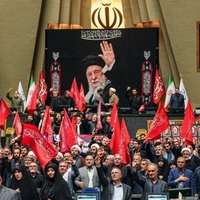
Aggressive slogans, posters targeting US officials and widespread displays of red flags symbolizing revenge have dominated parts of the funeral.

Critics said the tone appeared at odds with Tehran’s diplomatic calendar, with Iranian officials expected to meet US counterparts next week for talks aimed at reaching a broader agreement and easing Iran’s economic crisis.