Iran commander says renewed conflict with US 'likely'
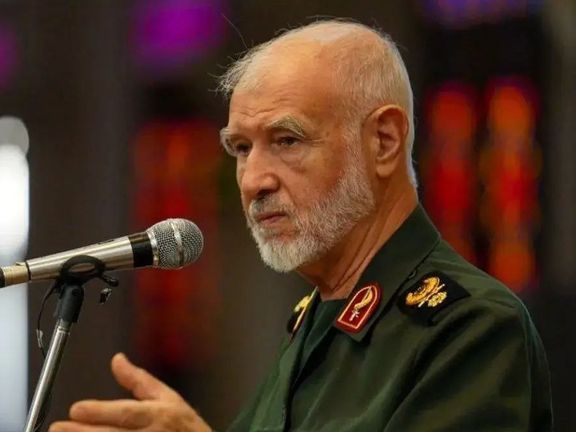

Mohammad Jafar Asadi said renewed conflict between Iran and the United States is likely and that Iran’s armed forces are fully prepared.
“Evidence has shown that the United States does not adhere to any commitments,” said Asadi, deputy inspector at Khatam al-Anbiya Central Headquarters.
He said tensions could escalate regardless of whether Washington takes military action. “A renewed confrontation between Iran and the United States is likely,” he said.
Asadi said Iran was ready to respond to any escalation. “We are fully prepared to confront any hostile action,” he said.






US President Donald Trump has raised in private meetings the prospect of a prolonged naval blockade of Iran to curb its oil exports and push for a denuclearization deal, Reuters reported, citing a White House official.
The official, on condition of anonymity, said the blockade could last for months, though no final decision has been made and the strategy remains unclear.
At the same time, Trump has left open the option of renewed military action. US Central Command has prepared options ranging from a short series of strikes to steps aimed at reopening the Strait of Hormuz to shipping, according to a report by Axios.
The reformist daily Shargh said authorities should counter what it described as a US effort to portray Iran as seeking conflict by closing the Strait of Hormuz.
“Americans are seeking to present a hard and inappropriate image of Iran to the world,” the newspaper wrote, adding that Iran should use public diplomacy to show it is not pursuing war or aiming to block the strategic waterway.
It also urged officials to pursue a political solution based on mutual benefit and avoid a prolonged economic squeeze on the country.
Shargh added that diplomacy should help end the war quickly and create conditions for reconstruction and stability.
President Donald Trump's administration has bypassed congressional review to approve military sales worth more than $8.6 billion to Middle Eastern allies Israel, Qatar, Kuwait and the United Arab Emirates.
The US State Department said on Friday that Secretary of State Marco Rubio determined an emergency required immediate action and waived congressional review requirements.
The approvals include $4.01 billion for Patriot air and missile defense support services for Qatar and $992.4 million for Advanced Precision Kill Weapon Systems (APKWS).
Kuwait was cleared to buy an integrated battle command system worth $2.5 billion, while Israel was approved to receive APKWS valued at $992.4 million. The United Arab Emirates was approved to buy APKWS for $147.6 million.
President Donald Trump said on Friday the United States is “in a war” and, without mentioning Iran by name, said it must not be allowed to obtain a nuclear weapon in a video posted on Truth Social.
“We are in a war because I think you would agree we cannot let lunatics have a nuclear weapon. Wouldn’t you agree?” Trump said in a video, followed by a crowd cheering and chanting “USA.”
Iran is scrambling for ways to respond to a US naval blockade that has disrupted its oil exports and exposed weaknesses in its long-standing strategy of relying on maritime disruption and sanctions evasion, the Wall Street Journal reported.
The report cited analysts as saying the blockade is testing Tehran’s long-standing strategy of leveraging disruption in the Strait of Hormuz and evading sanctions through covert oil shipments.
The report said the pressure is fueling internal divisions within Iran’s leadership, with some officials pushing for renewed escalation while others favor negotiations to end the standoff.