• العربية
  • فارسی
Brand
  • Iran Insight
  • Politics
  • Economy
  • Analysis
  • Special Report
  • Opinion
  • Podcast
  • Iran Insight
  • Politics
  • Economy
  • Analysis
  • Special Report
  • Opinion
  • Podcast
  • Theme
  • Language
    • العربية
    • فارسی
  • Iran Insight
  • Politics
  • Economy
  • Analysis
  • Special Report
  • Opinion
  • Podcast
All rights reserved for Volant Media UK Limited
volant media logo

Iranian lawmaker questions why internet was not cut sooner

Feb 15, 2026, 09:35 GMT+0

An Iranian lawmaker has questioned why authorities did not cut internet access earlier during unrest on January 8-9.

Hamid Rasaei, a Tehran MP, said it should be examined why the internet was not disconnected sooner during the nationwide protests that month.

During the January 2026 unrest, authorities imposed a near-total internet shutdown and disrupted access to satellite service Starlink, halting the flow of information.

Most Viewed

US blockade enters murky phase as tankers spoof signals and buyers hesitate
1
ANALYSIS

US blockade enters murky phase as tankers spoof signals and buyers hesitate

2

US tightens financial squeeze on Iran, warns banks over oil money flows

3
INSIGHT

Ideology may be fading in Iran, but not in Kashmir's ‘Mini Iran'

4
INSIGHT

Hardliners push Hormuz ‘red line’ as US blockade tests Iran’s leverage

5
VOICES FROM IRAN

Hope and anger in Iran as fragile ceasefire persists

Banner
Banner

Spotlight

  • Hardliners push Hormuz ‘red line’ as US blockade tests Iran’s leverage
    INSIGHT

    Hardliners push Hormuz ‘red line’ as US blockade tests Iran’s leverage

  • Ideology may be fading in Iran, but not in Kashmir's ‘Mini Iran'
    INSIGHT

    Ideology may be fading in Iran, but not in Kashmir's ‘Mini Iran'

  • War damage amounts to $3,000 per Iranian, with blockade set to add to losses
    INSIGHT

    War damage amounts to $3,000 per Iranian, with blockade set to add to losses

  • Why the $100 billion Hormuz toll revenue is a myth
    ANALYSIS

    Why the $100 billion Hormuz toll revenue is a myth

  • US blockade targets Iran oil boom amid regional disruption
    ANALYSIS

    US blockade targets Iran oil boom amid regional disruption

  • Iran's digital economy battered by prolonged blackout
    INSIGHT

    Iran's digital economy battered by prolonged blackout

•
•
•

More Stories

‘Good cop, bad cop’: Is Trump-Netanyahu Iran policy a ruse?

Feb 15, 2026, 09:23 GMT+0
•
Negar Mojtahedi

The latest US-Iran diplomacy may reflect coordinated pressure rather than compromise, analysts told Iran International’s Eye for Iran podcast, describing Washington and Jerusalem as playing a potential “good cop, bad cop” strategy.

Middle East analyst Dr. Eric Mandel said the contrasting public tones adopted by US President Donald Trump and Israeli Prime Minister Benjamin Netanyahu should not necessarily be read as disagreement.

“This could be a giant ruse — Netanyahu and Trump playing bad cop, good cop,” Mandel said, arguing that diplomacy may be designed to demonstrate that all political options were exhausted before stronger measures are considered.

Former US ambassador John Craig echoed that assessment.

“The pressure is deliberate,” Craig said, adding that talks could represent “a prequel… to military action,” as Washington increases its force posture in the region.

Military buildup alongside diplomacy

That military posture has become increasingly visible. President Donald Trump has said he is considering sending a second US aircraft carrier to the Middle East as tensions with Tehran escalate, describing an expanding naval deployment intended to reinforce American leverage.

“We have an armada that is heading there and another one might be going,” Trump said in an interview with Axios, signaling that additional forces could be deployed if diplomacy fails.

The United States has already positioned the USS Abraham Lincoln carrier strike group, accompanied by destroyers armed with long-range Tomahawk missiles, within the US Central Command area covering the Middle East.

The Pentagon has also moved additional fighter jets, air defense systems and other military assets into the region.

Defense planners are weighing further options should Trump authorize a broader buildup, including the possible deployment of additional carrier groups.

The military movements come as Washington pursues indirect talks with Iranian officials over Tehran’s nuclear program — the first such discussions since US strikes targeted three major Iranian nuclear facilities last June was held in Oman last week. A second meeting is set to continue this week in Geneva.

At the same time, the Trump administration has warned US commercial vessels to avoid parts of the Strait of Hormuz and the Gulf of Oman.

Netanyahu struck a notably cautious tone following his meeting with Trump in Washington, the seventh between the two leaders since the US president returned to office.

Speaking before departing the United States, the Israeli prime minister said Trump believes Iran could still be pushed into accepting what he called “a good deal,” but made clear he remains doubtful.

“I do not hide my general skepticism about the possibility of reaching any agreement with Iran,” Netanyahu said, stressing that any deal must address ballistic missiles and Tehran’s regional proxy network in addition to its nuclear program.

Trump, meanwhile, warned that failure to reach an agreement would be “very traumatic for Iran,” while urging Tehran to move quickly toward accepting US conditions.

Pressure grows as unrest inside Iran deepens

The diplomacy is unfolding against the backdrop of one of the deadliest crackdowns in the Islamic Republic’s history. Iranian security forces opened fire on nationwide protests on January 8-9 with at least 36 thousand killed in a matter of days as demonstrations spread across multiple cities.

Voices connected to people inside Iran, shared on Eye for Iran, suggest that the internal crisis is shaping how many Iranians now view international negotiations.

Mina, an Iranian speaking on the program whose friends were killed or imprisoned during the protests, described a level of desperation.

“There are people in Iran who watch the air traffic every night to see if there are fewer airplanes in the sky,” she said. “Maybe tonight intervention will come.”

Her account reflects a growing sentiment among some protesters who, after years of failed reform movements and escalating repression, say they no longer believe internal change alone is possible.

Many, she said, now see outside pressure — including potential military action — as the only remaining path to ending the rule of the Islamic Republic.

Analysts say that reality adds urgency to the current diplomatic moment. Washington emphasizes negotiations, while Israel highlights the risks of delay, creating what Mandel described as a coordinated messaging strategy rather than a clear policy divide.

“The president wants to show he has gone to the nth degree diplomatically,” Mandel said.

“But that doesn’t mean other options disappear.”

Craig argued the visible military buildup is intended to shape Iranian calculations during talks, warning Tehran may attempt to prolong negotiations to buy time — a pattern seen in previous nuclear negotiations.

Netanyahu’s skepticism mirrors longstanding Israeli concerns that agreements focused narrowly on nuclear restrictions fail to address broader threats posed by Iran’s missile program and proxy forces operating across the region.

The Israeli leader also announced he would not return to Washington next week for a planned Board of Peace gathering and will instead address the AIPAC conference virtually, a move that has fueled speculation about the urgency surrounding current Iran discussions.

“If you told me tonight something dramatic happened,” Mandel said, “I wouldn’t be surprised.”
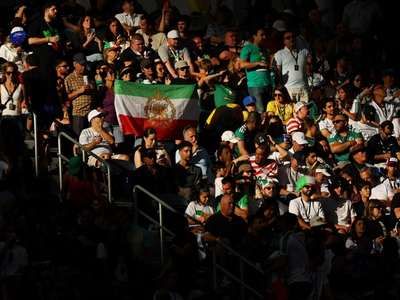
Rooftop chants echo across Iran after global solidarity rallies

Feb 15, 2026, 08:43 GMT+0

Nighttime chants were reported across multiple Iranian cities on Saturday, hours after mass rallies by Iranians abroad drew large crowds in support of protesters inside the country.

Videos and eyewitness accounts received by Iran International showed residents chanting anti-government slogans from rooftops and windows in cities including Tehran, Karaj, Rasht, Isfahan, Shiraz, Mashhad and Kermanshah.

Slogans included “Death to the dictator” and “Death to Khamenei,” as well as monarchist chants.

Islamic Republic does not represent Iranians, Canadian minister tells Toronto rally

Feb 15, 2026, 08:31 GMT+0

Canada’s Minister of Children, Community and Social Services Michael Parsa said the Islamic Republic does not represent the people of Iran, speaking at a large rally in Toronto.

Parsa described the widespread turnout of Iranians at demonstrations across major global cities as a powerful signal to international institutions, saying it shows Tehran lacks popular legitimacy.

“We will never abandon you,” he told the crowd.

Clash with state TV exposes limits of Iran's presidential authority

Feb 15, 2026, 08:27 GMT+0
•
Behrouz Turani

President Massoud Pezeshkian’s increasingly public confrontations with Iran’s state broadcaster have exposed the limits of his authority, underscoring how one of the country’s most powerful institutions operates beyond the reach of its elected government.

The tensions erupted most visibly on Wednesday, when Pezeshkian angrily confronted the head of state television during a cabinet meeting, accusing the broadcaster of refusing to show his administration’s progress.

The exchange was being aired live before the broadcast was abruptly cut off.

During a visit to Golestan Province the following day, Pezeshkian became embroiled in a heated argument on live television with a provincial commander of the Islamic Revolutionary Guard Corps (IRGC) over the military’s role in development projects.

This time, the cameras kept rolling. The commander looked directly into the lens and declared that the IRGC had fulfilled its duties—and that the government had not.

Together, the incidents offered a rare public glimpse into the president’s inability to control institutions that shape both policy and public perception in the Islamic Republic.

Moderate and reformist outlets have rallied to Pezeshkian’s defense, portraying the clash as a sign of the broadcaster’s unchecked power.

“For state TV, news is not the priority; controlling the narrative is,” read a commentary on Rouydad24. If the president’s message does not align with the broadcaster’s preferred narrative, the report said, “it will either ignore him or cut the broadcast.”

An editorial on Khabar Online added that the network’s decision to cut Pezeshkian’s speech reflected “a kind of intoxication with power” and an exaggerated sense of confidence.

“Even if the highest executive authority in the country takes a position against this broadcaster, it feels powerful enough to ignore it entirely,” the editorial said.

Clashes between Iranian presidents and state television are not new. Every president except Akbar Hashemi Rafsanjani, whose brother ran the broadcaster during much of his presidency, faced friction with the organization.

Mohammad Khatami, Mahmoud Ahmadinejad, and Hassan Rouhani all had public disputes with IRIB, the Islamic Republic’s state broadcaster. Rouhani barred a former IRIB chief from cabinet meetings, while Ahmadinejad withheld the network’s allocated budget to punish its managers.

But Pezeshkian’s confrontations come at a moment of growing public dissatisfaction and economic strain, weakening his ability to assert authority. He had promised salary increases of 21% to 43% for government employees, but with inflation running at 60%, even those raises would leave workers falling behind rising prices.

At the same time, Pezeshkian has publicly acknowledged the emotional toll of recent unrest, saying he “can hardly sleep at night” after January’s bloody crackdown. Yet his government’s inability to improve economic conditions or assert control over powerful institutions has reinforced perceptions of weakness.

What much of the media avoids stating openly is that Iran’s state broadcaster answers only to the Supreme Leader. As long as he approves of its conduct, no other authority—not even the president’s—can compel it to change course.

The result is a system in which the elected president can be openly challenged, contradicted, or even silenced by unelected institutions.

Australia’s foreign minister says Iran’s rulers lack legitimacy

Feb 15, 2026, 08:18 GMT+0

Australian Foreign Minister Penny Wong said Iran’s leadership lacks legitimacy, accusing the government of killing its own people to stay in power.

Wong told Australia’s Senate that Canberra has strongly condemned Iran’s violent crackdown on peaceful protesters and has called for respect for the right to protest, an end to killings, arbitrary detentions and internet shutdowns.

She pointed to Australia’s measures including sanctions on more than 200 individuals and entities linked to Iran’s authorities, including more than 100 tied to the Islamic Revolutionary Guard Corps, as well as steps such as expelling Iran’s ambassador and designating the IRGC as a terrorist organization.