US intercepts Iran-bound military shipment from China in rare raid - WSJ
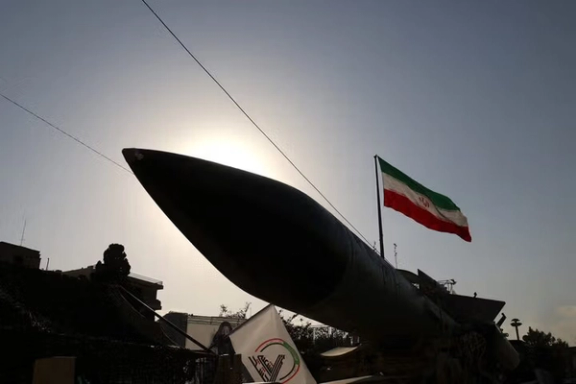
The S-200 missile system is displayed during the Iranian defense week, in a street in Tehran, Iran, September 24, 2024.
A US special operations unit last month boarded a vessel in the Indian Ocean and seized military-related items bound for Iran from China in a rare at-sea interdiction, The Wall Street Journal reported on Friday citing US officials.
The US operatives boarded the ship when it was several hundred miles off the coast of Sri Lanka and confiscated the cargo before letting the vessel proceed, the report added.
Washington had been tracking the shipment, according to officials speaking to the Wall Street Journal.
This was the first time in recent years the US military is known to have intercepted an Iran-bound cargo with Chinese origins.
Last month, two Democratic members of the United States Congress urged the Secretary of State and CIA Director to investigate a large shipment of missile propellant precursor material from China to Iran.
Representatives Raja Krishnamoorthi and Joe Courtney sent a letter to Secretary of State Marco Rubio and CIA Director John Ratcliffe, calling for a probe into Chinese firms' delivery of 2,000 tons of sodium perchlorate - a critical ingredient in making ballistic missile propellant - to Iran since late September in violation of UN sanctions.
The chemical shipped via 10 to 12 vessels to Bandar Abbas port, could fuel up to 500 mid-range missiles, accelerating Tehran's arsenal rebuild after a 12-day war with Israel in June, the congressmen said based on report previously appeared on CNN.
The letter said the shipments contravene September's reinstated UN sanctions prohibiting support for Iran's ballistic missile program and nuclear delivery systems.
“Beijing's aid enables Tehran's post-war rearmament efforts despite US efforts to deter such transfers,” the lawmakers said.
In April the US Treasury sanctioned several Iranian and Chinese entities for facilitating transfers of sodium perchlorate and similar chemical precursors to the Islamic Revolutionary Guards Corps (IRGC) for ballistic missile production.
However, the two lawmakers said that “April Treasury sanctions on Iranian and Chinese entities failed to halt the flow, as shipments continued unabated with another 1,000 tons delivered in June.”
Iran has rejected reported US demands that it curb the range of its missiles to achieve any peace deal, calling the requests a non-starter which curbs its defense.
A view shows Russian warships during major naval drills, File Photo.
Ukraine said on Friday it struck two Russian vessels in the Caspian Sea that had previously been sanctioned by the United States for transporting military cargoes between Iran and Russia.
Ukraine’s special forces said in a statement on Telegram that the operation was carried out with the help of what they described as a local resistance group and targeted the ships near the Russian republic of Kalmykia.
The vessels were identified as the Composer Rakhmaninoff and the Askar-Sarydzha. Ukraine said both ships had been used by Russia for military purposes and were under US sanctions over their role in moving weapons and military equipment between Iran and Russia.
Ukraine did not say how the ships were hit or provide details on the extent of any damage.
The statement said the resistance group had supplied information on the ships’ маршруtes and cargoes. Russia has not commented on the claim.
Iran and Russia have expanded military and logistical cooperation since Moscow’s full-scale invasion of Ukraine in 2022. Western governments have accused Tehran of supplying drones and other equipment to Russia, allegations Iran has denied.
Iranian-designed Shahed drones, now manufactured inside Russia under the name Geran, have played a growing role in the war. The Financial Times reported earlier this year that the drones are increasingly overwhelming Ukraine’s air defenses as Russia steps up swarm attacks.
Ukraine’s air force has said Russia often launches large numbers of Shahed-type drones alongside missile strikes to strain air defense systems. The United States has imposed multiple rounds of sanctions on Iran’s drone production and procurement networks over their alleged role in supporting Russia’s war effort.
A Baluch armed group said it carried out an attack on Iran's Revolutionary Guards personnel near Zahedan, a day after Iranian state media reported that several members had been killed during a border security mission in the restive southeast.
Haalvsh, a rights group that documents abuses and unrest in Sistan-Baluchestan, said the Jebhe-ye Mobaarezin-e Mardomi (People’s Fighters Front) claimed responsibility in a statement posted overnight. The group said it targeted a convoy of the IRGC’s Imam Hossein battalion, part of the Salman Brigade, in the Lar district on Wednesday.
A spokesman for the group said the attack was meant as retaliation for what it described as the role of security forces in suppressing residents in Sistan-Baluchestan. He said a vehicle carrying the unit’s commander was struck and that four members were killed and several others wounded.
State-linked media initially reported three dead and three wounded but later said the death toll had risen to four. Haalvsh cited local sources as saying the gunfire occurred as several IRGC vehicles were heading toward their base in the Lar area.
Iran’s southeast, bordering Pakistan and Afghanistan, has long experienced armed attacks on security forces and government sites. The region has seen repeated incidents this year, including a major assault on a courthouse in Zahedan earlier in which nine people were killed. A separate Baluch Sunni militant group, Jaish al-Adl, claimed responsibility for that attack.
Authorities said pursuit operations were underway following Wednesday’s shooting, but have released few details so far.
Iranian Revolutionary Guard ground force members carry out a mission in southeastern Iran, File photo.
Three members of Iran’s Revolutionary Guards Ground Force were killed on Wednesday "during a mission to secure the country’s borders" in a southeastern area near Zahedan, Iranian state media said.
The forces were part of the IRGC’s Quds Base unit and were killed during what authorities described as an encounter with armed militant groups near the border in Sistan-Baluchestan province.
State media said pursuit operations were under way, but added that few details had been released so far.
Iran’s southeast, which borders Pakistan and Afghanistan, has long been a focus of unrest and armed violence. The mainly Sunni Baluch region has seen repeated attacks on security forces, courts and government buildings by militant groups.
The incident follows a deadly attack earlier this year on a courthouse in Zahedan in which nine people, including three assailants, were killed, according to state media. Militants opened fire inside the building before shooting at civilians outside.
Jaish al-Adl, a Baluch Sunni militant group, later said it carried out the courthouse attack. The group has staged previous assaults on Iranian security forces and is designated a terrorist organization by both Iran and the United States.
A row of US LUCAS one-way attack drones are shown in an image released by CENTCOM on December 3, 2025.
Iran's military spokesman said on Tuesday that the United States had been forced to acknowledge Tehran's military prowess by reverse-engineering its Shahed kamikaze drone and deploying the copies to the Middle East.
"There is no greater honor than seeing self-proclaimed superpowers kneel before an Iranian drone and copy it,” Abolfazl Shekarchi said.
The senior spokesman for Iran's armed forces was referring to an announcement last week from the Pentagon that it would field a new fleet of one-way attack drones in the Middle East modeled on a captured Iranian Shahed.
Tehran’s reaction followed an announcement by US Central Command that it would deploy to the region the new drone squadron using LUCAS platforms—low-cost systems developed after US companies dismantled and reverse-engineered a damaged Shahed drone obtained years earlier.
CENTCOM said the drones can operate autonomously, launch from multiple platforms and are intended to beef up its supply of cheap lethal unmanned aerial vehicles which are widely viewed as the future of warfare.
Iran submitted the Shahed's design to Russia for use in its full-scale invasion of Ukraine, which under the name Geran-2 has been mass-produced to wreak havoc on cities and battlefields there.
File photo of Iranian Shahed drones.
US defense officials told CNN and other outlets that the drone deployment marks an effort to “flip the script” after years in which Iran and its armed allies used cheap drones to strike US positions, including the 2024 attack in Jordan blamed on Iraqi militias that killed three American soldiers.
Washington’s belated push into mass-manufactured, expendable drones comes as low-cost platforms increasingly dominate conflicts from Ukraine to the Red Sea.
US officials have not disclosed the number of LUCAS drones now in the region, saying only that “many” are already deployed and more are coming.
At roughly $35,000 apiece, they remain far more expensive than models produced in Iran, China or Russia, raising questions among analysts about whether the Pentagon can scale fast enough or cheaply enough to match its adversaries’ output.
'Thorn in the throat'
Iran's military spokesman said the US and Israel’s recent threats against Tehran were “delusional,” insisting that the brief war in June had shown how such threats collapse “in the real field of battle.”
Shekarchi said Iran’s forces—particularly the Revolutionary Guard's Aerospace Force—remain “a thorn in the throat of the hegemonic system.”
Defense analysts say the Shahed’s simple design and low unit cost compared with hundreds of thousands for Western equivalents have driven global efforts to produce cheaper unmanned systems.
Western governments have imposed multiple rounds of sanctions on Iranian drone manufacturers and procurement networks, accusing Tehran of supplying drones to Russia and regional armed groups.
Iran has denied direct involvement in combat operations abroad, saying its technology serves defensive purposes.
Russian service members, who were involved in the country's military campaign in Ukraine, march in columns during a military parade on Victory Day in Red Square in Moscow, Russia, May 9, 2024.
The Russian Embassy in Tehran has denied any connection to flyers circulating in the Iranian capital that invited men to enlist in the Russian army for large cash rewards.
In a statement on Tuesday, the embassy said “unscrupulous individuals” had been spreading fake letters online, offering Iranian men aged 18 to 45 contracts “to serve with the Armed Forces of the Russian Federation in the area of the special military operation.”
“The embassy officially declares that this letter and any similar document are forgeries of a criminal nature,” the statement said. “Neither the embassy nor any official Russian institution has any connection with them.”
The denial followed a report by the Tehran-based outlet Rouydad24, which said that leaflets distributed near the Russian Embassy in Tehran invited Iranian men to join the Russian army with promises of dollar payments and contracts “directly under the Ministry of Defense of the Russian Federation.”
The flyers, seen around College Square, targeted men aged 18 to 45 and offered starting bonuses of $15,000 to $18,000 and monthly salaries of $2,500 to $2,800, along with free housing, medical care, and military uniforms.
Rouydad24 said the leaflets directed readers to a Telegram channel that had published multilingual posts in Persian, Russian, Arabic, and English, describing the campaign as a “state-supported initiative.”
One video shared by the channel appeared to show a man in a Russian military uniform introducing himself in Persian as “Mohammadian Khatibi, from Iran.”
The Iranian report compared the flyers to similar alleged recruitment efforts in India, Nepal, Sri Lanka and several African countries, which foreign media have described as part of Moscow’s drive to attract foreign fighters amid heavy losses in Ukraine.
While the embassy has now categorically denied any such activity in Iran, Rouydad24 noted that the case underscores the vulnerability of economically distressed Iranians to online recruitment scams offering large foreign payouts.