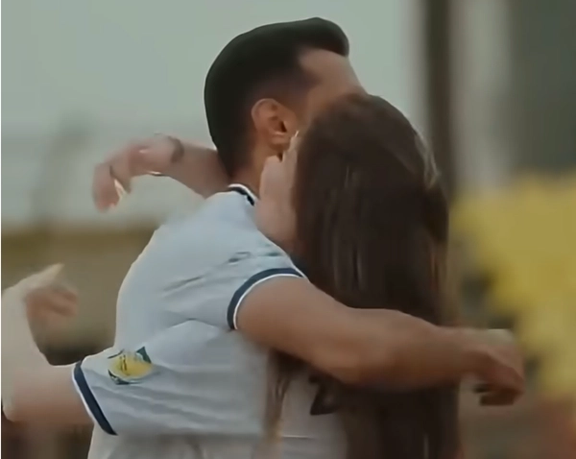
Malavan football team captain Saeed Karimi and his partner appear in a screenshot from a leaked video of the couple.
Iranian state TV is facing backlash for criticizing a footballer and his wife as immoral even after it was mute about a scandal over the daughter of a top official's revealing wedding dress last month.
The controversy began when a short video produced to mark the wedding of Malavan football club captain Saeed Karimi — showing the couple in his club’s uniform in romantic football-themed scenes at an empty stadium — was leaked on social media.
The case again thrusts women and public morality into the public discourse of the nearly fifty-year-old Islamic theocracy even after authorities this year backed off enforcing strict veiling laws in a likely bid to avoid protests.
Karimi's wife Zahra appeared variously in a the shorts and t-shirt of a football uniform and briefly wearing a baseball cap but at other times without the theocracy's mandatory Islamic head covering. In one brief scene the pair tumble into bed laughing.
The footballer said the video had been shared without his and his wife’s consent and asked users to delete it.
'What next?'
However, state TV presenter Rasoul Mehrabani devoted several minutes of live airtime to accusing the couple's video, calling it shameful, indecent disgraceful.
"If we do not stop this, if we do not stop these indecencies, what will happen tomorrow?" he said, inviting authorities to intervene.
Shortly after, judiciary-affiliated outlet Mizan, quoted provincial prosecutor Seyed Kamaleddin Mousavi as saying they had opened a case in connection with the circulation of a “video contrary to public decency” attributed to a Malavan player.
He said initial investigations showed the clip had been filmed in the northern city of Sari and released by one of the individuals involved in filming it.
Mousavi added that the player appeared before judicial authorities to file a complaint over the unauthorized publication, and that the case has since been transferred to the another prosecutor’s office for further review.
Federation reaction
Amid the controversy, the Ethics Committee of the Football Federation of the Islamic Republic of Iran announced on Tuesday that Karimi had been summoned for questioning.
The committee, a judicial body within the federation labelled by critics the “morality police of football,” has previously taken action against players who made critical comments about political or social issues.
This included those who expressed solidarity with protesters during the nationwide protests sparked by the death in morality police custody of 22-year-old Mahsa Amini in September 2022. Authorities quashed the demonstrations with deadly force.
Support for Karimi
Iranian social media users largely defended Karimi, calling the clip harmless and saying the outrage from state TV and hardline media was misplaced.
The controversy also sparked accusations of double standards, as users compared the reaction to Karimi’s video with the official silence when a video of the wedding of a top security official's daughter leaked last month.
Ali Shamkhani is a senior advisor to Supreme Leader Ali Khamenei and the footage showed his daughter without a hijab and in a Western-style white wedding dress with a plunging neckline.
“Why is Saeed Karimi’s video criminal, but not Shamkhani’s daughter’s?” one user wrote — a question that quickly spread across social media. Another highlighted that Karimi’s wife’s outfit was “far more modest,” while one joked, “If she had worn longer socks or a hat, even the most zealous critics would have stayed quiet.”
'People vs. state'
Fellow footballers also showed support for Karimi and his wife in posts on Instagram.
According to Tehran-based Etemad daily, Mehrabani’s six-minute tirade was filled with vulgar language that many described as “offensive and disgusting.” The paper said his comments drew far more attention to the clip, which had initially gone largely unnoticed.
Etemad said that the video was no different from countless romantic couple shoots posted on Instagram, questioning the mindset behind the presenter’s reaction.
A screenshot from the video made to mark Malavan captain Saeed Karimi and his partner’s wedding.
Ehsan Akbari, sports editor at Iran International said the episode revealed a divide between the public and the Islamic Republic’s mindset.
“This (public support for Karimi) shows how much society is standing against the mindset of the Islamic Republic,” he said. “The government have one opinion, but society has another.”
Akbari added that the contrast in public reactions to the two videos reflected both trust and authenticity.
“People criticized Shamkhani but support Saeed Karimi because Shamkhani has always presented himself as an Islamic figure and tried to impose his ideas on others, while behind the scenes behaving differently,” he said. “But Saeed Karimi reflects the reality of society — he’s just like ordinary people. Shamkhani on the other hand represents the hypocrisy of the Islamic Republic.”
'Double standard'
Sports journalist Raha Poubakhsh says the difference in how state media handled the two cases revealed a broader political motive.
“State media defended Shamkhani by portraying him as a victim, saying the video had been published without permission and that people’s privacy should be respected,” she said. “But when a private video of a football player was leaked, the situation was entirely different."
"This difference in approach shows that the issue is not about morality or justice, but about control and the exercise of power,” she added.
“In the Islamic Republic, the state itself decides what is considered ‘immoral’ — a label it only applies when the person in question is not in a position of power or part of the establishment.”
Malavan Football club files complaint
Malavan Football Club issued a statement condemning Mehrabani’s remarks as “disgusting and insulting,” accusing the Islamic Republic of Iran Broadcasting (IRIB) of “spreading hatred” to attract attention. The club demanded an official apology from state TV and said it had filed a formal complaint against the presenter.
“The dignity and reputation of our members are red lines,” the statement said. “Malavan expects the IRIB to clearly and publicly apologize to the player, the club, and the people of Bandar Anzali and Gilan province.”
The club added that it would not remain silent “when the name of Malavan or human dignity is disrespected,” reaffirming what it described as its half-century tradition of respect, passion and community spirit.
Progressive legacy
Malavan has a reputation as one of Iran’s most socially progressive football clubs.
In another example, the club shared a photo on its official Instagram page in October showing player Abouzar Safarzadeh’s wife kissing him on the forehead after he scored in a Persian Gulf League match — a move seen as breaking the clerical establishment’s social taboos on public displays of affection.
“Malavan was among the first Iranian teams after the (1979 Islamic) revolution to feature women in the unveiling of its official kits,” Akbari, the sports editor, said.
“Women have long had a presence in its matches and media, and it has one of the oldest women’s football teams in the country," he said. "The fact that Karimi’s wife appeared on the pitch in the club’s kit resonated because it felt real and authentic."
Iran’s political establishment is once again flirting changing laws to allow women to ride motorcycles even as women and girls have already spent years doing it without waiting for an official green light.
A senior official rekindled the debate on Monday when he said parliament should “decide” whether the law needs clarification on women’s licensing.
“If religious standards are observed, motorcycling does not contradict most sharia rulings,” said Abdolhossein Khosropanah, secretary of the Supreme Council of the Cultural Revolution.
Several news outlets quickly framed the remark as permission for women to ride, while conservative lawmakers bristled at the ball being tossed into their court, insisting that no such issue was on parliament’s agenda.
Khosropanah also warned that some women already ride “without proper hijab,” effectively acknowledging that the genie is out of the bottle.
Arezoo Abedini, the first Iranian female motorcyclist to compete in the Asian Cup in Thailand.
Reality on the streets
The supposed “green light” may not herald imminent policy change—and few seem to be waiting for it anyway.
Women on scooters and motorcycles have become increasingly common. Many now zip through traffic on lipstick-red, lilac, and canary-yellow bikes, taking children to school or commuting to work. Groups of young women even ride together in social clubs, sharing videos that draw thousands of likes.
Only a generation ago, even car driving was restricted in some areas, with families forbidding it despite valid licenses.
Women have also competed internationally since 2016, when MAFIRI opened motocross events to women despite the lack of a dedicated track. Earlier this year, the Women’s International Motorcycle Association launched an Iran chapter.
One rider told the moderate daily Etemad that her husband “stood up to relatives” who disapproved. “Sharing my rides on social media brought more clients,” she said. Another scooter rider said public reactions are largely positive: “People cheer us on, but some traffic police still treat us badly.”
The Sharia barrier
Supreme Leader Ayatollah Ali Khamenei has ruled that women’s cycling “in public view of men is haram because it attracts attention.”
While he did not mention motorcycles, many clerics apply the same logic, arguing that riding prevents wearing the hijab properly and exposes body movements.
Proponents counter that Islamic law never banned women from horse-riding and that women have long been allowed to ride as passengers on motorcycles without police interference.
Iranian law does not explicitly ban women from riding motorcycles, but no licensing system exists for them because the traffic code refers only to “men”—a gap police interpret as exclusion.
Without licenses, women cannot obtain insurance and may be liable for full blood money in accidents. Penalties for riding without a license include fines, bike confiscation, and up to two months in jail, rising to six months for repeat offenders.
Public pushback
A landmark 2019 lawsuit briefly forced police to issue a license before being overturned on appeal, but it galvanized public debate and encouraged more women to ride openly.
The Presidential Parliamentary Office recently said it is drafting a bill to modify Article 20 of the Law on Driving Offenses to allow women to obtain motorcycle licenses.
Legal scholar Mohsen Borhani wrote on X: “Opponents of women motorcyclists have no rational, moral, or religious basis. This discrimination is as absurd as Saudi Arabia’s old ban on female drivers.”
Commentator Sahand Iranmehr added: “Clinging to outdated rules only raises the cost. A law that resists social reality becomes obsolete and loses legitimacy.”
People walk next to a mural with a picture of Iran's Supreme Leader, Ali Khamenei, on a street in Tehran, Iran, November 5, 2025.
A confidential survey has found that more than nine in ten Iranians are unhappy with the country’s direction, the Tehran-based news site Rouydad24 reported on Wednesday citing an unnamed polling organization.
“What is clear is that total public satisfaction with all governments since the revolution is now overshadowed by a 92 percent dissatisfaction with the country’s current situation,” Rouydad24 wrote.
The report said the study was conducted by a recognized polling center that often carries out research for state institutions.
It assessed public views of Iran’s governments from the early years of the Islamic Republic to the present, ranking administrations by their perceived performance.
The data have not been released publicly, but Rouydad24 said “the most striking outcome was widespread discontent among respondents across the country.”
According to the outlet, “the level of satisfaction with Mahmoud Ahmadinejad’s administration was highest overall,” while those of “Hassan Rouhani and Masoud Pezeshkian ranked lowest.” The report said opinions in Tehran differed from other regions, with “lower popularity levels recorded in the capital.”
Poll prepared for internal use
The poll was prepared for internal use by decision-makers and was not intended for public release. Rouydad24 said “similar internal studies have long been carried out by various institutions to measure public sentiment and help guide policymaking.”
The publication noted that the results align with other recent research showing growing mistrust of political institutions and frustration over economic hardship. It said that although the time and context of each government shaped public expectations, “overall dissatisfaction across all administrations is now unprecedented.”
The findings echo a separate survey released earlier this month by the Netherlands-based GAMAAN institute, which found that most Iranians believed Israel prevailed in the June war and favored direct negotiations between Tehran and Washington. That survey also showed rising demand for change in Iran’s political system and declining confidence in its leadership.
Homayoun Ershadi, one of Iran’s most internationally recognized actors who rose from a career in architecture to global movie fame through Abbas Kiarostami’s Taste of Cherry and later The Kite Runner, has died at the age of 78.
Ershadi passed away on November 11 at the age of 78 after battling cancer, according to Iranian state media.
Born in Isfahan in 1947, Ershadi began his professional life as an architect, never imagining he would one day become the face of one of Iranian cinema’s most celebrated films.
His unlikely entry into the film industry became almost cinematic itself. As Ershadi recalled in interviews, world renowned director Abbas Kiarostami noticed him while both were stuck in Tehran traffic and asked if he would consider acting.
That spontaneous encounter led to Taste of Cherry (1997), which went on to win the Palme d’Or at the Cannes Film Festival.
Speaking years later about the experience, Ershadi told Media Max: “We were sitting in my car with Kiarostami, eating ice cream when I asked him about my character. He said, ‘Your character is an architect from Italy.’ I was also an architect working in Italy. I wore my own clothes in the film, and that was my car I drove. During the dialogues there was Kiarostami standing in front of me, instead of the actor. I was not playing a role; I was just being myself.”
Ershadi also once remarked with pride, “Kiarostami did not work with professional actors. The non-professional actors of his films did not continue their careers later. I can say I am the only one who kept acting after his film.”
Following his breakout performance, Ershadi devoted himself fully to cinema, appearing in dozens of productions in Iran and abroad. His most acclaimed international role came a decade later as Baba in Marc Forster’s The Kite Runner (2007), which brought him to the attention of Western audiences and received multiple nominations, including at the Academy Awards and the Golden Globes.
He went on to appear in Kathryn Bigelow’s Zero Dark Thirty (2012), Anton Corbijn’s A Most Wanted Man (2014), and Asif Kapadia’s Ali and Nino (2016).
In his later years, Ershadi often reflected on the bridge between architecture and acting, saying both required “a sense of structure, patience, and creativity.”
His quiet, dignified presence on and off screen left a lasting mark on Iranian and world cinema alike.
Iran’s Supreme Leader Ali Khamenei and President Masoud Pezeshkian
President Masoud Pezeshkian told parliament on Tuesday that Iran’s cohesion and stability hinge on the Supreme Leader’s security, warning that an attack on him during the June war could have provoked internal clashes posing a greater threat than any external enemy.
Speaking during a parliamentary session reviewing his government’s first year under the Seventh Development Plan, Pezeshkian said the country’s strength rests on Supreme Leader Ali Khamenei’s leadership, which he described as the anchor of national unity.
"The pillar of the country’s tent is the Supreme Leader," he said.
He added the turbulence of the June 12-day war with Israel had never shaken his confidence in Iran’s defense capabilities, but he feared that if anything happened to Khamenei, the country could fall into political infighting – a situation, he cautioned, that would serve Israel’s interests without further action.
"We can disagree with one another, but there is someone who ultimately makes the decisions. During the war I had no fear for myself, but I was worried that, God forbid, if something happened to the leader we would turn on one another – there would be no need for Israel to intervene... We must value him and stand firmly behind him."
Pezeshkian urged rival factions to avoid polarization and to reinforce “discipline, dialogue and cooperation” across institutions. He said the government was focused on economic recovery and stability, calling on lawmakers to help draft a deficit-free budget to curb inflation.
“Inflation rests on our shoulders – the government and parliament,” he said, admitting responsibility for economic hardship and calling for a smaller, more efficient state.
President Masoud Pezeshkian among lawmakers at the parliament on November 11, 2025
The president acknowledged widespread public frustration with living conditions, citing surveys showing discontent, and urged officials to “serve people without arrogance” rather than seeking political credit.
"It is our duty – we cannot govern while people go hungry. Set the budget so that livelihoods are the priority. I believe that if we do not resolve the public’s livelihood problems, we will go off course."
He also pointed to steps taken to reduce spending, promote renewable energy, and address water and energy shortages through scientific planning and cooperation with universities and regional authorities.
Pezeshkian said coordination among the government, judiciary and parliament had helped resolve several long-standing issues and expressed optimism that sustained cooperation could ease the country’s economic and social strains.
It’s eleven o’clock at night in Tehran when I open the phone lines for my live call-in show, The Program. Friday night is when I ask Iranians to do something that has become almost subversive: not just to talk, but to listen.
For more than forty some years, the Islamic Republic has tried not only to control power but to monopolize conversation itself, deciding who speaks, what is heard, and which "alternative truths" are permitted to exist.
Dialogue frightens it. So does ordinary patriotism, the kind that arises when people speak in their own words about their country.
On the line, a teacher from Kermanshah tells me that students are never taught the courage to ask critical questions. A Toronto caller describes a generation that has learned to survive by lying. A woman in Tehran confesses that she’s waiting for a miracle because she can no longer imagine change.
These voices are not fragments; they are coordinates on the map of a national psyche. Talking in Iran can be dangerous. Silence, in another way, is deadly too. When a society stops speaking to itself, it begins to turn against itself. Authoritarians thrive on that silence.
The live show I host is an attempt—improvised, fragile, sometimes chaotic, to reverse that damage. We bring Iranians together in real time, from Tehran to Los Angeles. We follow three simple rules: everyone gets heard, no judgment, and keep it suitable for all ages.
Our callers often contradict themselves. That’s what makes it real. Dialogue isn’t the theater of agreement; it’s the discipline of listening.
Across the static and emotion, three truths keep repeating.
First: the Islamic Republic never stops talking, but it doesn’t listen. It sermonizes, threatens, censors and congratulates itself. This isn’t strength, it’s fear.
Second: society has begun to mirror that refusal. Iranians interrupt before they understand, argue before they think and treat disagreement as contamination. The Islamic Republic feeds that instinct.
Third: the way out of this loop isn’t heroic, it’s procedural. Ask a real question. Wait for real answers. Let facts, not pride, decide who’s right. simple but challenging.
'Look in the mirror'
Iran today is divided by many wars: between people and government, truth and propaganda, hope and exhaustion. Yet, amid that division, I still hear the quiet persistence of life.
A caller from Tehran wants to talk about water: the taps shut off at midnight, and families fill bottles before the cutoff. That, too, is politics, the right to live without fear of thirst.
Another caller, from Shiraz, demands leadership. “Death with honor is better than life with humiliation,” he says. Moments later, a woman from Tehran replies, “Stop looking for a savior. Look in the mirror.”
These exchanges are the substance of what I call "national dialogue". Not a slogan or a policy, just the collective decision to speak before it’s too late.
Tunisia did it and saved itself from civil war. Nelson Mandela in South Africa did it and dismantled apartheid. Yemen pretended to do it and collapsed. For Iran, dialogue is not an ideal; it’s a means of survival.
I am not neutral about the Islamic Republic forcing people to whisper. But I am devout about the method that can outlast it. Patriotism, to me, is standing by the truth even when it’s spoken by someone you dislike.
Dialogue is resistance; listening is courage.
Some nights, when the last call ends, I sit in the quiet studio and hear only the click of the line going dead. But I know the sound that came before it—a mother’s whisper, a teacher’s question, a citizen’s confession—is proof of something still breathing inside the country.
After years of state monologue, the most subversive sound in Iran is a nation talking to itself. Something is stirring beneath the surface, and I can hear it. I hear it every night on the program. Live, raw, and authentic.