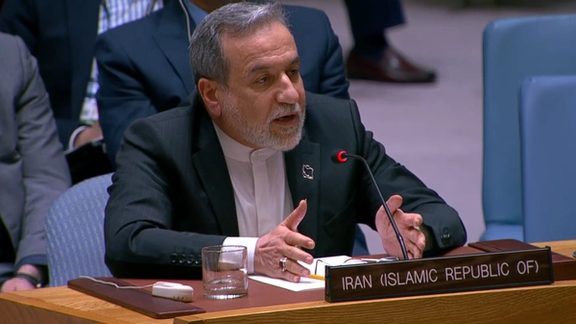
"The three European powers and the United States bear full responsibility for the serious consequences of today's decision," Iran's foreign minister Abbas Araghchi told the Security Council.
"By ignoring facts, spreading false claims misrepresenting Iran's peaceful program and blocking diplomacy, they have actively and intently paved the way for dangerous escalation."


Iran’s nuclear program can never be destroyed and the United States will face consequences if it launches new attacks, Secretary of the Supreme National Security Council Ali Larijani said.
With UN sanctions on Iran set to be reinstated on September 28, Tehran will halt cooperation with the International Atomic Energy Agency (IAEA), Larijani warned.
“We have pursued every option and mechanism available to resolve this conflict peacefully,” he said in an interview with PBS’s Frontline, recorded on September 22 and partially aired Friday.
Larijani warned US President Donald Trump against new attacks, saying Iran will never surrender.
Asked about damage to bombed nuclear sites, Larijani declined to provide details: “We haven't abandoned any of those locations. They could continue operating as they are or be shut down in the future.”
‘Know-how can’t be taken away’
Israel launched a surprise attack on Iran in June, targeting nuclear and military sites as well as key officials. Iran retaliated with drones and ballistic missiles.
On June 22, the United States joined the campaign, striking nuclear sites at Natanz, Fordow, and Esfahan. A US-brokered ceasefire between Iran and Israel was established on June 24.
Iran’s national security chief dismissed assertions that the country’s nuclear capabilities had been destroyed.
“Iran's nuclear program cannot be destroyed. Once a technology is discovered, it can't be taken away. It's like inventing a machine that gets stolen—you can still rebuild it,” Larijani said.
‘Unreasonable terms’
Any talks about curbing Tehran’s missile program are a non-starter, Larijani said.
“The Americans insist we negotiate specifically about Iran's missiles. They’ve demanded no enrichment at all, or missile ranges below 300 kilometers (185 miles), now 500 kilometers (310 miles) — essentially stripping us of key defensive and offensive capabilities.”
US president Donald Trump told the UN General Assembly on Tuesday that he had offered full cooperation in exchange for Iran suspending its nuclear program, but said his letter to Supreme Leader Ali Khamenei was met with threats.
Larijani said the Islamic Republic is open to dialogue but will reject what he called “unreasonable” terms.
Iran’s nuclear program can never be destroyed, and the United States will face consequences if it launches new attacks, Secretary of the Supreme National Security Council Ali Larijani said.
With UN sanctions on Iran set to be reinstated on September 28, Tehran will halt cooperation with the International Atomic Energy Agency (IAEA), Larijani warned.
“We have pursued every option and mechanism available to resolve this conflict peacefully,” he said in an interview with PBS’s Frontline, recorded on September 22 and partially aired Friday.

"The United Kingdom remains committed to pursuing a diplomatic solution that ensures Iran never acquires a nuclear weapon, while maintaining Iran's right to a civil nuclear program in line with the nuclear Non-Proliferation Treaty," British ambassador to the UN Barbara Woodward told the Security Council.
"Our commitment to diplomacy remains steadfast," she said after voting against a Russian-Chinese drafted resolution to delay the snapback of UN sanctions on Iran 30 days after the three European powers triggered it.

The UN Security Council on Friday rejected a draft resolution by Russia and China to extend the Resolution 2231 and delay the snapback of Iran sanctions.
Nine member states voted against the resolution, four voted in favor and two abstained from voting.
Before the voting, the French envoy told the UN Security Council that Europeans "expected concrete and specific gestures. Iran did not, did not produce any such gestures."
"We sought an immediate agreement. Iran preferred to postpone everything until subsequent negotiations," the envoy said.
The UN Security Council has started a meeting to vote on a resolution drafted by Russia and China aimed at delaying the snapback of UN sanctions on Iran.
Russia's representative at the meeting said Moscow "had hoped that the US, that European colleagues in the US, would think twice and that they would opt for the path of diplomacy and dialog instead of their clumsy blackmail, which merely results in escalation of the situation in the region."
However, the envoy said, "what did we see instead, in the 29 days that have elapsed since then, was the very same typical scenario for Europeans of pressure."
The Russian envoy said that "if the UK and France were genuinely willing to meet their obligations, fulfill their promises and to reject the snapback given the constructive approach of Iran, then the vote on the Russian-Chinese draft gives them the last opportunity to demonstrate that they indeed take responsibility for their words."

The Chinese envoy said his country along with Russia "tabled this draft resolution on a six-month technical extension to Resolution 2231 encouraging Iran to further its engagement with the IAEA and urging the original signatories of the JCPOA to immediately restart negotiations."
"The draft resolution is not about picking sides between Iran and E3; it aims to get more time for diplomatic efforts and create conditions for a political solution," the envoy said.
"China calls on all Council members to vote in favor of the draft resolution... Let's work together to bring the Iranian nuclear issue back on the right track for political and diplomatic settlement."