Iran's foreign ministry on Friday accused the United States of stigmatizing and threatening Iran over its nuclear program even though the country's "sole pursuit is the peaceful use of nuclear technology."
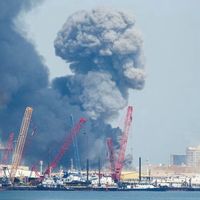
"The very actors that maintain vast stockpiles of weapons of mass destruction choose, instead of fulfilling their disarmament obligations, to carry out acts of sabotage and attack against our peaceful facilities," it said.
"Iran reaffirms its inalienable right to the peaceful use of nuclear energy and calls upon the world to stand firm against such duplicity & double standards," Iran's foreign ministry said in a post on its X account.
Richard Nephew, a former US negotiator in past Iran nuclear talks, commented on a report by London-based Amwaj Media that said Iran had offered to allow immediate UN inspections at its Natanz nuclear facility in exchange for European support of a Russian-drafted resolution to delay the return of sanctions later today.
“No deal. First, this isn’t the only access required. Second, the CSA applies to all safeguarded material, not just Natanz. Third, accepting the conditioning of CSA obligations in general is a mistake,” Nephew said in response to the reported offer.
“Iran signed the safeguards agreement. It should fulfill it.”

Israel Prime Minister Benjamin Netanyahu called for the elimination of Iran's highly enriched uranium stockpiles during his UN General Assembly speech on Friday, saying Tehran should not be allowed to rebuild its nuclear capabilities after June's 12-day war.
Netanyahu described Iran's pre-war nuclear efforts as an existential threat to Israel and a mortal danger to the world, aimed at destruction and global blackmail.
"Iran was rapidly developing a massive nuclear weapons program and a massive ballistic missile program," he told the UN General Assembly. "We devastated Iran's atomic weapons and ballistic missiles programs."
Israel launched a surprise attack on Iran in June, targeting nuclear and military sites and top military and nuclear officials. Iran retaliated by firing drones and ballistic missiles.
Iran reported over 1,000 fatalities and 5,332 injured while Tehran's counterattacks killed 31 Israeli civilians and an off-duty soldier.
The United States on June 22 joined the campaign, targeting nuclear sites in Natanz, Fordow and Isfahan. Two days later, US President Donald Trump brokered a ceasefire between Iran and Israel.
"President Trump and I delivered on our promise to prevent Iran from developing nuclear weapons,” Netanyahu said, praising the US president for "his bold and decisive action".
"We must not allow Iran to rebuild its military nuclear capacities. Iran's stockpiles of enriched uranium must be eliminated, and UN Security Council sanctions on Iran must be snapped back,” Netanyahu said.
The United Kingdom, France and Germany have activated the snapback mechanism under the UN Security Council Resolution, meaning the UN sanctions will go back into effect on September 28 unless the Security Council takes action by tomorrow.
Israel not done yet
Netanyahu said that "Israel rebounded from its darkest day to deliver one of the most stunning military comebacks in history, but we're not done yet."
He called Iran the core of a terror axis, backing proxies like Hamas, Hezbollah in Lebanon, and Houthis in Yemen, who "shout Death to America" and murder innocents.
In what he called a "pop quiz" for the delegates, Netanyahu asked: "Who shouts ‘Death to America?" and "Who has murdered Americans and Europeans in cold blood?” He said the answer was Iran and its allied forces.
Netanyahu spoked and envisioned a future where Iranian people overthrow the government in Iran, restoring ancient ties with Israel for global benefit.
The Israeli prime minister has in recent years repeatedly addressed the Iranian public through video messages, urging them to rise up against the Islamic Republic and reject their leaders.
In these messages, Benjamin Netanyahu has often portrayed Israel as a friend of the Iranian people while condemning Iran’s government for its nuclear program, regional policies, and human rights record.
Iran's foreign minister on Friday urged members of the UN Security Council to "say No to confrontation and Yes to cooperation" by voting for a draft resolution that delays the snapback of Iran sanctions later today.
"In past days and weeks, Iran has put forward multiple proposals to keep the window for diplomacy open. The E3 has failed to reciprocate while the US has doubled down on its dictates," Abbas Araghchi said.
"In the face of this apparent E3-US policy of escalation, Iran urges Council members to act responsibly and stand on the right side of history by supporting diplomacy, justice and international law."
Israeli Prime Minister Benjamin Netanyahu told the UN General Assembly that "Iran was rapidly developing a massive nuclear weapons program and a massive ballistic missile program."
"These were meant not only to destroy Israel, they were meant also to threaten the United States and blackmail nations everywhere," Netanyahu said in his Friday address.
"We devastated Iran's atomic weapons and ballistic missiles programs."
Netanyahu said Israel's 12-day war against Iran "will go down in the annals of military history. Our pilots neutralized Iran's missile defenses and took control of the skies over Tehran."
He thanked President Donald Trump "for his bold and decisive action", referring to the US strikes against Iran's nuclear facilities.

However, he added, "we must remain vigilant. We must remain absolutely clear minded and vigilant. We must not allow Iran to rebuild its military nuclear capacities, Iran stockpiles of enriched uranium. These stockpiles must be eliminated."
"Tomorrow, UN Security Council sanctions on Iran must be snapped back," Netanyahu said ahead of looming return of UN sanctions against Iran as part of the so-called snapback mechanism.
"Israel's victories over the Iranian terror axis have opened up possibilities for peace, that were unthinkable," Netanyahu said.
'Iranians will regain their freedom'
"Many of those who wage war on Israel today will be gone tomorrow. Brave peacemakers will take their place and nowhere, nowhere will this be more true than in Iran," Netanyahu said.
"The long-suffering Iranian people will regain their freedom, they will make Iran great again. And our two ancient peoples, our two ancient peoples, the people of Israel and the people of Iran, will restore a friendship that will benefit the entire world," he added.

Iran’s economy has slipped into its first contraction in more than four years and now faces mounting debt and record capital flight, official data show, days before UN sanctions are due to return.
According to the Statistical Center of Iran, GDP shrank by 0.1% in the spring, ending 17 straight quarters of expansion. Industrial and mining output, which grew 5.9% last spring, fell to -0.3% this year, while agriculture plunged from +2.3% to -2.7%.
Severe water and electricity shortages disrupted production across both sectors, hitting farms and factories alike.
With the so-called snapback of international sanctions due on September 2, Iran faces a narrowing path to growth—and a worrying prospect of rising unemployment and public discontent.
Mounting debt
A separate Central Bank report shows government debt to the bank surged 63% year-on-year as of June, reflecting the administration’s failure to meet revenue targets.
Officials say only 60% of projected revenues were generated in the first five months of the year, worse than in previous years and well short of the levels needed to stabilize public finances.
Since 2018, when President Donald Trump withdrew the United States from a 2015 nuclear deal and reimposed sanctions, about a third of Iran’s annual budget has gone unrealized.
The IMF now estimates public debt at 37% of GDP and climbing. This trend is likely to accelerate if sanctions further limit oil revenues.
Record capital flight
The Central Bank also reported a net capital account of -$21.7 billion for the last fiscal year—the highest on record and 2.5 times greater than in 2020.
Capital flight has been accelerating since 2020, as businesses and households move assets abroad to escape currency depreciation and political uncertainty.
The scale of outflows highlights both a collapse in investor confidence and the inability of the banking system to hold foreign exchange inside the country.
Oil gains vanished
Iran earned $66 billion from oil, petroleum products and natural gas exports last year, a 17% increase. Including non-oil goods, total exports reached $115 billion, $27 billion more than imports.
On paper, that left the goods trade in surplus.
But the services sector recorded a record $12 billion deficit, dragging the overall trade balance for goods and services down to just $13 billion.
Combined with the $21.7 billion in capital flight, much of the hard currency generated by oil exports is effectively leaving the country.
The result is sustained pressure on Iran’s already fragile foreign reserves and further instability in the rial, which hit a record low of 1.08 million to the dollar on Thursday.
The bottom line is that Tehran’s extremely hard-gained oil cash is being wiped out by falling output, runaway debt and unprecedented capital flight—leaving the country perilously exposed just as fresh sanctions loom.