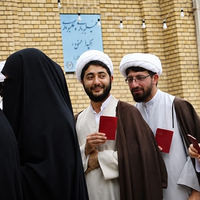
Despite millions of dollars in state funding and tight clerical oversight, most of Iran’s mosques sit half-empty, and Friday prayers have dwindled as a platform for religious and political messaging.
The Center for the Supervision of Mosque Affairs, a branch of the Organization for Islamic Propagation, oversees and coordinates mosque activities.
Prayer leaders in major mosques are appointed or vetted by provincial representatives of the Supreme Leader, while smaller neighborhood mosques may select imams locally—though clerical approval is still required.
Mosques also serve as mobilization hubs, with Basij units of the Revolutionary Guards frequently operating from them. This dual religious–military role shapes both administration and staffing.
No fewer than 24 institutions—from the Leader’s provincial offices and Basij units to the Endowment and Charity Affairs Organization (ECAO) and municipal authorities—play a direct or indirect role in mosque management.
Yet despite extensive resources, many remain underutilized.
Reza Moamami-Moghaddam of the ECAO has acknowledged that of Iran’s 85,000 mosques, only about 2,750 are highly active, around 20,000 host regular religious or cultural activities, and more than 16,000 are almost or completely inactive.
Low turnout in daily and weekly prayers reflects broader cultural shifts.
Senior cleric Mohammad Ali Ayazi complained in 2016 that in one city only 0.2 percent of the population attended Friday prayers, a decline that has eroded mosques’ role as community and mobilization centers.
Through the Friday Prayer Headquarters, the Leader’s office appoints and supervises Friday Imams, vets sermon content, and sets policy guidelines on political, social, and religious themes.
Sermons routinely stress resistance to foreign adversaries, support for domestic policies, and the ideals of the Islamic Revolution.
Friday Imams in provincial capitals wield particular influence, often outranking local governors as the Leader’s representatives. Their messaging is closely monitored to ensure complete alignment with state priorities, making Friday prayers a central instrument of official propaganda.
Funding comes from state budgets, imam salaries, provincial grants, mosque endowments (waqf) such as rental property and commercial assets, and local donations. Transparency is limited, with detailed expenditure reports rarely published.
Recent budgets earmarked trillions of rials for mosque and Friday prayer programs.
The Center for the Supervision of Mosque Affairs received 3.7 trillion rial ($3.7 million), the Headquarters for the Promotion of Prayer $2 million, the Friday Prayer Leaders Policy-Making Council $3.1 million, and the Friday Prayer Headquarters nearly $3 million.
These funds cover salaries, cultural programs, and construction projects, yet little is disclosed about how they are actually spent.
Outside the building of the General Directorate of Prisons of Semnan Province
A Swiss citizen Iran says died by suicide in prison was a 64-year-old tourist, a Swiss foreign ministry spokesman told Iran International, adding that Switzerland is seeking more details on his arrest and death from Tehran.
The foreign ministry added on Friday that the individual had been living in South Africa for the past 20 years and was traveling in Iran as a tourist.
The email response from the ministry said that the Swiss embassy in Iran was earlier denied access to the prisoner and now wants Tehran to provide full information about his arrest and death.
"Since Switzerland was informed of the arrest, the Swiss Embassy in Tehran has been in daily contact with the Iranian authorities to obtain more information about the circumstances of the arrest and to gain access to the detained Swiss citizen," the foreign ministry said.
"However, due to the accusations (espionage – national security), the requested consular access was not granted," it added. "Switzerland is demanding that the Iranian authorities provide detailed information."
The Swiss citizen who allegedly committed suicide in Semnan Prison on Thursday had been arrested while collecting soil samples in Iran’s central desert during an Israeli airstrike, media affiliated with Islamic Revolutionary Guard Corps reported.
Meanwhile, local media quoted unnamed Iranian official as saying that person was conducting espionage when he was arrested. The name of the Swiss citizen and the circumstances of his arrest and death remain unclear.
“This individual used prior intelligence training to take their own life during a specific opportunity,” Mashregh News, a publication affiliated with the Islamic Revolutionary Guard Corps (IRGC), reported late Thursday, citing an unnamed security official.
"Switzerland is demanding that the Iranian authorities provide detailed information on the reasons for his arrest and a full investigation into the circumstances of his death," the Swiss foreign ministry said.
The individual, detained by the IRGC Intelligence Organization, was accused of gathering information in a sensitive area during Israel's October air attack. The media report specifically said that this occurred during the Shahroud attack, which targeted an IRGC missile facility. Satellite imagery from Planet Labs later revealed significant damage to the site, known for building ballistic missiles and launching rockets as part of Iran’s space program.
After their arrest, the person was transferred to Semnan Prison, where they allegedly revealed information about their network and communication links, according to the outlet.
A local judiciary official confirmed the death on Thursday, saying that the Swiss national, facing espionage charges, had committed suicide in their cell.
Switzerland has also confirmed the death. "The FDFA confirms the death of a Swiss citizen in Iran," spokesperson Pierre-Alain Eltschinger told Iran International. "The Swiss Embassy in Tehran is in contact with the local authorities to clarify the circumstances of the death in an Iranian prison," he added.
According to Mizan, Iran's judiciary news website, the detainee asked their cellmate on Thursday morning to purchase food from the prison canteen. While alone in the suite, the detainee reportedly took their own life. "Prison officials immediately intervened to save the individual, but their efforts were unsuccessful," Mohammad Sadegh Akbari, a local judiciary official, was quoted as saying. “Suicide has been definitively confirmed.”
Iran has arrested dozens of dual nationals and foreigners in recent years, often on charges of espionage or security-related offenses. Some of these detainees have been released in exchange for deals involving Iranians held in foreign prisons.