Iran’s parliament to debate urgent bill on quitting NPT
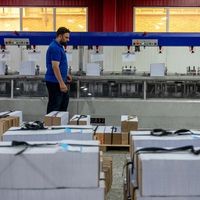
A session of the Iranian parliament
Iran’s parliament will on Sunday debate an emergency three-priority bill on withdrawing from the nuclear Non-Proliferation Treaty (NPT) and ending cooperation with the UN atomic watchdog, a senior lawmaker said, as Tehran faces renewed pressure over its nuclear program.
Parliament presidium spokesperson Abbas Goudarzi said the three-priority plan will be reviewed immediately without waiting in line, with Guardian Council members present to rule on its conformity with Islamic law and the constitution.
The draft, put forward by members of the national security committee, could see both general principles and details voted on the same day.
Tehran is weighing its options after Britain, France and Germany triggered the “snapback” mechanism last month to restore UN sanctions, citing Iranian breaches of the 2015 nuclear deal.
Officials have sent mixed signals: some lawmakers insist parliament can pass the measure on its own, while former nuclear chief Ali Akbar Salehi said such a decision lies with Supreme Leader Ali Khamenei.
The debate comes as Foreign Minister Abbas Araghchi said Iran will not return to pre-war negotiating terms after June’s conflict with Israel.
“It is not the case that after the war, we would just return to the negotiating table and as you call it ‘business as usual,’” he said on Saturday, though he added that indirect exchanges with Washington and talks with Europeans continue.
Araghchi also said Iranian diplomats in Vienna were “very close” to reaching a new framework of cooperation with the International Atomic Energy Agency, in line with a law passed by parliament.
Iran’s envoy in Vienna confirmed that the third round of technical talks with the IAEA had focused on drafting guidelines for safeguards implementation following strikes on nuclear sites.
Tehran will not return to the negotiating table under the same conditions that existed before the June war with Israel, Iran’s foreign minister said Saturday, days after Europe triggered the snapback leaving Iran to engage with the US or face UN sanctions.
“We were serious about the negotiations on sanctions relief. We had five rounds of negotiations and had fixed a date for the sixth round, but two days before that Israel launched a military attack and the US joined it,” Abbas Araghchi said.
“After this unjust war, naturally the negotiations will have a different shape compared to before the war. It is not the case that after the war, we would just return to the negotiating table and as you call it 'business as usual'."
"This is certainly not possible as the circumstances have changed. It is not possible to enter negotiations as before the war," he said in an address to a business and investment conference.
The June conflict began with a surprise Israeli strike on Iranian military and nuclear sites on June 13. Tehran said 1,062 people were killed, including 786 military personnel and 276 civilians.
Israel said it killed more than 30 senior Iranian security officials and 11 nuclear scientists. Iran retaliated with missile strikes that killed 31 civilians and one off-duty Israeli soldier.
In his Saturday remarks, Araghchi stressed that while talks have not been taken off the agenda, they will enter a new phase.
“We are not saying negotiations are off the table, but they definitely have a new format and dimensions, and new concerns and factors have entered them that we must understand and design for."
Talks with US and Europeans
Araghchi said Iran is exchanging messages with Americans through intermediaries.
"The day the Americans reach a point where they are ready for dialogue based on mutual interests and mutual respect, we will resume negotiations," he said.
The foreign minister said Tehran's talks with the Europeans are continuing and that he hopes the two sides would reach a mutual understanding.
“I think a better understanding of the situation is emerging," he said, referring to his meeting with EU Foreign Policy Chief Kaja Kallas in Doha and his phone calls with E3 foreign ministers.
Iran 'very close' to deal with IAEA
Araghchi said Iranian diplomats in Vienna continued their negotiations with the UN nuclear watchdog on Saturday to reach a new framework for cooperation.
"As far as I have been informed, they had very good talks," Iran's foreign minister said. "We are very close to reaching an agreement on a new framework of cooperation with the Agency in line with the parliament’s law."
His remarks come as Iran has three weeks to reengage in negotiations with the United States and the UN nuclear watchdog or face the reimposition of UN sanctions, after the Europeans triggered the so-called "snapback" mechanism.
On August 28, Britain, France and Germany triggered the mechanism, demanding that Tehran return to talks, grant IAEA inspectors wider access and account for its uranium stockpile.
Under Resolution 2231, sanctions will automatically return after 30 days unless the Security Council votes otherwise.
Iran's Supreme Leader Ali Khamenei along with his military commanders
Tehran risks sliding back into comprehensive multilateral isolation by the end of September, with the deadline for the return of UN sanctions fast approaching and Washington mulling restrictions on Iranian officials at this month’s General Assembly
Barely a week after the E3 (France, Germany and UK) set in motion the thirty-day countdown to reimpose UN sanctions, forty Republican lawmakers asked President Donald Trump to bar Iranian delegates from freely entering the United States.
Russia and China have signaled opposition to Europe’s move, offering Tehran diplomatic cover. But it’s not clear how far they would go if push came to shove.
For Israel, timing is critical.
The twelve-day war of 2025 showed both the dangers of escalation and the effectiveness of targeted strikes.
Israeli operations killed senior IRGC and Quds Force commanders and damaged Iran’s drone and missile networks. US forces joined with limited but highly consequential strikes on elements of Iran’s nuclear facilities, temporarily disrupting enrichment.
Iran can rebuild, but the episode laid bare the vulnerability of its most sensitive assets.
Yet the war also underscored the Islamic Republic's resilience and appetite for risk.
Tehran launched hundreds of missiles and drones at Israel, yet the conflict deepened doubts about its strategic trajectory under pressure.
At home, strains are mounting.
A summer of rolling blackouts, water shortages, and currency collapse has pushed the rial to historic lows. Inflation has eroded living standards, fueling discontent.
The return of UN sanctions could intensify instability, further constraining Tehran’s options abroad.
Against this backdrop, some policymakers are weighing military options, raising the question of international law.
Under Article 51 of the UN Charter, force is lawful only in response to an actual or imminent attack. Preventive strikes—such as Israel’s 1981 attack on Iraq’s Osirak reactor, unanimously condemned by the Security Council—remain controversial.
Iran’s program today is far more hardened and dispersed, and even a coordinated campaign could only delay, not dismantle, it—while risking multi-front retaliation. The global economic dimension looms just as large.
Iran has long threatened to close the Strait of Hormuz, which remains the world’s most sensitive energy chokepoint, and even limited hostilities could spike oil prices and strain fragile economies from Europe to Asia.
Despite these risks, advocates of preemptive strikes insist that the dangers of inaction outweigh the costs of escalation.
Yet the 12-day war underscored how quickly limited action can spiral into regional confrontation.
Iran has signaled tentative flexibility, but the snapback has created rare international cohesion. The coming weeks will determine whether pressure yields compliance, confrontation, or a recalibration across the region.
Several newspapers in Iran have warned that the return of UN sanctions and threats of renewed conflict with Israel could plunge the country into crisis, while also noting that some officials downplay the risks.
In the hardline Kayhan daily, columnist Jafar Bolouri described the country’s situation as “extraordinary,” cautioning that a new war could erupt at any moment alongside worsening economic and social pressure. He said the government’s priorities “do not match the situation,” accusing it of focusing on secondary issues instead of inflation, which “creates openings for enemies to exploit.”
The IRGC-linked Javan wrote that Western powers, unable to achieve their goals in the June 12-day war, are now using the snapback process as part of a “cognitive war” to inflame the economy and provoke unrest. “Supporters of the Zionist regime…exploit the snapback and hostile media to stir inflation, currency volatility and social unrest,” the paper said, warning that “domestic infiltrators” amplify these pressures.
The reformist Ham Mihan criticized what it called complacency among officials. “Snapback leads to the return of Security Council resolutions and gives sanctions a binding legal character. Evading them will be very difficult and costly,” the paper said. It added: “Some believe snapback adds little to existing sanctions. Such an interpretation is completely wrong.”
Snapback countdown
On August 28, Britain, France and Germany triggered the UN snapback mechanism, demanding that Tehran return to talks, grant inspectors wider access and account for its uranium stockpile. Under Resolution 2231, sanctions will automatically return after 30 days unless the Security Council votes otherwise.
Tehran has rejected the step. Foreign Minister Abbas Araghchi told EU foreign policy chief Kaja Kallas in Doha on Thursday that the decision was “illegal and unjustifiable,” and insisted that the EU should “play its role in fulfilling its responsibilities to neutralize moves against diplomacy.”
IAEA report raises alarm
A confidential report by the International Atomic Energy Agency said Iran’s stockpile of uranium enriched to 60% remains “a matter of serious concern” after inspectors lost visibility following Israeli and US strikes in June. The report noted Iran had 440.9 kilograms of 60% enriched uranium as of June 13, a short step from weapons-grade levels.
IAEA Director General Rafael Grossi told Reuters: “It would be ideal to reach an agreement before next week. It’s not something that can drag on for months.”
Officials downplay risks
Not all voices share the newspapers’ sense of alarm. IRGC political deputy Yadollah Javani called snapback talk a “psychological operation” to mask Western defeat in the June war. Babak Negahdari, head of parliament’s research center, argued that “the real pressure on Iran has come from US secondary sanctions,” and said any UN measures could be blunted by Russia and China, though he acknowledged “psychological and economic side effects if not handled carefully.”
Former presidential chief of staff Mahmoud Vaezi stressed that “some individuals do not understand the sensitivity of this moment” and warned against rhetoric that fuels division. He said the 12-day war had proved “national cohesion has completely overturned the enemy’s calculations,” and urged leaders to focus on preserving unity.
A screengrab from Iranian state TV footage purportedly shows the moment an Iranian missile is launched at Israel while an Israeli drone attack hits another launchpad in the same location.
Time is running out to avert a nuclear crisis, Nicole Grajewski of the Carnegie Endowment said, describing Iran's nuclear program as a complex file where diplomacy is limited, military strikes are insufficient, and Europe’s snapback of UN sanctions risks sparking fresh conflict.
Grajewski told Iran International's Eye for Iran that only Washington can break the deadlock by re-engaging directly with Tehran and backing a short extension that ties International Atomic Energy Agency (IAEA) inspections to credible security guarantees.
Tehran responded by restricting IAEA access. Soon after, Britain, France, and Germany — the E3 — formally invoked snapback under UN Security Council Resolution 2231. The mechanism automatically restores pre-2015 UN sanctions in 30 days unless the Council unanimously endorses continued relief.
Foreign Minister Abbas Araghchi accused Europe of “acquiescing” to Washington and Israel and warned any reinstated sanctions would be “null and void.” Iranian lawmakers have threatened to quit the Nuclear Non-Proliferation Treaty (NPT)—the cornerstone pact that obliges Iran to cooperate with the IAEA — if UN sanctions return.
Grajewski warned that such a step could be a trigger for war.
“Iran could withdraw from the NPT. And this is where you might see another conflict between Iran and Israel, more Israeli strikes on Iran’s program,” she said. “They’ll use the excuse that now we can’t see Iran’s nuclear program. We no longer have inspectors.”
She also cautioned against overreliance on force. “It’s unclear what we could have achieved with diplomacy. And it’s also clear that military action alone can’t solve the Iranian nuclear issue,” she said. President Donald Trump, for his part, has defended the June strikes as necessary.
What can Washington do now?
Grajewski urged the United States to resume direct or indirect talks, press for restored IAEA access, and offer a narrow, conditional assurance: no new strikes on nuclear facilities during a brief extension, so long as Iran meets inspection and transparency benchmarks. That package, she argued, could unlock a six-month snapback extension and lower the odds of escalation.
Moscow has floated a counter-resolution at the UN and, as Grajewski noted, is adept at using UN procedures to delay investigations and enforcement.
Grajewski tied today’s impasse back to the collapse of the 2015 nuclear deal, the Joint Comprehensive Plan of Action.
“Had the JCPOA remained in force, we probably wouldn’t have seen the 12-day war,” she said. But she added that Tehran overplayed its hand: “Iran has made so many terrible decisions… showing off their capabilities” exposed weaknesses and hardened adversaries’ resolve.
For now, the file sits on a knife-edge. “A crisis is not inevitable,” Grajewski concluded. “It’s possible and it’s somewhat likely — either a diplomatic crisis with NPT withdrawal or potentially something kinetic. But it’s not a foregone conclusion.”
Chinese guards of honour take part in a ceremony to welcome Russian President Vladimir Putin, who arrives at an airport to attend the Shanghai Cooperation Organisation (SCO) summit in Tianjin, China August 31, 2025.
Tehran’s sharpening nuclear clash with the West and embrace of Beijing and Moscow have brought it to a crossroads, where choices this month may decide the future of Iran’s rulers and the ruled.
The formal start of the UN “snapback” process to restore sanctions, the latest critical report by the International Atomic Energy Agency (IAEA), and President Masoud Pezeshkian’s high-visibility diplomacy at the Shanghai Cooperation Organization (SCO) summit together mark a decisive moment for Tehran.
The most immediate challenge is the likely restoration of UN snapback sanctions before 28 September.
European governments argue the trigger is Iran’s sustained non-compliance with key limits in the 2015 Joint Comprehensive Plan of Action (JCPOA) over the past six years. Tehran rejects that position, insisting the E3 forfeited standing by failing to deliver promised economic normalization after Washington’s 2018 withdrawal.
Whatever the legal briefs, reinstated measures would effectively return Iran to a Chapter VII-related sanctions framework, with all the familiar consequences: renewed constraints on arms transfers, reinforced financial isolation, and fresh layers of economic restrictions that have already strained household incomes and the broader investment climate.
Scrutiny intensifies
New IAEA findings have sharpened scrutiny of Iran’s program.
The agency signaled fresh shortfalls in cooperation, pointing to unexplained inventories of enriched uranium at levels exceeding JCPOA caps.
International Atomic Energy Agency (IAEA) Director General Rafael Grossi visits Iran's nuclear achievements exhibition, in Tehran, Iran, April 17, 2025.
A confidential tally circulated to member states indicated Iran holds about 441 kilograms of uranium enriched to 20% or higher – enough, by the agency’s rule of thumb, to yield material for around ten nuclear devices if further refined.
Director General Rafael Grossi has said there is no sign of diversion, but emphasized the need for verification and timely documentation – something Iranian officials have yet to provide.
Rather than escalate immediately, the Secretariat has kept contacts open in hopes of restoring routine access. Two reports to the IAEA’s 35-nation Board of Governors underline the urgency: inspections must resume “without delay,” and the buildup of highly enriched stocks remains a “serious concern.”
Eastward turn accelerates
It is against this tightening sanctions and verification backdrop that President Pezeshkian’s China tour looms large.
Over a week of meetings – most prominently with Xi Jinping in Beijing and Vladimir Putin in Tianjin – Tehran sought to translate a long-advertised “Look East” doctrine into concrete political and economic ballast.
Iranian officials pressed for more than sympathetic rhetoric: Moscow and Beijing are backing Iran’s claim that snapback is legally void but, crucially, Tehran hopes they avoid implementing any reimposed UN measures.
For China and Russia, the ask is non-trivial. Skirting U.S. and European unilateral sanctions is one thing; openly discounting UN obligations is another, with implications for their global positioning.
Russian President Vladimir Putin and Iranian President Masoud Pezeshkian attend a ceremony to sign an agreement of comprehensive strategic partnership between the two countries, at the Kremlin in Moscow, Russia January 17, 2025
Still, Pezeshkian delivered a message calibrated for both audiences at once.
He reaffirmed Iran as a “reliable friend” to China, echoing Supreme Leader Ali Khamenei’s priority on eastern partnerships. He also stressed Tehran’s readiness to operationalize the 25-year agreement with Beijing across energy, infrastructure, and technology.
The session with Putin amplified the signal: in Tehran’s view, China and Russia are no longer transactional partners of convenience, but strategic anchors to confront Western pressures.
Roadblocks remain
The SCO summit in Tianjin provided the showcase for this reorientation. Now a full member, Iran leaned into the organization’s language of sovereignty, non-interference, and resistance to unilateralism.
Yet the question of deliverables hangs over the pageantry.
Iran’s earlier eastward experiments, notably under Mahmoud Ahmadinejad, yielded less than the rhetoric promised. Banking bottlenecks, compliance risks for major companies, and the gravitational pull of Western markets on Chinese firms limited follow-through.
Whether today’s geopolitical alignment—and the higher stakes of great-power competition—change those cost-benefit calculations is the live test.
For Tehran, success will be measured not in communiqués but in sustained energy sales, credible financing channels, technology transfers, and visible progress on infrastructure that can withstand sanctions headwinds.
Iran's supreme leader Ali Khamenei meets top officials including president Masoud Pezeshkian and judiciary chief Gholamhossein Mohseni Ejei
Future hangs in balance
Inside Iran, the “Look East” pivot has sparked an energetic debate.
Hardline outlets herald the emergence of an “Eastern front” that validates decades of resistance to Western dominance. But reformist and moderate voices warn that the country risks swapping one form of dependence for another.
Their critique is less civilizational and more structural: if Iran becomes overly reliant on Moscow and Beijing for markets, capital, and diplomatic cover, it could re-create the asymmetries of influence that the 1979 Revolution sought to overturn.
In this reading, the pivot is a pragmatic hedge, but also a bargain that may constrain policy autonomy over time.
The central uncertainty is whether the “Look East” approach can move beyond symbolism and episodic deals to furnish the durable economic and technological lifelines Iran needs.
If it can, Tehran may blunt the effect of renewed UN measures and stabilize growth on an alternative platform. If it cannot, the pivot risks devolving into a slogan that masks deepening isolation and narrowing options.
As September advances toward the snapback deadline, Tehran stands at a genuine crossroads.
Choices made now – on access for inspectors, on the pace and level of enrichment, on the specificity of commitments with China and Russia – will shape not only Iran’s nuclear trajectory and economic survival, but also the character of its grand strategy for the remainder of Khamenei’s tenure.