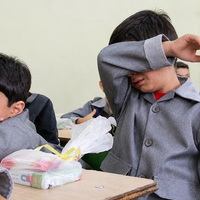
An elderly man sits on a metal railing at a taxi station in the southern Iranian city of Ahvaz, August 25, 2025.
Europe’s move to trigger the so-called snapback mechanism has sparked an online storm in Iran, ranging from despair and anger to calls for war, regime change, and nuclear weapons.
While those opposed to Tehran’s rule largely see in snapback a chance for collapse or regime change, hardliners dismiss the sanctions as psychological warfare and call for retaliation and escalation.
“If snapback is extended, what guarantee is there that six months later we won’t face demands over missiles?” an ultraconservative activist asked online. “Withdraw from the NPT, expel European ambassadors, block the Strait of Hormuz.”
Some went further still. “What rational reason is left not to build a nuclear bomb?” one user asked on X. Another warned: “From now on, any official who stands against developing nuclear weapons will not be remembered kindly in Iran’s history.”
Hardliners rallied under the hashtag “JCPOA is pure damage,” referring to the 2015 Joint Comprehensive Plan of Action, the nuclear deal between Iran and world powers. Many dismissed renewed UN sanctions as empty threats. “The uproar over snapback is merely psychological warfare,” one user insisted.
Defending the deal
Others countered that the nuclear accord shielded Iran from Chapter VII sanctions and the threat of war for a decade and should not be discarded.
Journalist Hossein Yazdi recalled the grim days before the deal: “Ask those who remember how dire things were before the JCPOA. Was it not true that people in Khuzestan traded rice for Iraqi infant formula?”
Writer Mohammadreza Mohajer drew a parallel with Iraq before the 2003 invasion.
“It hardly matters whether we have 400 kilos of enriched uranium or 40 million tons—just as it didn’t matter whether Saddam had weapons of mass destruction,” he posted on X.
“Let’s not forget: we did not want Iran for enrichment; we wanted enrichment for Iran.”
‘Blessing in Disguise’
Some voices on the other extreme framed snapback as less a source of despair than a potential opening.
“Iranians are drowning anyway … But perhaps snapback will bring war, and with it a chance to break the chains,” one activist wrote. “Yes, we, the people of Iran, welcome snapback.”
Another argued that sanctions would finally “prove to the grey middle class that hoping for Khamenei to make concessions was always an illusion” and push them toward revolt.
Humor and anxiety
Not all reactions were grim. “How long does snapback take to kick in? It’s been a day since activation, and I don’t feel anything yet,” one user joked.
But humor quickly drew pushback. “Snapback is no laughing matter. It is about people’s daily bread, our children’s future, our very lives. How can anyone joke about this?” journalist Hoda Hashemi wrote.
Others highlighted the human cost more directly.
“The activation of snapback saddens me, because I know the burden will fall directly on the people … who had no role in creating this catastrophe,” diaspora activist Amin Pouria posted.
“But I would still mourn had it not been activated, because that would mean the Islamic Republic and Khamenei could once again breathe easy. Either way, the people suffer. Damn you for holding an entire nation hostage!”
Outside the building of the General Directorate of Prisons of Semnan Province
A Swiss citizen Iran says died by suicide in prison was a 64-year-old tourist, a Swiss foreign ministry spokesman told Iran International, adding that Switzerland is seeking more details on his arrest and death from Tehran.
The foreign ministry added on Friday that the individual had been living in South Africa for the past 20 years and was traveling in Iran as a tourist.
The email response from the ministry said that the Swiss embassy in Iran was earlier denied access to the prisoner and now wants Tehran to provide full information about his arrest and death.
"Since Switzerland was informed of the arrest, the Swiss Embassy in Tehran has been in daily contact with the Iranian authorities to obtain more information about the circumstances of the arrest and to gain access to the detained Swiss citizen," the foreign ministry said.
"However, due to the accusations (espionage – national security), the requested consular access was not granted," it added. "Switzerland is demanding that the Iranian authorities provide detailed information."
The Swiss citizen who allegedly committed suicide in Semnan Prison on Thursday had been arrested while collecting soil samples in Iran’s central desert during an Israeli airstrike, media affiliated with Islamic Revolutionary Guard Corps reported.
Meanwhile, local media quoted unnamed Iranian official as saying that person was conducting espionage when he was arrested. The name of the Swiss citizen and the circumstances of his arrest and death remain unclear.
“This individual used prior intelligence training to take their own life during a specific opportunity,” Mashregh News, a publication affiliated with the Islamic Revolutionary Guard Corps (IRGC), reported late Thursday, citing an unnamed security official.
"Switzerland is demanding that the Iranian authorities provide detailed information on the reasons for his arrest and a full investigation into the circumstances of his death," the Swiss foreign ministry said.
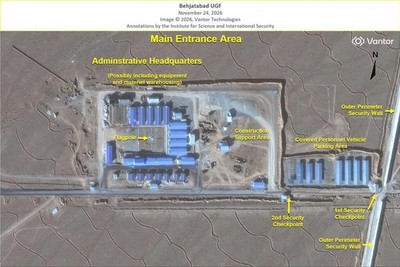
The individual, detained by the IRGC Intelligence Organization, was accused of gathering information in a sensitive area during Israel's October air attack. The media report specifically said that this occurred during the Shahroud attack, which targeted an IRGC missile facility. Satellite imagery from Planet Labs later revealed significant damage to the site, known for building ballistic missiles and launching rockets as part of Iran’s space program.
After their arrest, the person was transferred to Semnan Prison, where they allegedly revealed information about their network and communication links, according to the outlet.
A local judiciary official confirmed the death on Thursday, saying that the Swiss national, facing espionage charges, had committed suicide in their cell.
Switzerland has also confirmed the death. "The FDFA confirms the death of a Swiss citizen in Iran," spokesperson Pierre-Alain Eltschinger told Iran International. "The Swiss Embassy in Tehran is in contact with the local authorities to clarify the circumstances of the death in an Iranian prison," he added.
According to Mizan, Iran's judiciary news website, the detainee asked their cellmate on Thursday morning to purchase food from the prison canteen. While alone in the suite, the detainee reportedly took their own life. "Prison officials immediately intervened to save the individual, but their efforts were unsuccessful," Mohammad Sadegh Akbari, a local judiciary official, was quoted as saying. “Suicide has been definitively confirmed.”
Iran has arrested dozens of dual nationals and foreigners in recent years, often on charges of espionage or security-related offenses. Some of these detainees have been released in exchange for deals involving Iranians held in foreign prisons.