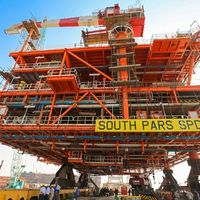
Iran's oil minister told the state TV the "snapback" mechanism triggered by European powers could impose restrictions on Tehran's oil sales that may require further countermeasures, but stressed the Islamic Republic will not be constrained by them.
"We have faced restrictions on oil sales for years, and this has given us the expertise to bypass such sanctions. Our current team can devise different ways of overcoming these restrictions," Mohsen Paknjead said.
"The snapback sanctions can move us toward conditions that require new countermeasures, but we won't be tied down by them," he added.
"Iran's continued participation in the Treaty on the Non-Proliferation of Nuclear Weapons (NPT) is nothing but yielding to the enemy’s blackmail and an insult to the Iranian nation and government," said Hossein Shariatmadari, the representative of Iran's Supreme Leader in the hardline Kayhan newspaper.
"During the recent 12-day war, the European troika (Britain, France and Germany) stood alongside the United States and Israel and even refused to condemn America’s attack on our nuclear facilities. Make no mistake: the recent move by the three European countries is a continuation of that 12-day war and is aimed at compensating for the defeat of the United States and the Zionist regime."
Shariatmadari said "leaving the NPT is not only an overdue necessity at this point, but also Iran’s ‘counter-attack’ to the enemy’s ‘offensive,’ and any delay in doing so would mean giving ground to the adversary."

The acting Friday prayer Imam of Tehran, Mohammad Javad Haj Ali Akbari, accused Britain, France, and Germany of acting as “proxies” for Israeli interests after their move to trigger the UN snapback mechanism against Iran.
Calling the step “illegal, immoral, and purely political,” he said it was done under US and Israeli pressure.
“This decision is a symbolic act of desperation after the disgraceful failure of the US and Israel in the recent conflict,” he said during his sermon on Friday.

Amid growing economic uncertainty following the reactivation of the UN snapback mechanism, influential cleric Ahmad Alamolhoda warned Iranians not to fuel instability by rushing to buy foreign currency or gold.
“Some naive individuals, hearing news of sanctions, rush toward buying dollars and gold, which only drives prices higher,” the Friday prayer Imam in Mashhad said during his sermons.
Alamolhoda criticized what he described as “enemy psychological warfare” aimed at weakening Iran's economy and society, urging citizens and officials to resist panic and protect the country’s economic front.

Hashem Hosseini Bushehri, Friday prayer Imam in Qom, said Iranians must resist Western pressure with “initiative and resistance” like the people of Yemen, and warned that the snapback of UN sanctions amounts to Europe taking the Iranian people “hostage.”
Speaking at prayers in Qom on Friday, Hosseini Bushehri condemned the US for abandoning the nuclear deal and accused Europe of following suit by triggering the snapback mechanism. He said, “They tore up the agreement and now they want to hold the people of Iran accountable.”
Qom, located in central Iran, is one of the country’s key religious and political centers.
A senior aide to Iran’s Supreme Leader has criticized the activation of the UN snapback mechanism, saying it has no legal foundation and will only complicate the diplomatic landscape.
“The activation of snapback, which lacks legal grounds, will merely lead to a more complex diplomatic atmosphere,” Mohammad Mokhber, an adviser to the Supreme Leader, wrote Friday on X.
He added that the move will not affect the Islamic Republic’s determination to preserve its independence and development.