Australia expels Iranian envoy after blaming Tehran for antisemitic attacks

Australia accused Iran of two antisemitic arson attacks and ordered its ambassador to leave the country within seven days, Prime Minister Anthony Albanese said on Tuesday.
Australia accused Iran of two antisemitic arson attacks and ordered its ambassador to leave the country within seven days, Prime Minister Anthony Albanese said on Tuesday.
Albanese said intelligence gathered by the Australian Security Intelligence Organisation showed Iran had directed attacks on a kosher restaurant in Sydney and a synagogue in Melbourne last year.
“These were extraordinary and dangerous acts of aggression orchestrated by a foreign nation on Australian soil,” Albanese told reporters.
ASIO Director-General Mike Burgess said Iran had “sought to disguise its involvement,” but the agency assessed it was behind the attacks on the Lewis Continental Kitchen in Sydney on 20 October last year, and the Adass Israel Synagogue in Melbourne on 6 December. He said Iran was “likely” behind further incidents targeting Jewish Australians.
Revolutionary Guards to be listed as terrorist group
Albanese also said Iran’s Revolutionary Guards would be listed as a terrorist group and confirmed Australia’s diplomats had left Tehran and were now in a third country.
Foreign Minister Penny Wong said Iran’s ambassador Ahmad Sadeghi and three officials must leave within a week. This is the first time Australia has expelled an envoy since World War Two.
The Australian government had previously warned Ambassador Ahmad Sadeghi over inflammatory social media posts, including a June message where he described Israel as “the most venomous snake on the planet” and a “genocidal regime.”
The remarks were made during the June conflict between Iran and Israel. A spokesperson told Iran International that Australia had made clear to Tehran that such rhetoric was unacceptable and urged all sides to de-escalate. Sadeghi had also faced past warnings for praising Hezbollah and calling for Israel’s destruction.
Politicians condemn Iran as Jewish community says fears were long ignored
Australian politicians condemned Iran’s alleged role in antisemitic attacks. Victorian Premier Jacinta Allan said her anger “will never subside,” calling the synagogue fire an act of terror. NSW Premier Chris Minns said the revelations were “deeply disturbing and utterly unacceptable.” Independent MP Allegra Spender, whose electorate includes the targeted Bondi restaurant, urged the government to continue working with Jewish communities to address security concerns.
Jewish community figures said the announcement confirmed long-standing concerns. Rabbi Gabi Kaltmann, whose synagogue is near the one targeted in Melbourne, called it “an I told you so moment” that had shaken community trust. Naomi Levin, CEO of the Jewish Community Council of Victoria, said the attacks were acts of international terrorism and a threat to national security.
Israel also welcomed the expulsion, with its embassy in Australia saying Iran was a threat not only to Jews or Israel but to the free world.
Former detainee says response is overdue
Australian academic Kylie Moore-Gilbert, who was imprisoned in Iran and is a vocal critic of Tehran, welcomed the move but said it had been too long coming.
In a post on X, she applauded the government's "decisive action against a brutal regime" but called it "a shame that it's taken them so long."
“For years now the Iranian-Australian community and other victims of the IRGC, including myself, have been literally screaming at rallies... that Iranian agents are operating brazenly and with few consequences here on Australian soil,” she wrote.
Travel warning for Australians in Iran
The Department of Foreign Affairs has advised Australians and dual nationals in Iran to leave the country if it is safe to do so. The Australian embassy in Tehran has suspended operations, and the government has warned of a high risk of arbitrary detention for foreigners.
Albanese said the government’s actions sent a message that foreign-directed aggression on Australian soil would not be tolerated.





A Swiss citizen Iran says died by suicide in prison was a 64-year-old tourist, a Swiss foreign ministry spokesman told Iran International, adding that Switzerland is seeking more details on his arrest and death from Tehran.
The foreign ministry added on Friday that the individual had been living in South Africa for the past 20 years and was traveling in Iran as a tourist.
The email response from the ministry said that the Swiss embassy in Iran was earlier denied access to the prisoner and now wants Tehran to provide full information about his arrest and death.
"Since Switzerland was informed of the arrest, the Swiss Embassy in Tehran has been in daily contact with the Iranian authorities to obtain more information about the circumstances of the arrest and to gain access to the detained Swiss citizen," the foreign ministry said.
"However, due to the accusations (espionage – national security), the requested consular access was not granted," it added. "Switzerland is demanding that the Iranian authorities provide detailed information."
The Swiss citizen who allegedly committed suicide in Semnan Prison on Thursday had been arrested while collecting soil samples in Iran’s central desert during an Israeli airstrike, media affiliated with Islamic Revolutionary Guard Corps reported.
Meanwhile, local media quoted unnamed Iranian official as saying that person was conducting espionage when he was arrested. The name of the Swiss citizen and the circumstances of his arrest and death remain unclear.
“This individual used prior intelligence training to take their own life during a specific opportunity,” Mashregh News, a publication affiliated with the Islamic Revolutionary Guard Corps (IRGC), reported late Thursday, citing an unnamed security official.
"Switzerland is demanding that the Iranian authorities provide detailed information on the reasons for his arrest and a full investigation into the circumstances of his death," the Swiss foreign ministry said.
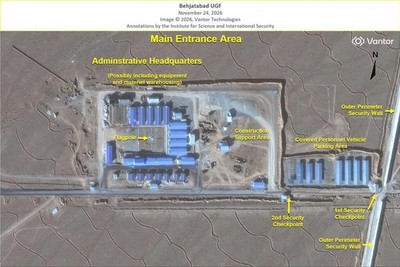
The individual, detained by the IRGC Intelligence Organization, was accused of gathering information in a sensitive area during Israel's October air attack. The media report specifically said that this occurred during the Shahroud attack, which targeted an IRGC missile facility. Satellite imagery from Planet Labs later revealed significant damage to the site, known for building ballistic missiles and launching rockets as part of Iran’s space program.
After their arrest, the person was transferred to Semnan Prison, where they allegedly revealed information about their network and communication links, according to the outlet.
A local judiciary official confirmed the death on Thursday, saying that the Swiss national, facing espionage charges, had committed suicide in their cell.
Switzerland has also confirmed the death. "The FDFA confirms the death of a Swiss citizen in Iran," spokesperson Pierre-Alain Eltschinger told Iran International. "The Swiss Embassy in Tehran is in contact with the local authorities to clarify the circumstances of the death in an Iranian prison," he added.
According to Mizan, Iran's judiciary news website, the detainee asked their cellmate on Thursday morning to purchase food from the prison canteen. While alone in the suite, the detainee reportedly took their own life. "Prison officials immediately intervened to save the individual, but their efforts were unsuccessful," Mohammad Sadegh Akbari, a local judiciary official, was quoted as saying. “Suicide has been definitively confirmed.”
Iran has arrested dozens of dual nationals and foreigners in recent years, often on charges of espionage or security-related offenses. Some of these detainees have been released in exchange for deals involving Iranians held in foreign prisons.