Women in black chadors hold up posters of slain Iranian commanders, Tehran, Iran, August 6, 2025
Moderates’ call for an overhaul of Iran’s political order has drawn fierce conservative backlash, with some critics invoking reformist appeals of 2003 that ended in bans, prison, and exile.
The new call for “national reconciliation”, issued by Reform Front on August 17, framed a return to popular sovereignty as the only way out of Iran’s multiple crises.
It cited both the aftermath of the recent conflict with Israel and the looming threat of the EU activating the nuclear “snapback mechanism” as urgent reasons for change.
Conservative outlets quickly drew comparisons to the controversial 2003 open letter by 127 reformist lawmakers urging Supreme Leader Ali Khamenei to “drink the chalice of poison” and accept reforms.
Many of those signatories were later banned from politics, imprisoned, or forced into exile.
By invoking that episode, conservatives sought to portray the new initiative as both politically subversive and ultimately doomed.
Beyond calls for social and political freedoms, the statement urged controversial steps to resolve Iran’s nuclear standoff, direct negotiations with Washington, suspension of uranium enrichment, and acceptance of full IAEA monitoring in exchange for sanctions relief.
Despite visibility in elite circles and the press, the appeal has gained little traction among ordinary citizens or social media users.
‘Betrayal’
Hardline media and politicians reacted with near unanimity, branding the statement treasonous and aligned with foreign agendas.
The ultra-hardline daily Kayhan, funded by Khamenei’s office, derided the document as “a Persian translation of Netanyahu’s speeches.” Sadegh Mahsouli, secretary-general of the Paydari Party, framed it as the opening move of a new “sedition” designed to fracture the country.
An adviser to Parliament Speaker Mohammad-Bagher Ghalibaf called the document “a dagger to the heart of national unity.”
Pragmatic conservative Ali Motahari voiced skepticism in a post on X, arguing that suspending uranium enrichment was unrealistic since Western powers would demand further concessions on missiles and regional policy.
Some even accused the authors of targeting Khamenei himself.
“The signal … to the enemy is that … by holding the defensive lines, the Leader is still preventing the project of Iran's capitulation,” former editor of the hardline outlet Raja News, Ehsan Salehi, posted on X.
“If giving such signals to the enemy isn’t treason, then what is?”
Reformist divisions
The statement also drew criticism from within the reformist spectrum.
The reformist daily Ham-Mihan, linked to the Executives of Construction Party, said the text reflected aspirations rather than a practical roadmap.
Saeed Nourmohammadi, spokesman for the reformist Neda-ye Iranian party, opposed issuing such manifestos that escalate tensions and “create binary divides.”
Others urged restraint.
Emad Bahavar of Iran's Freedom Movement argued that neither the authors nor critics should be vilified:
“Overcoming the current complex situation requires national reconciliation and constructive dialogue among all groups that genuinely care about the country and its people, whose primary concern is the ‘Iran question’.”
Some dismissed conservative attacks outright.
“They denounce any path that opposes their views, have little taste for peace, reconciliation, or coexistence, and treat 'enrichment' as a sacred, untouchable principle,” posted senior reformist journalist and politician Mohamad Sohofi on X.
“They spin the 12-day war—which should have been a lesson—as a victory, and despite the failure of their bluster-and-threat policies, the hardline conservatives remain obstinately uncompromising.”
Outside the building of the General Directorate of Prisons of Semnan Province
A Swiss citizen Iran says died by suicide in prison was a 64-year-old tourist, a Swiss foreign ministry spokesman told Iran International, adding that Switzerland is seeking more details on his arrest and death from Tehran.
The foreign ministry added on Friday that the individual had been living in South Africa for the past 20 years and was traveling in Iran as a tourist.
The email response from the ministry said that the Swiss embassy in Iran was earlier denied access to the prisoner and now wants Tehran to provide full information about his arrest and death.
"Since Switzerland was informed of the arrest, the Swiss Embassy in Tehran has been in daily contact with the Iranian authorities to obtain more information about the circumstances of the arrest and to gain access to the detained Swiss citizen," the foreign ministry said.
"However, due to the accusations (espionage – national security), the requested consular access was not granted," it added. "Switzerland is demanding that the Iranian authorities provide detailed information."
The Swiss citizen who allegedly committed suicide in Semnan Prison on Thursday had been arrested while collecting soil samples in Iran’s central desert during an Israeli airstrike, media affiliated with Islamic Revolutionary Guard Corps reported.
Meanwhile, local media quoted unnamed Iranian official as saying that person was conducting espionage when he was arrested. The name of the Swiss citizen and the circumstances of his arrest and death remain unclear.
“This individual used prior intelligence training to take their own life during a specific opportunity,” Mashregh News, a publication affiliated with the Islamic Revolutionary Guard Corps (IRGC), reported late Thursday, citing an unnamed security official.
"Switzerland is demanding that the Iranian authorities provide detailed information on the reasons for his arrest and a full investigation into the circumstances of his death," the Swiss foreign ministry said.
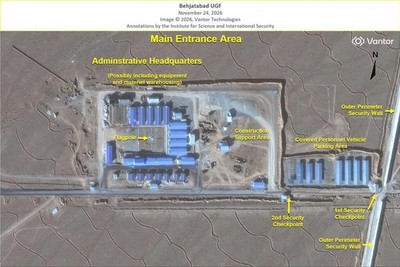
The individual, detained by the IRGC Intelligence Organization, was accused of gathering information in a sensitive area during Israel's October air attack. The media report specifically said that this occurred during the Shahroud attack, which targeted an IRGC missile facility. Satellite imagery from Planet Labs later revealed significant damage to the site, known for building ballistic missiles and launching rockets as part of Iran’s space program.
After their arrest, the person was transferred to Semnan Prison, where they allegedly revealed information about their network and communication links, according to the outlet.
A local judiciary official confirmed the death on Thursday, saying that the Swiss national, facing espionage charges, had committed suicide in their cell.
Switzerland has also confirmed the death. "The FDFA confirms the death of a Swiss citizen in Iran," spokesperson Pierre-Alain Eltschinger told Iran International. "The Swiss Embassy in Tehran is in contact with the local authorities to clarify the circumstances of the death in an Iranian prison," he added.
According to Mizan, Iran's judiciary news website, the detainee asked their cellmate on Thursday morning to purchase food from the prison canteen. While alone in the suite, the detainee reportedly took their own life. "Prison officials immediately intervened to save the individual, but their efforts were unsuccessful," Mohammad Sadegh Akbari, a local judiciary official, was quoted as saying. “Suicide has been definitively confirmed.”
Iran has arrested dozens of dual nationals and foreigners in recent years, often on charges of espionage or security-related offenses. Some of these detainees have been released in exchange for deals involving Iranians held in foreign prisons.