Smuggled Iranian produce floods Persian Gulf markets - The Economist
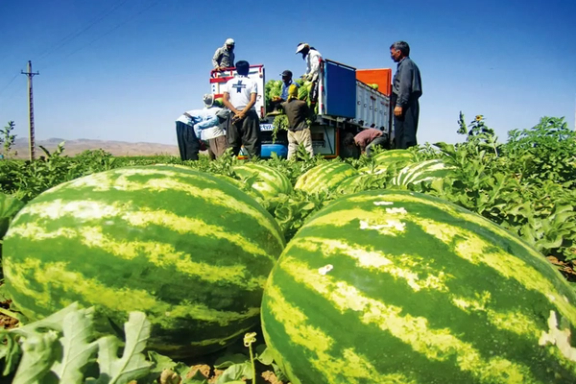
Watermelon harvest in Iran — farmers load freshly picked melons onto a truck.
As Iran faces a deepening water crisis, a recent report by The Economist shows how the Islamic Republic is quietly flooding Persian Gulf markets with fruit and vegetables through a sprawling export scheme.
“The Islamic Republic… is in a serious pickle,” The Economist wrote in its Friday report.
Flooding the Persian Gulf with fruit and veg is one of its ways to pay for foreign goods it so desperately needs, added the outlet, saying “Iran now supplies nine out of ten cauliflowers, tomatoes and watermelons imported by the UAE.”
The trade relies on large state subsidies that make water, fertilizers and energy almost free.
Iran’s greenhouse cultivation has more than tripled in area since the early 2010s, supported by imported technology from countries including China and the Netherlands. Much of the equipment, The Economist wrote, originates from Israel—“a leader in the field”—though routed indirectly.
But this export boom is exacerbating water scarcity across Iran. With agriculture consuming over 90% of available water, and government support concentrated on export-focused farms, residents in cities like Tehran, Isfahan, Mashhad, and many others endure hours-long daily shutoffs. Officials have warned of a collapse of groundwater resources and irreversible environmental damage.
Tomato harvest in Iran — a worker packs freshly picked tomatoes in crates on a farm.
Across Iran, families are enduring days without running water. Many are stockpiling bottles, installing rooftop storage tanks, or relying on tanker deliveries—some of which provide unsafe supplies.
Satellite images obtained by Iran International show that Tehran’s main reservoirs—Amir Kabir, Lar, and Latyan—are at historic lows, holding less than 10% of their usable volume.
At the same time, the capital is physically sinking. Excessive extraction from depleted groundwater resources has caused sections of Tehran to subside by more than 25 centimeters per year.
Iran's produce in Sharjah port
The report by the Economist details how Iran’s produce reaches the UAE’s Sharjah port via small ships from Bandar Lengeh, south of the country.
From there, trailers carry shipments to Dubai’s Al Aweer market, the region’s largest wholesale food hub, where wholesalers blend Iranian goods with other imports or repackage them entirely.
Labels are swapped to hide origin—“We just put a sticker on the carton with a new origin: Azerbaijan, Turkey—anything but Iran,” one trader said.
The export trade operates through a parallel financial system. Formal banking channels are avoided due to US sanctions, so traders use the informal system to settle payments.
UAE-based middlemen collect dirhams from food buyers and channel them to Iranian exporters—often in exchange for vital machinery and appliances Tehran cannot otherwise import.
Eggplants growing in an Iranian greenhouse
The Economist estimated the value of this clandestine export trade at $4bn to $5bn in 2024 alone.
Iran’s fruits often reach Persian Gulf supermarkets disguised and mispriced. Wholesalers inflate margins by mixing cheap Iranian tomatoes with Dutch imports and reselling the lot as premium goods.
“Instead of 4–5 dirhams, they sell the lot for 20–25 dirhams per kg,” said one insider. Some retail chains fly their staff business class and house them in luxury hotels—funded by “blended” produce profits, according to The Economist.
Despite occasional anti-dumping probes, Persian Gulf states appear to tolerate the flow. The report suggests some governments may see cheap Iranian food as a way to control inflation—or even preserve their own scarce groundwater by outsourcing farming to Iran.
But as water crisis deepens across Iran and key basins dry beyond recovery, Tehran’s strategy of exporting fruit may prove unsustainable. “However tempting,” The Economist warned, “bingeing on Iranian produce looks like a recipe for trouble.”
A seminary student in Qom burns a flag of the United States in October 2013, after President Rouhani's visit to New York.
The Islamic Republic is holding at least four Iranian American citizens including two individuals arrested after last month's US and Israeli airstrikes, The New York Times reported Saturday, citing rights groups and lawyers.
“Three of the Americans are in jail, and one has been barred from leaving the country,” the New York Times wrote, quoting individuals familiar with the detentions.
Hostage Aid Worldwide, a nonprofit that aids families of detainees, was quoted as saying it remains in contact with the detainees’ friends and relatives, and that all four had traveled to Iran from the United States to visit family.
Two of the four were arrested by security forces shortly after Israel’s attacks on Iran in June, according to the Human Rights Activists News Agency (HRANA) and Hengaw, independent rights groups based outside the country.
The other two were arrested last year, the report said.
The detentions “are likely to increase the already tense political climate between Tehran and Washington after the United States joined Israel’s attack on Iran and bombarded and severely damaged three of its nuclear sites in June," the report added.
One is a 70-year-old Jewish man from New York, a father and grandfather who runs a jewelry business. Rights groups and the man’s colleagues and friends said he is being questioned over a past trip to Israel.
HRANA identified him as Yehuda Hekmati on July 28.
Another case involves a California woman previously held in Evin prison, whose whereabouts remain unclear after the prison was attacked by Israel and evacuated.
Kylie Moore-Gilbert, an Australian British academic formerly imprisoned in Iran, confirmed the details, according to The New York Times.
A third Iranian American woman, initially detained in December 2024, is now out of prison but cannot leave the country, the report said. “She is currently out of prison, but her Iranian and American passports were confiscated."
Her US-based lawyer said that after the war, “the Iranian judiciary elevated her case and charged her with espionage.”
Reza Valizadeh, a US-Iranian journalist and former Radio Farda employee, was also arrested in October 2024 while visiting family and later sentenced to 10 years for “collaborating with a hostile government.”
Two Iranian officials told the Times that the New York man and California woman were detained as part of a crackdown on suspected operatives linked to Israel and the US.
The arrests come as President Masoud Pezeshkian has publicly urged members of the Iranian diaspora to return, saying he would coordinate with the intelligence and judiciary ministries to ease the process, according to local media.
“We have to create a framework so that Iranians living abroad can come to Iran without fear,” he said last week.
The United States on Friday advised citizens against traveling to Iran citing what it called escalating paranoia and an unprecedented crackdown on alleged spies and opponents following the 12-day war with Israel.
"The Iranian regime, following the 12-day war with Israel, is in the midst of unprecedented paranoia and a crackdown on spies and regime opponents," the State Department said in a post on its Persian X account USA Beh Farsi.
"Anyone considering travel to Iran should reconsider their decision. We repeat: US citizens should not travel to Iran!" the post reads.
A plume of smoke in Tehran following an Israeli airstrike in June 2025
A new national plan for civil defense training and shelter preparedness has been approved, Iran’s top military official said Saturday, just days after Israeli media warned of another potential war with Tehran.
“The new directive defines the responsibilities of executive bodies in building and managing shelters and emergency housing,” said Major General Abdolrahim Mousavi, who chairs Iran’s Armed Forces General Staff.
The announcement follows a report aired Thursday by Israel’s Channel 12, which cited analysts warning that both Iran and Israel appear to be preparing for another round of fighting despite a ceasefire in their 12-day conflict in June.
Iranian President Massoud Pezeshkian also warned this week that “Israel may attack again at any moment,” adding that Iran’s armed forces are fully prepared to repel any aggression.
"Today, within the armed forces, we are pursuing different preparedness programs across three timeframes—short-term, medium-term, and long-term," Mousavi said. "Improving readiness in the civilian sector and securing infrastructure must also be addressed with this same approach."
The new civil defense directive comes as Iranian authorities face criticism over the country’s vulnerability to airstrikes.
During the war with Israel, observers highlighted the lack of functioning air defense systems, early warning sirens, and public shelters.
Iran's government says 1,062 people were killed during the 12-day conflict with Israel, including 786 military personnel and 276 civilians.
Iranian strikes also killed 29 civilians and one off-duty soldier, Israeli media reported.
People window shopping in Tehran's gold and jewellery bazaar
Capital flight from Iran’s stock market has intensified since the June war with Israel, with retail investors pulling half a billion dollars—much of it appearing to shift into gold or exit the country altogether.
The trend highlights a deepening crisis of confidence that extends well beyond the battlefield.
Roughly 450 trillion rials ( $500 million) in individual investor funds have exited the Tehran Stock Exchange (TSE) since the 12-day conflict began on June 13.
For a market valued at about $100 billion, of which retail holdings make up less than 10%, this scale of withdrawal is striking.
Though the war ended with a ceasefire on June 24, capital outflows have continued. The benchmark TSE index has yet to recover, indicating sustained unease among ordinary investors.
Safe havens over stocks
No official data is available on how capital is shifting across asset classes, but given the prolonged stagnation in Iran’s housing market, much of the capital exiting equities appears to be flowing into gold.
Recent data from the World Gold Council, published July 31, confirms the trend. In the second quarter of 2025, gold coin and bullion purchases in Iran rose by 20%, while jewelry demand increased by 12%, despite record global prices.
Iran was the only major country to record a rise in jewelry consumption during this period.
Crisis Habits Repeat
The summer of 2022 offers a telling parallel.
Iranian rial lost almost a third of its value during that year’s widespread protests—widely known as the Woman, Life, Freedom movement. The currency fall sparked a surge in gold buying that hit the highest level since mid-2018, when the US reimposed oil sanctions.
In recent years, Tehran has eased restrictions on gold imports to bypass banking sanctions. Exporters are now allowed to bring in gold instead of repatriating foreign currency, which would be subject to strict exchange rate controls or forced conversions.
As a result, Iran imported more than 100 tons of gold in 2024—worth over $8 billion. That figure is triple the previous year’s and represents roughly 11% of total imports, an extraordinary share for a single non-industrial commodity.
In a climate of banking restrictions, currency volatility, and public mistrust in the rial, gold has become the most accessible safe haven for Iranian capital.
Offshore Exodus
Precise figures for capital flight during spring 2025 are not yet available. But the Central Bank of Iran estimated that about $20 billion left the country each year in 2023 and 2024—six times more than in 2018.
For a country with a GDP of around $400 billion in 2024, such persistent outflows are economically devastating.
They signal not just financial instability, but a broader collapse of trust in the domestic system, both economic and political.
A boy holds a Palestinian flag during a demonstration against what Palestinians say is Israel's confiscation of their land, as Isareli security forces stand guard, in Raba, near Jenin, in the Israeli-occupied West Bank July 18, 2025.
Iran’s Islamic Revolutionary Guards Corps (IRGC) on Saturday slammed efforts to promote a two-state solution to the Israeli-Palestinian conflict, a few days after a UN conference co-chaired by Saudi Arabia pushed for the solution.
“These satanic efforts are prescribing a two-state solution to end the Palestinian issue,” the IRGC said in a statement, marking the first anniversary of the Israeli killing of Hamas leader Ismail Haniyeh in Tehran.
“But the resistance remains firm on the path of martyr Haniyeh and others.”
The Guards said the path forward lies not in political compromise but in continued resistance. Quoting a Hamas slogan attributed to Haniyeh, the statement said: “We do not recognize Israel—never, never, never.”
A High-Level International Conference for the Peaceful Settlement of the Question of Palestine and the Implementation of the Two-State Solution took place at the United Nations in New York from July 28-30, 2025.
The conference, co-chaired by France and Saudi Arabia, aimed to revitalize efforts towards a two-state solution between Israel and the Palestinians, with a focus on achieving a just and lasting peace.
Traditionally, Iran has advocated for the annihilation of Israel, rejecting a two-state solution that would create an independent Palestinian state alongside Israel. Supreme Leader Ali Khamenei said in 2015 that Israel must be destroyed within 25 years.
Gaza war
The IRGC's statement described the war in Gaza as a genocide carried out with the broader aim of seizing strategic and resource-rich regions of the Islamic world.
“Those who engineered the genocide in Gaza are undoubtedly pursuing larger goals—the swallowing of the Muslim world’s rich and strategic regions,” it said.
“But with God’s help, the breaking of global silence and the surge of anti-Zionist international protest will shatter the hopes and ambitions of the Zionist-American criminal band, which must now await the unmasking of its hidden fate.”
It also condemned the killing of Haniyeh in Tehran, which occurred while he was in the city for Iran’s presidential inauguration.
The IRGC credited continued Palestinian resistance to what it called the legacy of Haniyeh and other slain leaders of the anti-Israel struggle.
“The Aqsa Storm was not a passing event but a strategic doctrine sealed by the blood of martyrs,” it said, referencing the October 7, 2023 Hamas attack on Israel.
Since the October 7 attacks which saw at least 1,200 people killed and more than 250 more taken hostage by the militant group, Israel’s military campaign has killed over 53,000 people in Gaza, according to the Hamas-run Ministry of Health statistics.
The Israeli military says at least 20,000 of those are militants.
Accusing Israel of using starvation and siege as instruments of war, the IRGC called on international organizations to recognize such tactics as war crimes and to impose serious sanctions on the Israeli government.
“The deliberate creation of famine is a recognized crime against humanity,” the statement said.
The IRGC, a powerful parallel military in Iran with extensive economic and intelligence roles, was designated a terrorist organization by the United States in 2019 under President Donald Trump. Washington and Ottawa have called on European allies to follow suit.
UK Foreign Secretary David Lammy has warned that regime change in Iran could produce outcomes “as bad or worse,” saying there is no guarantee that any successor to the Revolutionary Guards would be an improvement.
“There are lots of people in Iran who would like regime change,” Lammy told The Guardian, in an interview published on Saturday. “But there are no guarantees that what would replace the current Iranian Revolutionary Guard Corps would not be as bad or worse.”
“The US decision to bomb was not to topple Iran’s government,” he added.
Lammy emphasized that the decision over Iran’s political future “is for the Iranian people to determine,” and that his focus remains on preventing Tehran from developing nuclear weapons.
Nuclear concerns remain central
Lammy also said Iran has failed to justify its production of uranium enriched to 60% purity, a level far beyond what’s needed for civilian energy.
“Its leaders cannot explain to me, and I’ve had many conversations with them, why they need 60% enriched uranium,” he said, pointing out that enrichment in UK sites like Sellafield and Urenco does not exceed 6%.
He warned of a broader risk to the region: “We would be very suddenly handing over to our children and grandchildren a world that had many more nuclear weapons in it than it has today.”
Tehran denies talks aim at a deal
Lammy’s comments come amid renewed, but limited, diplomatic contacts between Iran and the so-called E3 — Britain, France and Germany. Tehran insists these are not formal negotiations.
“There are no talks aimed at reaching a deal with Europe at the moment,” Iranian government spokesperson Fatemeh Mohajerani told Russia’s Sputnik news agency. “These are exchanges of opinion.”
The discussions follow last week's meeting in Istanbul, the first such engagement since Israeli and US strikes on Iranian territory in June.
NPT threat underscores tensions
Iran International earlier this week reported that Tehran has warned it may withdraw from the Nuclear Non-Proliferation Treaty (NPT) if the E3 moves to trigger snapback UN sanctions under Security Council Resolution 2231.
Tehran rejects the legal basis of such a move and accuses European states of aligning themselves with US and Israeli military actions.
Iran says diplomacy backed by Supreme Leader
A senior Iranian lawmaker said on Saturday that the recent talks have full backing from the country’s top leadership.
“What is happening now is certainly the decision of the ruling system,” said Abbas Golroo, a senior lawmaker and member of the national security and foreign policy committee. He called the decision to engage diplomatically “the right one.”
Golroo said talks could help reduce threats and stressed the need to keep close ties with Russia and China. “Our backing must allow the team to protect national interests and manage challenges in these delicate conditions,” he said.