Iran’s state broadcaster has openly challenged Pezeshkian’s stance on the claims, airing local testimonies that directly contradict the president’s position.
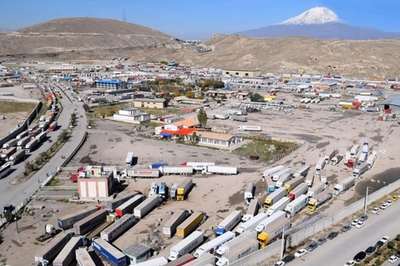
On July 7, the Islamic Republic of Iran Broadcasting (IRIB)—controlled by ultra-hardliners—aired a segment featuring residents of border towns in Ardabil Province, near the Azerbaijani frontier.
Locals claimed they had seen Israeli aircraft and drones enter Iranian airspace from Azerbaijan during the war.
The segment aired just hours after Pezeshkian appeared to downplay the allegations, in remarks seemingly aimed at de-escalation and alignment with Baku’s denials. Speaking in Gilan Province, the president said:
“Contrary to some rumors, the country’s security institutions have not confirmed any sign of military cooperation between neighboring countries and the Zionist regime.”
His comments echoed a June 26 phone call with Azerbaijani President Ilham Aliyev, in which, according to Iran’s foreign ministry, Aliyev assured Pezeshkian that using Azerbaijani territory against Iran was a “red line” that would not be crossed.
Yet the very need for such reassurances revealed Tehran’s underlying anxiety—rooted in precedent. In 2012, Iranian officials accused Israel of launching surveillance drones from Azerbaijani bases.
Hardliners seize on the report
The IRIB footage quickly gained traction on conservative media and Iranian social platforms.
Alef News republished the segment with the headline: “Clear Proof of Aliyev Regime’s Involvement in Iran-Israel War: Israeli Fighter Jets Entered Iran from Azerbaijan.”
“There’s no need for the interviews—radars recorded everything,” one widely liked comment read, implying the state was turning a blind eye. Another popular post criticized Pezeshkian’s warm greeting of Aliyev at last week’s ECO Summit in Baku.
Hardline outlets circulated clips of the president smiling and rising to greet Aliyev, accusing him of projecting weakness.
Farhikhtegan daily, tied to conservative factions, called his demeanor “undiplomatic” and “inappropriate.”
Scapegoat for military failures?
Even traditionally moderate conservative papers joined the backlash.
“Baku’s leaders must understand that no one in Iran will forgive a neighbor that betrays this nation,” Jomhouri Eslami warned on July 6. “They must prove they did not collaborate with the Zionist regime—or be prepared to face consequences.”
The paper also accused Azerbaijani media of launching a coordinated propaganda campaign against Iran during the conflict.
What many of Pezeshkian’s critics omit, however, is that the president has no command over the armed forces or intelligence services.
Responsibility for monitoring and responding to foreign threats rests with parallel institutions, making him an easy scapegoat for failures beyond his remit.
Baku has pushed back forcefully.
On July 1, Azerbaijan’s Milli Majlis Commission on Combating Foreign Interference condemned what it called a “deliberate disinformation campaign” by actors in Iran and abroad, aimed at inflaming anti-Azerbaijani sentiment on Persian-language social media.
Ties strained but intact
Despite the intensifying rhetoric, Tehran and Baku continue to preserve key ties. Cooperation persists on infrastructure and energy, including the Rasht-Astara railway and regional gas swap agreements.
Still, deep mistrust lingers—especially over the proposed Zangezur Corridor, which would link Azerbaijan to Nakhchivan through Armenian territory.
Baku views it as a vital trade route to Turkey and Central Asia, while Tehran fears it could undermine its regional leverage and sever its land access to Armenia.