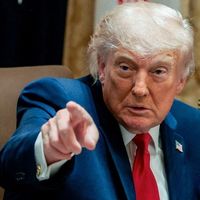
US President Donald Trump said he is not offering Iran “anything” and added that he is "not even talking" to the Iranian officials following US strikes on the country’s nuclear facilities.
“Tell phony Democrat Senator Chris Coons that I am not offering Iran ANYTHING, unlike Obama, who paid them $Billions under the stupid ‘road to a Nuclear Weapon JCPOA (which would now be expired!),’” Trump wrote Monday on Truth Social.
“Nor am I even talking to them since we totally OBLITERATED their Nuclear Facilities.”
The United States reached out through an Arab country to propose a ceasefire, Iran’s foreign ministry spokesperson said, but criticized US and Israeli conduct for undermining diplomatic efforts.
“The United States contacted Iran through an Arab country and proposed a ceasefire and a halt to aggressive actions,” Esmail Baqaei said in an interview with Russia Today.
“The actions of the United States and Israel destroyed diplomacy. It is their responsibility to work toward restoring the trust of the Iranian people,” he added.
Baqaei also criticized European countries' stance on the war between Iran and Israel, saying they “tried to justify the [Israeli] attack instead of condemning it.”
An aide to Iran’s Supreme Leader Ali Khamenei and former vice president under the late Ebrahim Raisi threatened Israel following the ceasefire, calling the country a “cancerous tumor.”
“[Israel] will soon be uprooted with the firm determination that exists among the Iranian people, the leadership, and the armed forces,” said Mohammad Mokhber.
Iran has demanded that the US halt further military strikes before diplomatic talks can restart, Deputy Foreign Minister Majid Takht-Ravanchi told the BBC on Sunday.
“Right now, we are seeking an answer to this question: Are we going to see a repetition of an act of aggression while we are engaging in dialogue?” he said.
The Trump administration is pursuing negotiations through intermediaries but must clarify its position on military attacks during talks, Takht-Ravanchi said.
When asked whether Iran’s uranium enrichment raised suspicions among other countries, he responded: “To say you should have zero enrichment, and if you do not agree, we will bomb you—that is the law of the jungle.”
US Special Envoy Steve Witkoff earlier said several channels of talks with Iran exist and that negotiations would happen soon.
Takht-Ravanchi replied that no dates have been set yet. “No date has been set for talks, and the Israel-Iran ceasefire remains fragile,” he added.
US President Donald Trump had previously set a 60-day deadline for Iran to reach an agreement. However, on day 61, Israel launched military strikes against three major nuclear sites in Isfahan, Natanz, and Fordow.
Following the Israeli campaign, Iran canceled planned talks with the US scheduled in Oman.
A member of Iran’s National Security Committee has accused the United States and Israel of establishing intelligence networks and cultivating infiltrators inside Iran over the past decade.
“The United States and Israel have established and nurtured intelligence networks and infiltrating elements inside Iran during nearly the past ten years,” said MP Abolfazl Zohrevand.
He also warned that the ceasefire with Israel could collapse at any moment.
The CIA director has told US lawmakers that American military strikes delivered a major blow to Iran’s nuclear program by destroying its only metal conversion facility, the Associated Press reported Sunday, citing a US official familiar with the classified briefing.
John Ratcliffe made the assessment during a closed-door hearing with members of Congress last week, calling the attack a “monumental setback” for Tehran’s nuclear capabilities that could take years to recover from, according to the unnamed official.
The revelation comes amid continued scrutiny from Democratic lawmakers over the scope and impact of the strikes carried out before last Tuesday’s ceasefire between Iran and Israel.
US intelligence believes the majority of Iran’s enriched uranium stockpile is now buried beneath the rubble of the Isfahan and Fordow sites—two of the three key nuclear facilities hit in the strikes, Ratcliffe told lawmakers.