Ali Shamkhani, a senior advisor to Supreme Leader Ali Khamenei, appeared in public on Saturday for the first time since being wounded in an Israeli strike earlier this month, Iranian media reported.
Photos showed Shamkhani attending the funeral of senior Iranian commanders killed in recent fighting with Israel. He had been targeted on the first night of Israeli attacks, and initial reports said he had been killed. State-linked outlets later said he was wounded but survived.

Iran should halt cooperation with the International Atomic Energy Agency in line with a new law approved by the Guardian Council, judiciary chief Gholamhossein Mohseni-Ejei said on Saturday.
Speaking to SNNTV at a funeral for those killed in recent attacks, Ejei said the IAEA had shared information with Iran’s enemies and could no longer be trusted. “When the agency cooperates with hostile powers and gives them information, it is natural that we cannot continue working with it as before,” he said.
The remarks follow Thursday’s announcement by the Guardian Council that it had approved a parliamentary bill requiring the government to suspend cooperation with the agency. The law now has full legal force.

Iran never surrendered to its enemies and instead forced them to submit to the will of the Iranian people, parliamentarian Ebrahim Azizi said on Saturday.
Azizi, who chairs the parliament’s National Security and Foreign Policy Commission, said the 12-day conflict proved once again that Iran’s strength lies in national unity and defiance. “This is an absolute, certain fact — we have never surrendered, but always made the enemy surrender to our will,” he said.
He added that despite the violence and casualties, the outcome showed that Iran’s adversaries were compelled to accept Iran’s decisions. “By God’s grace, the enemy will continue to yield to the will of the Iranian people,” he said.
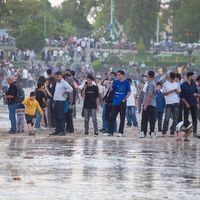
People attend the funeral of Iranian commanders and scientists killed in Israeli strikes, in Tehran, June 28, 2025.


Enemies of the Islamic Republic imposed a ceasefire out of fear, not through any agreement with Iran, retired Supreme Court adviser Ali Asghar Mojtahedzadeh said in remarks published Saturday.
Speaking to Rasa News, Mojtahedzadeh said Iran made no deal and did not seek peace, while the United States and Israel called for a halt to fighting after suffering heavy losses. He said Tehran’s official statements avoided any mention of a truce.
“The enemy attacked, was struck in return, and finally had to unilaterally announce a ceasefire,” he said.
“Iran is awake and armed,” said Mojtahedzadeh, the former head of the Special Clerical Court in Qom.
Iranian authorities have summoned and interrogated at least 35 Jewish citizens in Tehran and Shiraz over their contact with relatives in Israel, the US-based human rights group HRANA said on Friday.
The wave of interrogations began on Monday and marks one of the largest known crackdowns on Iran’s Jewish community since the early years of the Islamic Republic, HRANA said. Security agents told those summoned to avoid phone or online communication with family members abroad, according to a source close to the families.
The action comes amid rising tensions between Iran and Israel and appears to contradict the government’s claims that Iranian Jews enjoy equal rights. HRANA said the pressure has triggered serious fear within the community.
Iran criminalized travel to Israel in 2011, with penalties including prison and passport bans. Many Iranian Jews have relatives there due to decades of emigration.
The Tehran Jewish Committee declined to comment. But a senior figure in the community told HRANA the scope of the summonses is unprecedented and has caused deep concern about social and psychological safety.
Authorities have not explained the purpose of the interrogations. Some families were told the actions were preventive, not punitive, and tied to recent conflict. However, human rights lawyers argue that the measures could constitute religious and ethnic discrimination under international law, according to HRANA.