Persian Gulf leaders warned Trump against strikes on Iran - Axios
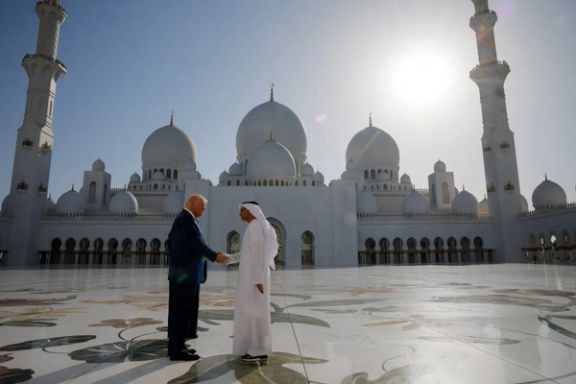
President Donald Trump shakes hands with Yousif Al Obaidli, director of Sheikh Zayed Grand Mosque, as he tours the mosque grounds in Abu Dhabi, United Arab Emirates, May 15.
Leaders from Saudi Arabia, the United Arab Emirates and Qatar privately urged US President Donald Trump to avoid military action against Iran’s nuclear facilities during his recent Middle East visit, Axios reported.
Citing fears of regional retaliation and instability, Saudi Crown Prince Mohammed bin Salman, UAE President Mohammed bin Zayed, and Qatari Emir Tamim Al Thani all expressed strong support for continued diplomatic efforts to resolve tensions with Tehran, sources familiar with the talks told Axios.
The leaders warned that any strike could provoke Iranian attacks on their countries, all of which host US military bases.
“They told Trump that Persian Gulf states would be hit first,” one source with direct knowledge said.
Iranian Foreign Minister Abbas Araghchi confirmed on Thursday that cleric Gholamreza Ghasemian, detained earlier this week in Saudi Arabia for criticising Riyadh, had been released following diplomatic intervention.
Ghasemian, a senior hardline religious figure, had posted a video from Medina during the Hajj pilgrimage accusing Saudi authorities of transforming Islam’s holiest cities into commercialized entertainment hubs.
“We continue our brotherly relations with Saudi Arabia and will not allow any disruption to affect them,” Araghchi said in a statement carried by IRNA.
He added that Tehran was in close coordination with Hajj officials to ensure the uninterrupted participation of Iranian pilgrims.
In the footage, recorded shortly before his arrest, Ghasemian said Mecca and Medina had become substitutes for casinos, brothels, and obscene concerts, alleging a Saudi-led erosion of Islamic values by the country which safeguards Islam's holiest sites.
Saudi authorities detained Ghasemian in Medina, but Iranian officials say he was freed without charges and returned to Iran via Dubai early Thursday.
Majid Rezapanah, head of consular affairs at Iran’s foreign ministry, said Saudi officials granted consular access twice during his detention.
“The matter was resolved through high-level engagement and reflects the seriousness of both sides in preserving recent diplomatic gains,” Rezapanah told state media.
Ghasemian, 52, is no stranger to controversy. He was previously linked by filmmaker Javad Mogouei to a fiery speech delivered ahead of the 2016 mob attack on Saudi diplomatic missions in Tehran and Mashhad.
The assault, triggered by the Saudi execution of prominent Shia cleric Nimr al-Nimr, led to Riyadh severing diplomatic ties with Iran until their resumption in 2023.
Since then, the two regional rivals have resumed direct flights, reopened embassies, and exchanged senior visits—including an April trip to Tehran by Saudi Defense Minister Prince Khalid bin Salman.
Iranian officials have sought to downplay the Ghasemian episode, emphasizing the broader stakes. “No one will approve of bad or offensive speech,” Iran’s ambassador to Riyadh, Alireza Enayati, posted in Arabic, aiming to reassure his Saudi hosts.
Ghasemian, now back on Iranian soil, thanked consular staff for securing his release in a post on X.
Iran will not back down from its position on preserving its nuclear enrichment cycle and peaceful nuclear knowledge, the country’s top security official said during a visit to Moscow, according to Iranian media.
“Iran will not retreat from its principles in maintaining the enrichment cycle and the peaceful use of nuclear knowledge,” said Ali Akbar Ahmadian, secretary of Iran’s Supreme National Security Council, during talks with Russian Security Council Secretary Sergei Shoigu.
Ahmadian said Tehran remains committed to resolving issues through dialogue but stressed its nuclear policy was non-negotiable.
An Iranian outlet close to the country’s Supreme National Security Council accused the United States on Thursday of using media tactics to pressure Tehran ahead of the next round of nuclear negotiations.
NourNews wrote on X that “media hype and early remarks by senior US officials” about the yet-to-be-finalized sixth round of talks are aimed at pressuring the Iranian negotiating team.
“The outcome will be decided at the table, after securing both sides' interests—not through media spin,” the post said.
The United States and Iran are nearing a broad agreement on the future of Tehran’s nuclear program, with talks progressing in recent weeks toward a framework that could be finalized at a planned meeting in the Middle East, CNN reported on Wednesday, citing multiple sources familiar with the discussions.
Negotiators have made headway on key issues, particularly uranium enrichment, which remains the central point of contention, according to the report.
Sources told CNN that one proposal under consideration would involve the creation of a multinational consortium—possibly including regional partners and the International Atomic Energy Agency—to produce nuclear fuel for Iran’s civilian reactors. The US may also contribute to Iran’s nuclear energy infrastructure as part of a broader agreement, though no final decisions have been made.
The ballistic missile issue is not part of the current negotiations, and sources said the US team, led by special envoy Steve Witkoff, is focused solely on the nuclear file to avoid complicating the process.
Austria’s domestic intelligence service believes Iran is actively pursuing a nuclear weapons program and expanding its missile capabilities, according to a report published by Fox News on Wednesday.
The Federal Office for the Protection of the Constitution, Austria’s equivalent of the FBI, said in a newly released report that Iran is seeking to rearm as part of a broader strategy to assert regional dominance and deter external threats.
The report describes Iran’s nuclear weapons development as “well advanced” and says Tehran now possesses a growing arsenal of ballistic missiles capable of carrying nuclear warheads over long distances.
Fox News, which reviewed the report, said it contradicts the current US intelligence assessment. In March, Director of National Intelligence Tulsi Gabbard told the Senate Intelligence Committee that the United States believes Iran is not building a nuclear weapon and that Supreme Leader Ali Khamenei has not revived the program suspended in 2003.
The Austrian agency’s report also highlights Iran’s efforts to evade international sanctions, provide weapons to proxy groups such as Hezbollah and Hamas, and use diplomatic cover in Vienna for intelligence activity. The Iranian embassy in Vienna is one of the largest that the Islamic Republic maintains in Europe.