Iran insists on uranium enrichment right, judiciary spokesman says
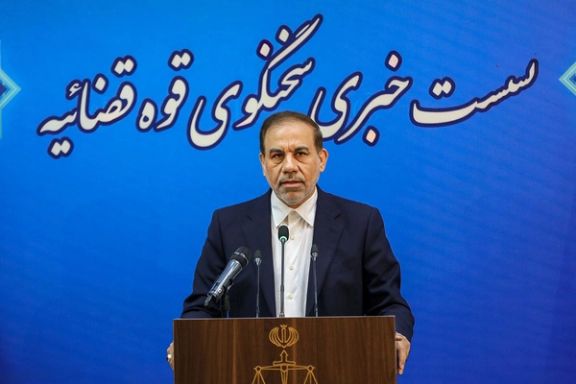
Iran remains firm on its right to enrich uranium and will not accept any foreign limits on the program, the country's judiciary spokesman said on Tuesday.
“Uranium enrichment is the Islamic Republic’s undeniable right,” spokesman Asghar Jahangir told reporters. “The Americans saying they won’t allow Iran to enrich uranium is a gross overstep.”
He added that Iran “acts in accordance with international law” and that “no one has the right to ignore this right.”
Jahangir also cautioned negotiators to avoid sending signals that could encourage adversaries. “We must act in a way that doesn’t tempt the enemy into miscalculation,” he said.
Iran is open to compromise in nuclear talks with the United States, but uranium enrichment remains non-negotiable, CNN reported citing an interview with foreign ministry spokesperson Esmail Baghaei on Monday.
“If the intention is to make sure that Iran’s nuclear program would not be weaponized, I think that’s something that we could simply do,” Baghaei said.
“If the (US) intention is to deprive Iranians of their right to peaceful nuclear energy, I think that would be very problematic to the extent that I think it would really challenge the whole process,” he added.
Asked how a compromise could be reached, he replied, “So many ways,” without elaborating.
Following Tehran and Washington's fifth round of nuclear talks, US President Donald Trump on Sunday said that “real progress” had been made in recent talks with Iran and suggested there could be “some good news” in the coming days.
However, in spite of the contentiousness of the issue, Baghaei suggested there is room for maneuver.
“The fact that so far we have continued our talks means that we understand there is a certain level of understanding that Iran cannot under any circumstances give up its right to peaceful nuclear energy,” he said.
Last week, Iran's Supreme Leader, Ali Khamenei, ruled out the option of ceasing enrichment.
"Saying things like 'we won’t allow Iran to enrich uranium' is way out of line. No one is waiting for anyone’s permission. The Islamic Republic has its own policy, its own approach, and it will continue to pursue it," he said, going as far as to say he felt it would be the issue to break the talks.
"Indirect negotiations took place (under Raisi) as well—just like now—but without results,” Khamenei said during a memorial ceremony for the late president and others killed in a helicopter crash last May.
“We do not think it would yield results now either. We do not know what will happen.”
Iran is increasingly blending hazardous petrochemicals into its gasoline supply to address a growing shortfall in domestic fuel production, risking environmental damage and endangering public health, according to confidential documents reviewed by Iran Open Data (IOD).
Among the additives is methyl tert-butyl ether (MTBE), a chemical known for its role in groundwater contamination and listed as a potential carcinogen.
Though banned or heavily restricted in numerous countries such as the US, MTBE is reportedly being used in substantial volumes—even in gasoline marketed under European emissions standards, such as Euro 4 and Euro 5.
Unacknowledged chemicals in ‘euro-standard’ fuel
The documents reviewed by IOD detail a system-wide reliance on off-site chemical additives to raise the octane rating of base gasoline. These include MTBE and aromatic octane boosters, which are not derived from conventional refining processes.
Iran’s Shazand refinery, the country’s largest producer of Euro-grade gasoline, blends approximately 350,000 liters of MTBE daily, while the Esfahan refinery adds 325,000 liters per day, according to the data. Both refineries label their fuel as Euro 4 or Euro 5 compliant.
The use of restricted additives contradicts environmental standards associated with the Euro classification, which are designed to reduce emissions and limit pollutants.
Production gap and fuel demand
Iran produced an average of 101 million liters of base gasoline per day in 2024, rising to 121 million liters per day after incorporating roughly 20 million liters of off-site additives. However, daily domestic demand stands at 123.5 million liters, leaving a shortfall of 2.5 million liters.
The shortfall, coupled with economic constraints and sanctions limiting imports and refinery upgrades, has prompted a quiet return to petrochemical-derived gasoline—first adopted during international sanctions in 2010.
Refining limitations and aging infrastructure
In spite of owning the world's second largest natural gas reserves, Iran’s refining infrastructure remains massively underdeveloped resulting from both sanctions and macroeconomic policies in Iran. No new refinery has been commissioned since 2017, and six of the ten major facilities predate the 1979 Islamic Revolution.
The Persian Gulf Star refinery, Iran’s largest by volume, produces 39 million liters/day, but none of its output qualifies for Euro-grade certification.
According to IOD, one-third of Iran’s gasoline is officially labeled Euro 4 or Euro 5, but internal documents indicate that even these fuels often contain high-risk chemical additives.
Health and environmental risks
MTBE is widely banned in Europe, the US, and other countries due to its high solubility in water and persistence in the environment. Even trace contamination of groundwater can lead to environmental damage and health risks for the population, making its use in consumer fuels controversial.
In 2014, a Tehran city health official warned that non-standard fuels could increase airborne benzene levels up to 35 times the safe limit.
A 2023 environmental review by Iranian authorities said that just 38% of gasoline met domestic quality standards. The IOD report suggests the problem has since worsened.
Iran maintains one of the world’s lowest gasoline prices—second only to Libya—due to heavy state subsidies, currency depreciation, and the impact of international sanctions.
Officials frequently cite low fuel prices as a driver of excessive consumption and cross-border smuggling, but attempts to increase prices have been shelved amid fears of social unrest.
The government has not publicly addressed the use of MTBE or other additives, and internal reports avoid naming specific chemicals, instead using general terms such as “aromatic octane boosters” or “off-site petrochemical inputs.”
Iran Open Data warns that Iran’s increasing dependence on petrochemical additives, without parallel investment in refining capacity, poses significant long-term risks to public health, environmental safety, and economic sustainability.
“The growing reliance on high-risk additives has become a cornerstone of fuel supply, in the absence of refinery upgrades,” the report said. “This strategy could carry severe health, environmental, and economic consequences.”
Officials from Iran’s Ministry of Petroleum and the Department of Environment did not immediately respond to requests for comment.
A senior Iranian cleric affiliated with the office of Supreme Leader Ali Khamenei was arrested in Saudi Arabia during the annual Hajj pilgrimage after publishing a video critical of the kingdom’s religious and cultural policies, Iranian state media reported on Monday.
Gholamreza Ghasemian, a conservative religious scholar and a former head of Iran’s parliamentary library and documentation center, was detained in the city of Medina while performing Hajj rituals, the reports said.
On Tuesday, Iran’s judiciary spokesman said the arrest of Gholamreza Ghasemian in Saudi Arabia was “unjustified and unlawful,” adding that the Foreign Ministry would follow up on the case.
Saudi authorities have not commented publicly on the matter.
In a video posted before his arrest, Ghasemian criticized Saudi Arabia, accusing it of transforming the Islamic holy cities of Mecca and Medina into destinations for entertainment and commercialization.
He also described conditions for pilgrims as highly restrictive, alleging that Saudi authorities prevent worshippers from engaging deeply with Islamic teachings during Hajj.
Cleric linked to 2016 Saudi embassy attack
Ghasemian has been linked by an Iranian documentary filmmaker to the 2016 attack on Saudi diplomatic missions in Iran, which triggered a major rupture in relations between Tehran and Riyadh.
According to the filmmaker, Javad Mogouei, Ghasemian gave a fiery speech at a religious gathering shortly before some attendees went on to storm the Saudi embassy in Tehran.
The assault on the embassy and the consulate in Mashhad came after Saudi Arabia’s execution of prominent Shia cleric Nimr al-Nimr. The incident led Riyadh to sever diplomatic ties, accusing Iran of failing to protect foreign missions. Iranian security forces were widely criticized for allowing demonstrators to set fire to the embassy and destroy diplomatic property.
Saudi and Iran continue to rebuild relations
The arrest comes at a time of cautious rapprochement between Tehran and Riyadh, who resumed diplomatic relations in 2023 after a seven-year break.
In April, Saudi Defense Minister Prince Khalid bin Salman made a rare visit to Tehran, marking only the second such trip since Iran’s 1979 revolution.
Ties have also improved in practical terms. Earlier this month, a direct flight by Saudi carrier Flynas landed in Iran for the first time in nearly a decade, marking the start of Hajj operations under a bilateral agreement that will see around 37,000 Iranian pilgrims flown to Saudi Arabia by July 1. Flynas and Iran Air are jointly operating the routes.
A judge was assassinated in a stabbing attack on Tuesday in Shiraz, the capital of Fars province in southwestern Iran, according to the local judiciary.
"This morning, two individuals attacked and assassinated Judge Ehsan Bagheri, head of Branch 102 of Shiraz Criminal Court 2, on his way to work. Unfortunately, he was martyred in this terrorist act," local judiciary chief Sadrollah Rajaei told Iran’s official IRNA news agency.
"This assassination was carried out with a cold weapon," he added.
Iran’s judiciary chief Mohseni Ejei condemned the assassination, calling it "cowardly," according to a statement published on Mizan.
The statement said that Ejei also ordered an urgent investigation into the incident and called for the perpetrators to be identified and prosecuted swiftly.
No details about the motive behind the assassination or the identities of the attackers have been released by Iranian authorities.
IRNA’s report said that Bagheri was 38 years old and had 12 years of judicial experience.
Iran's judiciary-affiliated news agency Mizan said that before becoming a criminal court judge, Bagheri spent over a decade at the Public and Revolutionary Prosecutor’s Office. The Revolutionary Court system in Iran, where he served, is responsible for handling cases related to national security, political and ideological offenses.
Earlier this year, two Revolutionary Court judges, Mohammad Moghiseh and Ali Razini, were assassinated in Tehran on January 18. Both had decades-long records of issuing death sentences and lengthy prison terms to dissidents in numerous cases.
The source said Asadi originally intended to also target former Revolutionary Court judge Mahmoud Toliyat but changed his mind for unknown reasons before fatally shooting himself.
Authorities have arrested several striking truck drivers in the southern city of Shiraz, according to the provincial prosecutor, as a nationwide truckers’ strike entered its fifth day on Monday.
“Those who have blocked the movement of freight trucks have been identified and arrested under the supervision of security and law enforcement agencies,” Kamran Mirhaji, the prosecutor of Fars province said on Monday.
“Those who obstruct the delivery of goods and cargo by trucks will be dealt with seriously according to the law,” he said, according to Iran's semi-official Mehr news.
Launched on May 22 in the southern port city of Bandar Abbas, the coordinated protest has since spread widely across the country, with truckers pledging to hold out for a full week or longer if their demands remain unmet.
Drivers are demanding better working conditions, higher freight rates, and relief from high insurance costs and fuel restrictions.
The arrests come as videos obtained by Iran International on Monday show the strike entering its fifth day and continuing across multiple regions of the country, including Fars province, where the detentions took place.
A citizen who sent a video to Iran International on Monday described the Shiraz–Marvdasht road in southern Iran as completely deserted, saying, “There is not a single truck in sight.” The road connects Shiraz, a major commercial hub, to Marvdasht in Fars province and is normally a busy route for freight transport.
Other footage shows heavy vehicle drivers refusing to transport goods in cities such as Shahrud in north-central Iran, Torbat-e Jam in the northeast, and Meybod in central Iran.
In a statement on Monday, Reza Akbari, head of Iran’s Road Maintenance and Transportation Organization, downplayed the scope of the strike and blamed the unrest on foreign interference. “A limited number of drivers are trying to create unrest, and these actions are the result of incitement by hostile foreign media that seek to portray the country’s roads as unsafe,” he said.
Akbari said independent Persian-language media based abroad were inflating the scale of the protests and that some domestic outlets were inadvertently amplifying what he described as false narratives. He added that “truck drivers have been very cooperative in efforts to resolve the existing issues.”