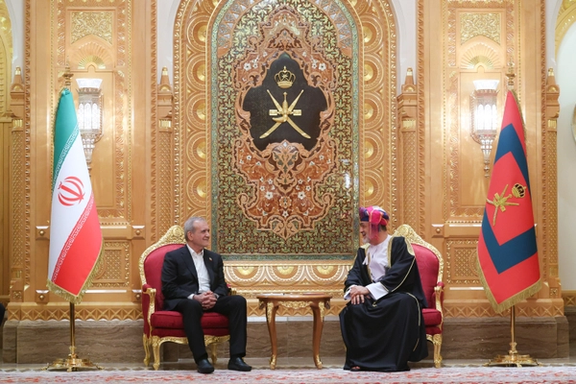
Iran's President Masoud Pezeshkian, in a meeting with Oman's Sultan Haitham in Muscat, praised the Sultanate's "active and constructive role" in Iran-US talks.
"We appreciate the valuable efforts of the friendly and brotherly country of Oman in mediating the negotiations, and we hope this process will lead to positive outcomes," Pezeshkian said.
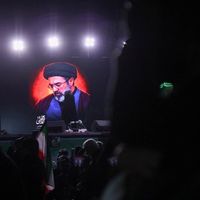
Mossad chief David Barnea and Israeli minister of strategic affairs Ron Dermer are visiting Washington DC to meet American officials for talks on Iran, Axios reported citing an American source.
Dermer is expected to meet White House Special Envoy for the Middle East and chief negotiator in Iran talks Steve Witkoff.
Barnea has also met CIA Director John Ratcliffe and other senior officials for talks on Iran, the report added.
Iranian President Masoud Pezeshkian and Foreign Minister Abbas Araghchi arrived in Muscat on Tuesday for a two-day official visit to Oman, as indirect diplomacy between Tehran and Washington over Iran’s nuclear program continues.
The Iranian delegation was received by Omani Deputy Prime Minister Shihab bin Tariq al-Said and Foreign Minister Badr al-Busaidi, Iranian state media reported.
Tehran and Muscat have expanded economic ties in recent years, with Pezeshkian noting before his departure that bilateral trade had reached nearly $2.3 billion and was “increasing day by day.”
Foreign Ministry spokesman Esmail Baghaei said earlier on Tuesday that the visit had been scheduled in advance and follows Sultan Haitham’s trip to Tehran. He confirmed that regional issues — including nuclear negotiations with the United States — would be discussed.
“This visit is part of normal diplomatic exchanges,” Baghaei said. “Naturally, developments related to Iran-US talks may come up during meetings, but there is no planned negotiation with the American side on the sidelines.”
An Iranian lawmaker said on Tuesday that the United States relies more on Iran’s internal dysfunction than its own strength to pressure the country, blaming government mismanagement for many of the nation’s problems.
“The United States has placed more faith in our mismanagement, inaction, and lack of accountability than in its own power,” said Salman Es’haghi, a member of parliament from Qaenat, during a speech in a public session.
He said the suffering of ordinary Iranians stems less from foreign sanctions and more from poor decision-making at home. “The pain of the people is not US hostility or sanctions — it’s the failure of our own officials to act responsibly,” he said.
A senior Iranian cleric said on Tuesday that missile production and nuclear technology remain non-negotiable issues for Tehran in any indirect talks with the United States.
“Missile production in Iran’s missile cities and our nuclear technology are red lines,” said Ahmad Khatami, Tehran’s interim Friday prayer Imam, according to local media.
Khatami also accused what he called Western-backed media of spreading disinformation aimed at dividing Muslims. “These hostile media outlets, supported by America and the West, are trying to disturb public opinion through fake news in cyberspace,” he said.

Iran is open to compromise in nuclear talks with the United States, but uranium enrichment remains non-negotiable, CNN reported citing an interview with foreign ministry spokesperson Esmail Baghaei on Monday.
“If the intention is to make sure that Iran’s nuclear program would not be weaponized, I think that’s something that we could simply do,” Baghaei said.
Read more here.