Iran accused the United States of undermining talks through sanctions and contradictory messaging.
“The other side cannot speak of diplomacy while continuing to use the language of threats and pressure,” the foreign ministry said in statement on Tuesday.
It described new US sanctions as “completely inconsistent with the negotiation process” and said “such actions increase mistrust.”
Tehran added that it had entered talks “with seriousness and the aim of reaching a result” and would not shift its stance arbitrarily.
While the outcome of negotiations is uncertain, the ministry said Iran’s position remains stable and called on Washington to avoid issuing conflicting statements.
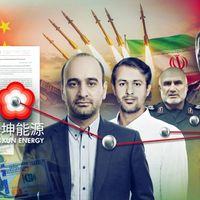
The United States on Tuesday introduced fresh sanctions against a shipping network it says has sent millions of barrels of Iranian oil to China, the State Department announced.
The network facilitated "the shipment of millions of barrels of Iranian crude oil worth billions of dollars to China on behalf of Iran’s Armed Forces General Staff (AFGS) and its front company, Sepehr Energy Jahan Nama Pars (Sepehr Energy)," the State Department's statement said.
Donald Trump gestures as he speaks during a rally, in Conroe, Texas, US, January 29, 2022.
The fourth round of indirect negotiations between Tehran and Washington ended without a breakthrough but preserved a fragile diplomatic opening on the eve of President Donald Trump’s visit to Iran’s Arab neighbors.
Before traveling to Saudi Arabia on May 12, Trump reaffirmed his opposition to Iran acquiring nuclear weapons, while praising Iranian negotiators for being, in his words, very reasonable and very intelligent.
Despite pillorying Tehran at length in a speech in Saudi Arabia the next day, the comments suggested an openness to continued dialogue—even amid mounting pressure from within his own ranks.
Trump’s position reflects a carrot-and-stick strategy: applying sanctions while keeping the door open for a potential deal. Yet, internal divisions are growing.
Middle East envoy and chief negotiator Steven Witkoff told Breitbart last week that no level of uranium enrichment should take place in Iran—opposing the allowances made under the 2015 Joint Comprehensive Plan of Action (JCPOA).
Witkoff’s remarks echo those of hawkish Republicans who reject even limited enrichment under international monitoring. Witkoff once again aligned himself with that position, signaling that any new deal could be more restrictive than the 2015 deal.
In the same interview, however, Witkoff distanced himself from advocates of military action, accusing them of a “bias toward war.” He emphasized that Trump prioritizes diplomacy, arguing that critics underestimate the risks of armed confrontation.
The messaging—hardline on enrichment, moderate on military force—underscores the absence of a unified Republican policy.
Trump himself has sent conflicting signals. In an interview with Hugh Hewitt on 7 May, he reaffirmed his desire to end Iran’s uranium enrichment but also indicated a willingness to hear justification for maintaining some nuclear infrastructure.
Elusive positions
A week—and one more round of talks—later, we are none the wiser about the Trump administration’s red lines.
US vice president J.D. Vance has taken a more flexible position, suggesting a tightly monitored, limited centrifuge program could be acceptable. His stance diverges from that of US secretary of state Marco Rubio and Witkoff’s latest, betraying disagreement at the very top.
In Tehran, the message has been more consistent—in public at least. The right to enrich uranium is non-negotiable, foreign minister Abbas Araghchi posted on X on the eve of the fourth round of talks.
Enrichment, in reality, is what gives supreme leader Ali Khamenei the leverage he has always sought to face his western ‘enemies.’
Khamenei’s strategy, as far as can be surmised from his decisions in the last two decades, is to remain close to the nuclear threshold without crossing it, standing on the brink without falling into the abyss of war.
Despite this impasse, both sides agreed to extend the negotiations, signaling a desire to avoid blame for their collapse. Still, the fundamental disagreement over enrichment remains unresolved.
Witkoff has also called for the talks to address Iran’s regional conduct, particularly its support for armed groups like Hezbollah and the Houthis. He argues any deal should reduce the Islamic Republic’s hostile actions against the US and Israel.
These positions are yet to be formalized, but the rulers in Tehran appear to have used whatever influence they have with the Houthis to calm the Red Sea and ease pressure on Iran’s negotiators.
But the link between nuclear diplomacy and regional security remains tenuous.
Fraught issue
Historically, the US strategy on Iran’s nuclear program has fluctuated. The Bush administration failed to enforce a zero-enrichment model; the Obama administration accepted a 3.67% cap to delay Iran’s breakout capacity. Trump’s second-term ambitions appear to aim higher—but face the same practical limits.
UN nuclear chief Rafael Grossi asserted recently that completely eliminating Iran’s program may no longer be achievable.
Also significant is public opinion in the US. In a recent poll by the University of Maryland, more than two-thirds of respondents said they preferred a negotiated deal to curb Iran’s nuclear activities, with only 14% backing military action.
On this point at least, and for now, President Trump appears to be reflecting the popular will, letting diplomacy run its course while pursuing his maximum pressure campaign of sanctions, hoping to force Iranians to blink first.
Unclear to nearly all watching the talks—and perhaps even to those involved in it—is how far and how long he is willing to go without visible results.
US President Donald Trump gestures following a Memorandum of Understanding (MOU) signing ceremony at the Royal Court in Riyadh, Saudi Arabia, May 13, 2025
Speaking before Crown Prince Mohammed bin Salman and other top Saudi and US officials, President Donald Trump spent much of a lengthy speech on Tuesday criticizing Iran while urging a deal over its disputed nuclear program.
Tehran as obstacle to regional peace
"The only thing still standing between this region and its unbelievable potential was a small group of rogue actors and violent thugs seeking constantly to drag the Middle East backward and into havoc, mayhem and indeed, into war. Unfortunately, instead of confronting these destructive forces, the last US administration chose to enrich them and empower them and give them billions and billions of dollars.
"Our task is to unify against the few agents of chaos and terror that are left and that are holding hostage the dreams of millions and millions of great people.
"The biggest and most destructive of these forces is the regime in Iran, which has caused unthinkable suffering in Syria, Lebanon, Gaza, Iraq, Yemen and beyond. There could be no sharper contrast with the path you have pursued on the Arabian Peninsula than the disaster unfolding right across in the Gulf in Iran."
A Persian Gulf of contrasts
"While you have been constructing the world's tallest skyscrapers in Jeddah and Dubai, Tehran's 1979 landmarks are collapsing into rubble and they had it going for a little while under a much different system but those buildings are largely falling apart.
"Iran's decades of neglect and mismanagement have left the country plagued by rolling blackouts lasting for hours a day ... While your skill has turned dry deserts into fertile farmland, Iran's leaders have managed to turn green farmland into dry deserts as their corrupt water mafia ... causes droughts and empty river beds. They get rich."
Syria and Lebanon
"Countless lives were lost in the Iranian effort to maintain a crumbling regime in Syria. Look at what happened with Syria and Lebanon, their Hezbollah proxies have pillaged the hopes of a nation whose capital Beirut was once called the Paris of the Middle East.
"Can you imagine all of this misery and so much more was entirely avoidable?
"If only the Iranian regime had focused on building their nation up instead of tearing the region down.
"In Syria, which has seen so much misery and death, there is a new government that will hopefully succeed in stabilizing the country and keeping peace. That's what we want to see in Syria, they've had their share of travesty, war killing many years.
"I will be ordering the cessation of sanctions against Syria in order to give them a chance."
Enmity or peace with Iran
"In the case of Iran, I have never believed in having permanent enemies. I am different than a lot of people think. I don't like permanent enemies ... I want to make a deal with Iran.
"But if Iran's leadership rejects this olive branch and continues to attack their neighbors, then we will have no choice but to inflict massive maximum pressure drive Iranian oil exports to zero like I did before."
"(The US will) take all action required to stop the regime from ever having a nuclear weapon."
Speaking in a Riyadh conventional hall crowded with top Saudi and US officials including Crown Prince Mohammed bin Salman, US President Donald Trump again vowed to deny Iran a nuclear bomb.
In the lengthy address, Trump excoriated Iran at length, accusing it of spreading militancy and war throughout the region and demanding it swiftly choose whether to accept a new nuclear deal.
"Our task is to unify against the few agents of chaos and terror that are left and that are holding hostage the dreams of millions and millions of great people," Trump said.
"The biggest and most destructive of these forces is the regime in Iran, which has caused unthinkable suffering in Syria, Lebanon, Gaza, Iraq, Yemen and beyond. There could be no sharper contrast with the path you have pursued on the Arabian Peninsula than the disaster unfolding right across in the Gulf in Iran."
Trump insisted he sought to end wars and unify enemies but that time was limited for Iran to accede to US demands on reaching a nuclear deal as talks completed a fourth round over the weekend.
"In the case of Iran, I have never believed in having permanent enemies. I am different than a lot of people think. I don't like permanent enemies ... I want to make a deal with Iran.
"But if Iran's leadership rejects this olive branch and continues to attack their neighbors, then we will have no choice but to inflict massive maximum pressure drive Iranian oil exports to zero like I did before," Trump added, stopping short of explicitly mentioning an attack on Iran as he has previously.
"(The US will) take all action required to stop the regime from ever having a nuclear weapon."
The United States on Tuesday introduced fresh sanctions against a shipping network it says has sent millions of barrels of Iranian oil to China, the State Department announced.
The network facilitated "the shipment of millions of barrels of Iranian crude oil worth billions of dollars to China on behalf of Iran’s Armed Forces General Staff (AFGS) and its front company, Sepehr Energy Jahan Nama Pars (Sepehr Energy)," the State Department's statement said.
The sanctions were imposed one day after Iran International reported that Sepehr Energy company worked on behalf of the Iranian military and spawned a network of shell companies to sell sanctioned Iranian oil to Asia and did business with a Netherlands-based firm that was aware of its government ties.
Business documents and emails obtained by Iran International revealed a layered network of shell companies used to mask the military links and channel the sanctioned oil through foreign intermediaries.
As Iran grapples with a worsening electricity crisis, the government has resolved to prioritize power supply to industries, sacrificing residential comfort and daily public services in a bid to avert economic collapse.
“There will be no such thing as production if we cut off the supply of gas in winter and electricity in summer to industries,” government spokeswoman Fatemeh Mohajerani said on Monday, justifying the decision to shield factories and major production centers from the worst of the power cuts.
“So instead of imposing power cuts solely on industries, we have directed some of it to domestic consumption.”
Iran is currently facing a peak-hour electricity deficit of around 20,000 megawatts. With the summer heat intensifying and water levels in hydropower dams at historic lows due to years of drought, power outages—both scheduled and unexpected—have become routine.
The government of President Masoud Pezeshkian blames inherited problems for the shortage. In parliamentary hearings for his cabinet approval in August last year, energy policy dominated the debate.
Lawmakers voiced concern at the time that the growing electricity gap could bring more severe blackouts and industrial shutdowns than before.
Economic survival over public comfort
The move to protect industry over residential demand is a calculated risk. Iran's manufacturing sector, already battered by sanctions, inflation, and a volatile exchange rate, is considered too critical to fail.
If industries grind to a halt, Iran risks deeper economic stagnation. But if public resentment continues to grow amid daily blackouts, the political costs could be just as severe.
Many industries, including cement plants and steel factories, which require uninterrupted energy for their kilns and machinery, are particularly vulnerable to power cuts.
The total annual loss from power cuts to the steel industry last year, according to the head of the Isfahan Chamber of Commerce, Amir Kashani, was estimated at around $4 billion.
Power cuts affecting daily lives
Widespread dissatisfaction is mounting, as daily life for millions is disrupted by blackouts as the daily power cuts are more than an inconvenience—they are a source of hardship, danger, and economic loss in the lives of millions of ordinary Iranians.
Social media is filled with videos and reports of people trapped in elevators, traffic lights failing and causing massive jams, and water not reaching upper floors of apartment buildings due to non-functional pumps.
Mobile phone signals have also been affected, as network operators are forced to shut down towers to prevent equipment damage when backup batteries run out.
Many small businesses, including bakeries, restaurants and cafes and grocery stores, report spoilage of perishable goods, compounding their financial strain.
Adding to the frustration, the government has shifted working hours for state offices to 6:00 AM in an effort to avoid peak hours, a move that has caused widespread disruption for employees and service recipients alike.
On Monday, authorities announced that school hours would also be adjusted to follow this new schedule.
A long-term crisis years in the making
Experts argue that Iran’s electricity shortage is not a sudden development but the result of decades of mismanagement and underinvestment.
Despite having the world’s second-largest reserves of natural gas, Iran has failed to expand its generation capacity or modernize its energy infrastructure.
“This crisis did not arise overnight, nor can it be solved in the short term,” Mehdi Masaeli, secretary of the Electricity Industry Syndicate, recently told Zaman-e Eghtesad, warning that officials should not downplay the severity of the situation.
Resolving the crisis would take at least three years, he said, citing the need for significant financial investment, equipment procurement, and coordinated management.
Earlier this week, Energy Minister Abbas Aliabadi said illegal use of miners has expanded and is responsible for around 1,000 megawatts of energy consumption.