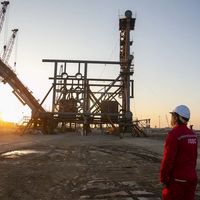
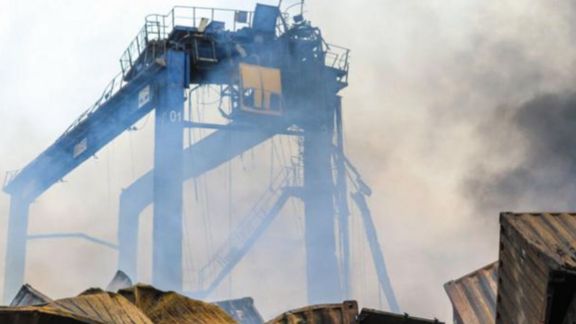
About 90 percent of the fire at Iran’s Rajaei Port has been extinguished, Bandar Abbas mayor Mehdi Noubani told ISNA news outlet.
“Port operations are ongoing and damages are still being assessed,” he added.


Iran said it foiled a major cyberattack targeting its infrastructure on Sunday in the midst of blazing fires following the explosion which rocked its key container port in Bandar Abbas.
"One of the most widespread and complex cyber attacks against the country's infrastructure was identified and preventive measures were taken," IRGC-affiliated Tasnim News quoted Behzad Akbari, CEO of Iran’s Telecommunications Infrastructure Company and Deputy ICT Minister as saying on Monday.
Akbari did not provide further details on the origins of the hack.
Only in September, Iran's Cybersecurity Strategic Management Center announced a state of cyber-readiness, issuing a red alert for financial, monetary, and communication sectors, and an orange alert for other sectors, according to Iranian media reports.
"Organizations are advised to maintain round-the-clock availability of technical teams and rapid response units due to the potential for cyber attacks," it said.
In the past Iran has blamed Israel for cyber attacks. A cyberattack that 70% of Iran's petrol stations in December 2023 was claimed by Gonjeshk-e-Darande or Predatory Sparrow, a hacking group that Iran has previously accused of having links to Israel.
In October 2021, Iran experienced a cyberattack that disrupted its fuel distribution system, affecting approximately 4,300 gas stations. Gholamreza Jalali, head of Iran’s civil defense organization, attributed the attack to foreign actors, specifically accusing the United States and Israel.
The cyberattack came just one day after Tehran and Washington concluded a third round of nuclear talks on Saturday in Oman.
Meanwhile, emergency services were fighting the fallout of a deadly explosion in Iran’s Rajaei Port in Bandar Abbas, with authorities yet to disclose the cause.
Emergency support was sent from Tehran's allies in Moscow to fight the disaster which saw at least 40 killed and hundreds more injured, according to Iran's official figures.
However, one worker at the port contacted Iran International saying that at least 23 women were killed in their office alone.
Iran’s foreign minister accused Israeli Prime Minister Benjamin Netanyahu of trying to dictate both Iranian and US policy, warning that any military action against Iran would be immediately reciprocated.
Iranian Foreign Minister Abbas Araghchi criticized Netanyahu in a post on X, saying Israel’s belief that it can control Iran’s actions was detached from reality. “Israel’s fantasy that it can dictate what Iran may or may not do is so detached from reality that it hardly merits a response.”
Araghchi wrote, "What is striking, however, is how brazenly Netanyahu is now dictating what President Trump can and cannot do in his diplomacy with Iran."
The top diplomat also took aim at US officials from President Joe Biden’s administration, describing them as "Netanyahu’s allies" and accusing them of falsely portraying current negotiations as a revival of the 2015 nuclear deal, formally known as the Joint Comprehensive Plan of Action (JCPOA).
"Iran is strong and confident enough in its capabilities to thwart any attempt by malicious external actors to sabotage its foreign policy," Araghchi said, adding that a large segment of the Iranian public no longer views the JCPOA as sufficient and is seeking tangible dividends.
"There is no military option, and certainly no military solution. Any strike will be immediately reciprocated," he warned.

Ali Shamkhani, an advisor to Iran's Supreme Leader, has warned Israel of "unimaginable consequences" following remarks by Israeli prime minister regarding the destruction of Iran's nuclear capabilities.
In a post on the social media platform X, Shamkhani questioned whether Netanyahu's threats stemmed from an independent decision by Israel or were coordinated with the US President Donal Trump.
On Sunday, Benjamin Netanyahu had repeated calls for Iran's entire nuclear infrastructure to be dismantled in a scenario akin to the 2003 agreement that Libya made with the West that saw it give up its nuclear, chemical, biological and missile programs.
Netanyahu said that he had told Trump that any nuclear agreement reached with Iran should also prevent Tehran from developing ballistic missile. "We are in close contact with the United States. But I said, one way or the other, Iran will not have nuclear weapons."
Shamkhani responded, "The consequences of this action for Israel are beyond imagination, but the question is: are these threats the result of Israel's direct decision, or are they coordinated with the immediate past US administration and aimed at advancing negotiations with it?"
An Iranian lawmaker called for clear accountability over failures linked to the explosions at Rajaei port.
Ahmad Fatemi, a member of parliament’s Social Committee, urged "oversight bodies and the judiciary" to investigate the incident, Iran’s state media reported.
"Failures to act must be fully identified and condemned. In places where flammable chemical materials are present, all safety protocols must be strictly observed. Of course, we will not judge prematurely," Fatemi said.
Possible failures, including in civil defense measures, are under investigation following a major explosion at Rajaei port, said Iran’s Interior Minister on Monday.
"Those found responsible at any level will be dealt with," Eskandar Momeni told Iran’s state television.
Momeni added that investigators are examining potential safety violations and incorrect declarations of flammable materials.