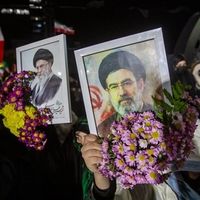
Iranian Nobel Peace Prize laureate and human rights advocate Narges Mohammadi blamed the Islamic Republic for the tragedy in Bandar Abbas, calling it the "root of all disasters."
"We are mourning not only the lives lost, but also the hardship of living under a despotic, inefficient, and unaccountable regime. The Islamic Republic, concerned only with its own survival, has no regard for its people. It bears no responsibility for the suffering it causes," she said in a post on her Instagram page.
"We are living amid tragedies. The greatest tragedy — the root of all disasters — is the regime itself: a regime that shirks responsibility."
Mohammadi called the Islamic Republic "a regime concerned solely with its own survival, where the people have no place."
"It is we, the people of Iran, who must find a way to overcome this situation. With hope, solidarity, and determination, we will bring this painful chapter to an end."
The type of fire and smoke confirms that the explosive material was a derivative of sodium, and that a container is by no means a suitable vessel for storing sodium perchlorate, as the heat inside a container cannot be controlled, Farzin Nadimi, a senior defense and security analyst at the Washington Institute, told Iran International.
He said it did not appear that the containers were refrigerated, and the rise in temperature could have been one of the factors triggering the reaction and fire.
“If someone wanted to cause such a reaction leading to a fire, it would be very easy to set off an explosion in such a shipment. It did not seem that there were any serious security measures in place beyond surveillance cameras," Nadimi said regarding the possibility of an act of sabotage.
According to the analyst, either a person or an aerial device could have been responsible.
Nadimi added: “In the video, we did not see anything hitting the container from the sky, but on the ground, a very small and simple explosive device could have triggered the initial fire.”
A senior Iranian lawmaker said on Sunday that the explosion at the southern port city of Bandar Abbas, which he blamed on Israel, would not impact ongoing talks with the US.
Mohammad Seraj, a member of Iran’s parliament representing Tehran, said that the blasts, which struck multiple containers simultaneously, showed clear signs of sabotage orchestrated by Israeli forces.
"This incident will have no effect on the course of negotiations," Seraj said."The Zionists (Israel) are attempting to disrupt Iran’s international relations, but the Iranian people are too wise to be deceived by such conspiracies."
Seraj dismissed the possibility of a natural fire, arguing that chemical materials typically ignite at a single point and would not cause simultaneous explosions at multiple locations.
Iran has not formally accused Israel at the state level, and the investigation into the cause of the explosions is ongoing.

Resolving the wide-ranging disputes between the United States and Iran will require days of intensive negotiations, political analyst and journalist Omid Memarian told Iran International on Sunday.
Memarian said Iran seeks the full removal of US oil and banking sanctions, but Washington has conditioned any lifting of sanctions on Tehran’s cooperation with the International Atomic Energy Agency (IAEA) — a demand the Islamic Republic has so far resisted.
"Verification and access by the IAEA to Iran’s nuclear activities remain major points of contention," Memariansaid, adding that while US officials are pressing for more comprehensive inspections, Iranian authorities continue to impose restrictions on the agency's monitoring efforts.
An Iranian parliamentarian accused Israel of orchestrating the deadly explosion at Bandar Abbas’s Rajaei port, according to remarks published Sunday by Rokna News.
Mohammad Seraj, a Tehran MP, said that explosives were pre-planted in containers and detonated remotely, possibly via satellite or timer.
"This event was not accidental," Seraj added. He dismissed natural fire as a cause and linked the incident to broader Israeli efforts to disrupt Iran’s international relations.
Seraj compared the attack to the Beirut port explosion but said damage was contained due to better management. No independent evidence has been presented supporting his comments.

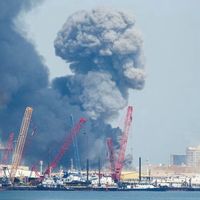
Iran's Ministry of Defense said on Sunday that no military-related cargo was present at the Shahid Rajaei Port in Bandar Abbas, where a deadly explosion occurred over the weekend.
Defense Ministry spokesperson Brigadier General Reza Talaei-Nik told state media, "There were no imported or exported shipments related to military use or rocket fuel at the site of the incident," dismissing foreign media reports as psychological operations.
“Investigations and evidence confirm that no imported or exported cargo for fuel or military applications was present within the fire-stricken area or Shahid Rajaei port. Certain foreign media outlets are engaging in targeted sensationalism aligned with enemy psychological operations,” he said.
The remarks come following reports that the massive blast -- which killed at least 28 people and injured more than 1,000 -- was linked to the storage of sodium perchlorate, a chemical used in the production of solid rocket fuel.
While the exact cause remains undetermined, a source close to Iran’s Islamic Revolutionary Guard Corps told the New York Times that sodium perchlorate -- a precursor chemical used to make ammonium perchlorate, an important component in solid rocket fuel -- was the likely cause of the explosion.
Investigations into the cause of the blast are ongoing, Iranian officials said, adding that the Ministry of Interior and disaster management authorities are leading the probe. Authorities pledged to publicly disclose findings once the investigation concludes.
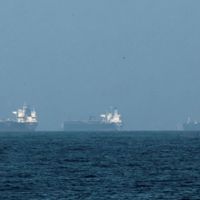
Earlier this year, shipping data tracked by The Maritime Executive indicated that two vessels owned by the US-sanctioned Islamic Republic of Iran Shipping Lines (IRISL) — the MV Golbon and MV Jairan — transported sodium perchlorate from China to Bandar Abbas in February and March.
The chemical is later processed at facilities such as Parchin and Khojir in Iran’s solid-fueled ballistic missile programs.
It remains unclear whether the containers from the shipments were still stored at the Sina container terminal at the time of the blast or if they played a role in the explosion.