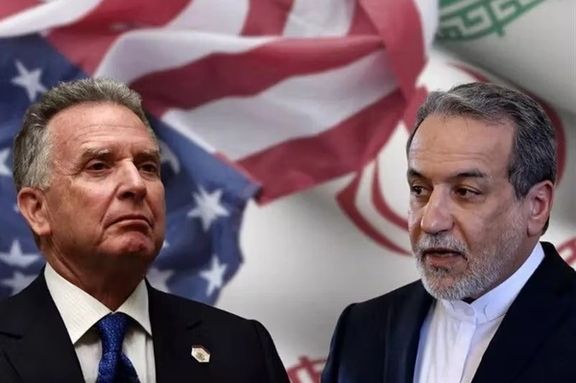
The United States faces a formidable adversary in talks with Islamic Republic, a former top US intelligence official told Iran International, and Tehran's aim could be to buy time for its nuclear program.
Norman Roule, a veteran of the Central Intelligence Agency for over 30 years who once oversaw its Iran desk, said Tehran's veteran negotiators could drag out the talks to their advantage while enriching uranium toward levels needed to build a bomb.
“Every day talks drag on, Iran moves closer to the threshold,” he said. “And if it calculates that it gains more from staying on the edge of weaponization than actually building a bomb, it will continue to play this game.”
Tehran has proven adept, Roule said, at “negotiating the negotiation”, or what he described as using drawn-out diplomacy to defuse military threats and reduce sanctions while continuing nuclear development.
As the United States prepares to resume nuclear talks with Iran this weekend, Iran’s leadership would appear to be on the backfoot amid uncertainty over its political succession, economic malaise, regional setbacks and rising international suspicion of its nuclear ambitions.
Iran has historically used negotiations as a pressure valve, Roule said, entering talks only when the threat of military confrontation peaks, with previous talks in 2003, 2012, and 2015 coinciding with an escalated US military presence or regional turmoil.
But this time is different, he argued.
Norman Roule pictured during an interview with Marzia Hussaini at Iran International's office in Washington DC
“This regime is weaker, more isolated, and increasingly unpopular. If Iran keeps using its nuclear program as a shield to avoid pressure on its oppression, terrorism, and hostage-taking, the international community must call its bluff.”
According to Roule, the Trump administration is entering the talks with a clear objective: a permanent end to Iran’s capacity to build a nuclear weapon, without repeating the perceived flaws of the 2015 Joint Comprehensive Plan of Action (JCPOA).
“The 2015 agreement placed temporary and reversible limits on Iran’s nuclear program but gave Tehran permanent sanctions relief,” Roule said. “The result was that Iran used that economic relief to finance terrorism and militias across the region.”
Now, Washington may seek to allow Iran a more limited civilian nuclear capability while barring any path to weaponization and denying access to funds that could revitalize Iran’s destabilizing regional network.
Historic Strain
The talks with Trump are proceeding as Tehran is at is weakest strategic moment since emerging from the punishing Iran-Iraq War in 1988, Roule argued.
Politically, the sudden death of President Ebrahim Raisi in a 2024 helicopter crash removed the only viable successor to Supreme Leader Ayatollah Khamenei who shared the veteran leader's ideological alignment and political credentials.
Presidential elections last year saw historically low turnout, signaling popular resignation, and the recent ouster of the Vice President and the Finance Minister pointed to factional infighting.
On the economic front, inflation and the proportion of Iranians living below the poverty line both stand at around 30% while blackouts routinely plunge residents and businesses into the dark.
“This is an economic catastrophe,” he said. “Iran's people are paying the price for decades of mismanagement and isolation.”
Militarily, an Oct. 26 Israeli attack likely knocked out much of Iran's air defenses, capping months of harsh Israeli blows on Tehran's allies Hamas and Hezbollah.
“The ring of fire Iran built around Israel is now broken,” Roule said. “The Quds Force remains, but it is bruised and scattered,” he added, referring to the elite paramilitary force that oversees Tehran's foreign operations.
Moment of reckoning
While Roule emphasized his support for a diplomatic solution, he acknowledged that Israel in particular is closely studying plans for a potential attack
“If Israel delivers a significant strike, it won’t eliminate Iran’s nuclear capability permanently,” he said, “but it could raise the costs so high that Tehran would hesitate to rebuild.”
Still, there was some possibility that Tehran could choose a fundamentally different posture toward the United States.
“This could be the moment the Supreme Leader chooses normalization over confrontation,” Roule said. “The Iranian people — brilliant, resilient — deserve a future that isn’t shaped by threats, militias and sanctions.”
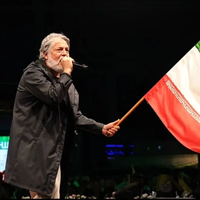
A man gestures the victory sign as he holds a Hezbollah flag, on the second day of the ceasefire between Israel and Iran-backed group Hezbollah, in Tyre, southern Lebanon November 28, 2024.
The Lebanese state must have a monopoly on weapons in the country and the transfer of Iran-backed Hezbollah's arms to Beirut should proceed via direct talks between the presidency and the group, Lebanon’s president Joseph Aoun said on Tuesday.
“The decision has been made to restrict the possession of weapons to the state,” Aoun told the London-based Al-Araby Al-Jadeed in an interview published ahead of his visit to Qatar, saying the move ought to be carried out this year.
“The implementation process remains to be decided through dialogue, which I see as bilateral between the presidency and Hezbollah.”
Washington has pressed for Hezbollah’s disarmament, but Aoun said he warned US envoy Morgan Ortagus about the risk of triggering civil strife.
Hezbollah receives extensive military and financial support from Iran, including arms, training, and strategic guidance from the Islamic Revolutionary Guard Corps. Iranian help has allowed the group to grow into one of the most formidable non-state military organizations on earth.
However, both Iran and Hezbollah have faced strategic setbacks in recent months. Israeli strikes killed many high-ranking Hezbollah commanders and key IRGC personnel in Syria, while Iran’s influence over its proxies in Iraq and Yemen appears to be shifting under regional and international pressure.
Outlining a future security transition, Aoun rejected forming a Hezbollah-only military unit along the lines of Iraq’s Iran-backed Popular Mobilization Forces. Instead, he said Hezbollah members who meet military standards could be absorbed individually into the Lebanese Armed Forces.
Over 150 hardline Iranian lawmakers urged a key decision-making body on Tuesday to block Iran’s accession to the Countering the Financing of Terrorism and Palermo conventions, two key components of the Financial Action Task Force (FATF) reform package.
In a letter published Tuesday addressed to the chair of the Expediency Council Sadeq Amoli Larijani, they warned against endorsing the bills “until the threat of the snapback mechanism is fully lifted.”
Snapback refers to the automatic reimposition of UN sanctions under the 2015 nuclear deal framework. The UN snapback mechanism is expected to expire in October 2025—unless a party triggers it beforehand.
Their appeal signals deep resistance in conservative circles to legislation seen as necessary to remove Iran from the FATF blacklist.
The CFT targets terrorism financing while the Palermo convention tackles transnational crime. Their passage has stalled since parliament passed them with reservations.
Larijani recently suggested conditional approval was possible, citing parliamentary safeguards. But MPs insisted even a conditional endorsement could expose Iran to economic penalties.
Under Trump’s leadership, White House special envoy Steve Witkoff “is working to resolve our differences with Iran through dialogue and diplomacy, if that is possible,” a State Department spokesperson told Iran International.
"This diplomacy is being led by Ambassador Witkoff, who is coordinating with Secretary Rubio," the spokesperson said.
"Secretary Rubio has repeatedly echoed what President Trump has said: Iran cannot have a nuclear weapon," the spokesperson added.
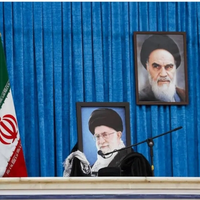
Iran's Supreme Leader Ali Khamenei during a meeting with a group of senior officials on April 15, 2025
Iran's Supreme Leader has expressed a mix of cautious optimism and profound skepticism regarding the ongoing talks with the United States, dismissing the talks as only one of Foreign Ministry’s dozens of tasks.
During a meeting with a group of senior officials, Ali Khamenei emphasized the need to avoid tying the country's issues to the outcome of these negotiations.
"We are neither extremely optimistic nor extremely pessimistic about these talks," he said, adding however that “we are very pessimistic about the other side, but we are optimistic about our own capabilities."
Khamenei added, "Ultimately, it is a task and a move that has been decided upon, and the initial steps have been implemented well.”
"We must avoid linking the country's issues to these discussions, repeating the mistake of the JCPOA where national progress was made dependent on the negotiation's advancement. Such an approach creates a conditional environment, stalling everything until the talks' results are known," the Supreme Leader said in a reference to the 2015 agreement.
Khamenei's carefully balanced comments suggest a pragmatic approach to the dialogue, acknowledging the necessity of exploring diplomatic avenues while maintaining deep reservations about the intentions of the American side.
As Tehran and Washington gear up for the next nuclear talks on April 19, a sense of cautious optimism appears to be growing among Iranian officials and many public figures,apparently stemming from a perceived shift in Khamenei’s stance, evidenced by his greenlight of Muscat negotiations.
The influence of ultra-hardline opponents of US engagement, such as former nuclear negotiator Saeed Jalili and the Steadfastness Front (Paydari Party), appears to be diminishing amid internal divisions.
Resistance to negotiations among hardliners has softened because outright opposition risks being seen as defiance of Khamenei’s authority.
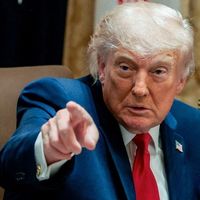
US President Donald Trump signs an executive order in January 2025
The Trump administration is considering a proposal to cut nearly 50 percent of the State Department's funding for the upcoming fiscal year, The New York Times reported.
The report cited an internal memo about a proposal to eliminate almost all funding for international organizations like the United Nations and NATO, ending the budget for supporting international peacekeeping operations and curtailing all of the department’s educational and cultural exchanges, like the Fulbright Program.
It said that it is uncertain whether the drastic cuts proposed in the memo would gain approval in the Republican-controlled Congress.
Among the proposed cuts, the report said, the memo outlines a pay and hiring freeze through fiscal 2026, with exceptions for any hires necessary to oversee foreign aid programs transferred from the US Agency for International Development (USAID), which is being disbanded.
The report added that the memo seeks to reduce foreign aid spending by more than 50 percent of the current budget levels for both the State Department and USAID.
The State Department will request a $28.4 billion budget for fiscal year 2026, $26 billion less than the allocation for fiscal year 2025, according to the memo.
The report said that the Trump administration also plans to claw back some funds for the current fiscal year, seeking to reclaim approximately $20 billion in unspent funds from fiscal year 2025 to return to the Treasury.
The report did not specify whether Iran-related programs were included in the cuts.
Over the years, USAID has been a donor to Iranians in the diaspora to strengthen freedom of speech and free flow of information.
A part of the US funds also covers the expenses of Virtual Private Network (VPN) services which ordinary Iranians used to circumvent the Islamic Republic’s censorship.
Official government figures show Washington is the world's biggest donor of international aid, spending $39 billion in the 2024 fiscal year, out of which $65 million was allocated to funding State Department-administered Near East Regional Democracy (NERD).
The body is the main foreign assistance channel through which the United States has supported civil society and human rights in Iran since 2009, according to the Congressional Research Service.
The report added that it was not immediately clear if Secretary of State Marco Rubio had endorsed the memo which NYT said was dated April 10.