Iran says the second round of its negotiations with the US will be held in Muscat and not Rome, IRNA reported citing the Foreign Ministry spokesman.
"It has been agreed that Muscat will continue to host the second round of negotiations, which will be held on Saturday, April 19," Esmaeil Baghaei said, denying both Iranian and Italian announcements that the talks were due to be held elsewhere.
The announcement came just two hours after Iran's foreign minister told Arab counterparts that the talks would be held in Europe, according to his official X account.
Italy's foreign ministry had confirmed earlier on Monday it would host the negotiations on Saturday.
Iran requested that Washington exert influence on European states not to trigger United Nations sanctions on Tehran in talks on Saturday in Oman, Iran's state-run Tehran Times newspaper reported.
"(Iran) told the US on Saturday that it would be on Washington to make sure snap back does not get activated," the paper wrote, without specifying its sources.
Germany, Britain and France are parties to a 2015 international nuclear deal which is due to expire by October 18 and can trigger international sanctions which predate the deal up until then if it deems Iran non-compliant.
The sanctions that were lifted under that agreement are due to "snap back" into place 30 days after the mechanism is triggered unless the council's five permanent members unanimously vote to keep the sanctions lifted.
Iranian political analyst and former diplomat Hossein Alizadeh said the upcoming visit of Iran's foreign minister Abbas Araghchi to Moscow indicates that both Tehran and Washington "place special importance on Russia."
The trip comes days after US special envoy Steve Witkoff also visited Russia. The two men led their countries' delegations in talks held in Oman over the weekend, with a second round due in Rome on Saturday.
Alizadeh told Iran International that although Moscow’s role is no longer as prominent as it was during talks for a previous nuclear deal, Russia still plays an important part in Iran’s international relations.
According to Alizadeh, Russia likely wants to push the United States to show more flexibility toward a mutually acceptable deal in the second round of negotiations, saying the Rome talks are bound to be more substance-oriented after a mostly symbolic first round.

In a meeting with IAEA Director General Rafael Grossi in Vienna, Iran's new envoy to the UN nuclear watchdog Reza Najafi expressed hope that Grossi’s trip to Tehran on Wednesday would help reinforce cooperation between the two sides.
He also urged the IAEA to remain "independent, impartial and focused on technical matters."
"Continued engagement and cooperation with the Agency is essential at a time when diplomatic solutions are urgently needed," Grossi had said earlier in a post on X.
Iran's Foreign Minister Abbas Araghchi will travel to Moscow later this week, Foreign Ministry spokesman Esmaeil Baghaei confirmed on Monday.
The spokesman said the trip, which will precede a second round of Iran-US talks in Rome, had been planned in advance.
“Based on a prearranged schedule, the Foreign Minister will travel to Russia later this week and during this visit, various issues—including the latest developments in Muscat—will be discussed," he said, referring to the first round of talks with the United States held in Muscat.
Maria Zakharova, spokesperson for the Russian Foreign Ministry, said Araghchi is scheduled to meet with his counterpart Sergey Lavrov as well as other senior Russian officials.

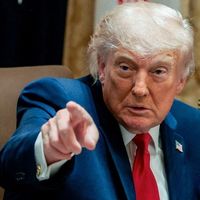
"We've got a problem with Iran, but I'll solve that problem. That's almost an easy one," US President Donald Trump told reporters in the White House on Monday.
"Iran has to get rid of the concept of a nuclear weapon. They cannot have a nuclear weapon," he added. "I think they're tapping us along because they were so used to dealing with stupid people in this country."
"They've got to go fast, because they're fairly close to having one, and they're not going to have one. And if we have to do something very harsh, we'll do it. And I'm not doing it for us, I'm doing it for the world. And these are radicalized people. and they cannot have a nuclear weapon."
Asked if his remarks referred to strikes on Iranian nuclear facilities, Trump responded: "Of course it does."