Iranian Navy Commander Rear Admiral Shahram Irani said on Thursday that Iran’s naval and defense capabilities are at their strongest level to date, amid rising tensions over the possibility of a military attack against the country.
“Our maritime power and defensive capabilities are stronger than ever,” Irani said. “Today, our enemies see the Islamic Republic’s armed forces and strategic navy as a superpower.”
“The enemy seeks direct confrontation at sea, but with divine support, we will defeat and drown the devil, just as Pharaoh was drowned.”
Iran’s Supreme Leader Ali Khamenei (left) pictured alongside President Masoud Pezeshkian (right) during a public meeting.
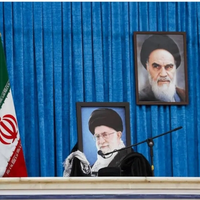
Supreme Leader Ali Khamenei’s decision to drop his longstanding opposition to talks with the United States drew criticism from some Iranians that the veteran leader capitulated under pressure in order to retain power.
The reaction came after Iran International invited public responses to the reversal in Khamenei’s stance, asking why he would now consider negotiations he previously called “unwise, undignified, and dishonorable.”
One respondent, in a video message to Iran International, referenced the leader’s earlier rhetoric: “You said negotiating with America is dishonorable. Now do you realize you’re without honor?”
US President Donald Trump on Tuesday confirmed the start of high-level, direct talks with Iran, following his meeting with Israeli Prime Minister Benjamin Netanyahu.
“We’re dealing with them directly and maybe a deal is going to be made,” Trump said, warning that if not, “Iran is going to be in great danger”.
Tehran is set to hold negotiations with Washington in Oman on Saturday.
In the face of criticism from inside and outside government, Iranian officials continued to frame the diplomatic channel as indirect. Foreign Minister Abbas Araghchi told state TV, “What America is doing is dictating. We believe indirect talks are more effective”.
Fatemeh Mohajerani, the administration’s spokesperson, also said the negotiations, while advanced and significant, remain indirect for now. “We have to begin the process to see where it leads, but the format remains non-direct,” she added.
Still, the public remains unconvinced by the government’s attempts to save face. Several respondents accused Khamenei of misleading the population over years of opposition to the US, only to retreat under duress.
“They lied about indirect negotiations for so long,” one person said in a voice message. “Now they should admit they were wrong.”
Others tied the capitulation to a fear of system collapse in the wake of the Women, Life, Freedom movement which has seen a mass movement against the government since 2022.
“Khamenei agreed to talk because he fears ending up like Gaddafi or Saddam,” another one said.
One man argued the stakes had now grown too high, just last month, Trump threatening to bomb Iran if a new deal was not agreed upon within two months. “Khamenei has no choice but to sit at the table. He knows if war breaks out, the same youth he wants to send to fight won’t aim at America or Israel—they’ll aim at him," he said.
Criticism also targeted the perceived hypocrisy of the leadership. “You used to accuse protesters of collaborating with hostile governments,” said one voice message addressed to Khamenei. “Now you’re negotiating with the very government you called hostile.”
Another message addressed Khamenei directly: “You’re a coward ruining the lives of over 80 million people. Now that you've suffered a defeat and backed down, even your own followers can see how cowardly you are.”
A separate voice message even accused the leader of backpedaling so much that he risked a total turnaround of decades of anti-US and anti-Israel animosity.
“Khamenei redefines words. Even ‘honor’ means something different to him,” the speaker said, before adding, “Soon he’ll be on his way to kiss Netanyahu’s hands.”
An overwhelming sense of "humiliation" has dominated the messages received by Iran International.
“This is humiliation. Khamenei once vowed neither war nor negotiation. Now there’s negotiation, no deal, and he still has to go," another Iranian said.
US lawmakers from both parties reacted to President Donald Trump’s approach to talks with Iran, with some expressing concern over the scope of his objectives and the role of allies in the process, The Hill reported Thursday.
Rep. August Pfluger (R-Texas), chair of the Republican Study Committee, said any agreement must include the complete dismantlement of Iran’s nuclear program. “A firm commitment, verifiable and permanent, is the only acceptable outcome,” he said.
Some lawmakers also questioned whether the White House is coordinating closely with Israel, which remains wary of any US engagement with Tehran.
Sen. Mark Warner (D-Va.), the top Democrat on the Senate Intelligence Committee, said the process appeared to bypass key allies. “I worry a little bit that this seems to be done, almost going around Israel,” he said.
Sen. Tommy Tuberville (R-Ala.) expressed doubt over the effectiveness of any verification mechanism. “It would be hard to do,” he said, though he added he could support an agreement if verification was possible.
A senior Iranian military adviser said on Thursday that Iran’s armed forces are prepared to respond forcefully to any potential military strike, amid renewed threats from the United States.
Amir Nasser Arasteh, deputy head of Supreme Leader Ayatollah Ali Khamenei’s military advisory group, dismissed the warnings from Washington as empty rhetoric.
“The threats from global arrogance and the US president will never be carried out, and we are ready to respond to them,” Arasteh said, according to state media. “As a veteran, I firmly say these threats will not materialize.”
He added that Iran’s armed forces are fully prepared to confront any military action. “Our readiness goes beyond these threats, and above all, it is the faith of our soldiers that will answer any aggression,” he said.
Arasteh said forces have been placed on alert to respond “with power and decisiveness.”
A senior Iranian lawmaker said on Thursday that Tehran will not engage in direct talks with the United States, insisting that any upcoming negotiations will be conducted through intermediaries.
Esmail Kowsari, a member of the Iranian Parliament’s National Security and Foreign Policy Commission, said the Islamic Republic’s stance in the talks is unchanged.
“Our positions are clear, and we will not back down under any circumstances, as we believe the Iranian people are being wronged by the current sanctions,” Kowsari told state media.
He added that, following discussions with the foreign minister, any future negotiations with Washington would be “completely indirect.”
“There must be a third-party mediator — direct negotiations will absolutely not happen,” he said.
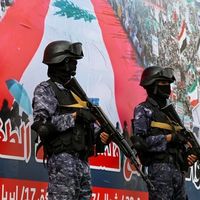
People walk next to an anti-US mural on a street in Tehran, Iran, April 8, 2025.
Iran’s conservative factions are concerned upcoming talks with the United States could extend beyond the nuclear file and may involve additional demands such as disarming Tehran’s regional allies that remain deeply contentious.
Hardline publication Khorasan cautioned that Iranian negotiators must guard against what it called mission creep, particularly in the face of US efforts to shift the agenda toward direct talks.
Iran insists the Oman discussions will focus solely on its nuclear program and officials in Tehran have ruled out negotiations on regional issues or its ballistic missile capabilities.
However, US officials may press for a broader agenda. An executive order US President Donald Trump signed in February called for curbs on Iran’s ballistic missile program and an end to its support for allied groups across the region, such as the Houthis in Yemen.
The group, designated a terrorist organization by countries such as the US and UK, is currently engaged in a tit-for-tat battle with the US amid its blockade of shipping in the Red Sea region.
Khorsan also warned that the talks should not overtake national priorities, including the country's economic crisis, the worst since the founding of the Islamic Republic in 1979. Iran has been demanding the quick lifting of US sanctions that have devastated the economy.
The publication wrote that "diplomacy is not a solution to the country’s core problems".
On the eve of talks this week, President Masoud Pezeshkian, speaking on National Nuclear Technology Day, reiterated Iran’s rejection of nuclear weapons.
“They [UN inspectors] have checked us a hundred times. Check again. We are not after the bomb,” he said. “We need nuclear science. They want us weak, but we will stand tall through knowledge.”
US President Donald Trump has warned of bombing Iran if Tehran fails to reach a new deal over its nuclear program, giving a two month deadline, without stating when that ends.