Iran state TV prepares backup programming amid military tension
Iran's state broadcaster, the Islamic Republic of Iran Broadcasting (IRIB), has commissioned thousands of hours of backup programming from production companies affiliated with the government, according to a report by IranWire.
The move aims to ensure that provincial television networks can continue broadcasting even if main facilities are targeted in potential attacks, an unnamed source told IranWire.
According to the report, a special budget has been allocated for this contingency planning. The commissioned content includes a wide range of programs, such as entertainment, competitions and historical documentaries.
A photograph captured on April 5, 2025 by the European Space Agency's Sentinel-2 satellites shows US aircraft carrier USS Carl Vinson exiting the Strait of Malacca and entering the Indian Ocean en route to the Red Sea.
Satellite images show that US Navy aircraft carrier USS Carl Vinson has entered the Indian Ocean via the Malacca Strait, marking a step up in the US military's presence in the region amid tensions with Iran, Newsweek reported on Monday.
The report said that the move signals the potential for a more aggressive US stance in the coming days and weeks, amid rising tensions between Iran and Yemen's Houthis which continues to target US vessels amid its blockade of the Red Sea.
The imagery showed that the USS Carl Vinson, originally deployed in the western Pacific, has now moved into the Indian Ocean, on its way to join the USS Harry S. Truman in the Middle East, which has specifically come under fire from the Houthis.
The two aircraft carriers were deployed by Defense Secretary Pete Hegseth, the Associated Press (AP) reported last month citing a US official.
AP's report said that Hegseth signed orders on March 20 to keep the USS Harry S. Truman in the Middle East for at least an additional month and ordered the USS Carl Vinson, which had been operating in the Pacific, to make its way toward the Middle East, extending its scheduled deployment by three months.
The rare deployment intended to bolster US strikes against the Houthis, whose primary benefactor is Iran. This buildup follows persistent Houthi attacks on commercial and military vessels in the Red Sea, which the group frames as a response to the Israeli war in Gaza.
Last month, the US military deployed long range bombers at a strategic Indian Ocean airbase, a spokesperson told Iran International, as Washington ramped up rhetoric against Iran and continued strikes against Houthi fighters in Yemen.
"B-2 Spirit bombers have arrived at Naval Support Facility Diego Garcia," a US Strategic Command spokesperson said, referring to the strategic British territory.
Trump recently said that all military actions carried out by the Houthis will be attributed to Iran, though Tehran denies it controls the group.
The US has launched multiple strikes on Houthi infrastructure, which has stepped up in recent weeks as Trump vows to end the blockade which, while intended to target Israeli-linked ships, has disrupted global shipping on the key maritime route.
The Kremlin said on Monday that Russia is ready to do everything possible to resolve the issues surrounding the Iranian nuclear program through political and diplomatic means.
"This process will continue, including in the near future. And, of course, Russia is ready to make every effort, to do everything possible to contribute to this problem's resolution by political and diplomatic means," Kremlin spokesman Dmitry Peskov told reporters.
Moscow also said it is in constant consultation with its Iranian partners, including discussions regarding the nuclear deal.
"We are in constant consultations with our Iranian partners, including on the topic of the nuclear deal."
The Kremlin added that these consultations will continue, including in the near future.
Mithal al-Alusi, a former Iraqi lawmaker and the founder of Iraqi Ummah Party, has disputed a Reuters report suggesting that several Iranian-backed Iraqi armed groups are prepared to disarm.
In response to a question from Iran International, Alusi dismissed the Reuters report as incorrect,suggesting that the disarmament claims might be a nominal measure only “to acquit some political names involved with the militias.”
Mithal al-Alusi
He added that "in practice, the real militias have received advanced weapons, and their participation on the battlefield may be completely evident."
His comments contradict the Reuters account, which cited senior Iraqi commanders and officials saying the militias were prepared to disarm to avert conflict with the US.
US President Donald Trump disembarks Air Force One as he arrives at Joint Base Andrews in Maryland, April 6, 2025.
Iran is waiting for a decision from the United States on whether to engage in indirect negotiations, foreign ministry spokesman Esmail Baghaei said on Monday.
“We have conveyed our position to the US and are now awaiting their response on entering talks,” Baghaei said.
While US President Donald Trump has recently pushed for direct diplomacy with Tehran, Baghaei said that indirect talks remain Iran’s preferred path for now—but left the door open to future adjustments.
“Decisions will be made in line with conditions and at the appropriate time.”
He confirmed that technical discussions had already taken place covering both nuclear cooperation and sanctions relief.
“There have been exchanges and consultations on various aspects of the matter, including some technical details,” Baghaei said.
Confirming speculation, he finally said Iran will be looking to Oman as a mediator. “Should a new process begin, Oman would be one of the main candidates for this important task,” he added, Oman one of the mediators which helped Iran resume diplomatic relations with Saudi Arabia in 2023.
Baghaei also said the country had given approval for a visit by International Atomic Energy Agency chief Rafael Grossi, who earlier said he hopes to travel to Tehran by late April, showing the country's readiness to cooperate with international nuclear oversight.
Iran has always said its nuclear program is for peaceful purposes. Amid threats from the US to push Tehran into a new nuclear deal or risk being bombed, he added that Iran’s military remains vigilant.
“Our armed forces maintain and upgrade their readiness moment by moment to face any potential scenario,” Baghaei said.
In response to Trump's latest threats, Supreme Leader Ali Khamenei said that the Islamic Republic would deal a "strong blow" in retaliation for any attack.
Iran has also threatened to target American interests in the region, including the strategic US naval base, Diego Garcia in the Indian Ocean, if attacked.
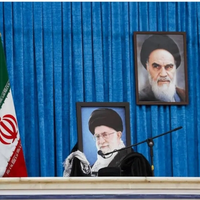
Iran's supreme leader Ali Khamenei in an even with officials and delegates of Muslim countries
In a new twist to Iran’s nuclear saga, the official government newspaper - Iran - said on Monday that Supreme Leader Ali Khamenei’s alleged fatwa against atomic weapons does not necessarily ban their production – only their deployment and use.
“The issue of nuclear weapons generally involves three components: production, stockpiling, and use or deployment,” the newspaper wrote—drawing a distinction that is rarely considered meaningful in academic or military discussions on nuclear strategy. The article went on to assert, “In the modern era, the possession of nuclear weapons—rather than their use—is inherently deterrent in nature.”
It appears that the government’s official newspaper is suggesting that producing and stockpiling atomic bombs is not a big issue as long as Iran says it has a fatwa prohibiting their use.
Iranian diplomats and officials often refer to a statement made by Khamenei in 2010 against weapons of mass destruction, calling their use “haram” or forbidden in Islam. They insist that this constitutes a fatwa, a religious ruling by a senior Shi’ite cleric that has the power of law.
However, Khamenei’s statement was submitted to a disarmament conference, and delivered in the tone of a political address, rather than as a formal religious ruling. It was neither published on Khamenei’s official website as a fatwa nor reiterated by him in subsequent speeches. Even if interpreted as a binding religious edict, a fatwa can be superseded by a new ruling, especially under the principle of expediency—a concept frequently invoked in Shi’ite jurisprudence to adapt religious rulings to changing political and strategic circumstances.
The newspaper argues that the Supreme Leader’s fatwa does not prohibit the production or stockpiling of nuclear weapons, which it claims serve purely as a deterrent, but only bans their use. “If we consider the two reasons cited above for the prohibition of nuclear weapons,” the article states, “it becomes clear that they apply to their use—not their production or storage. The primary objective of developing such weapons is, fundamentally, deterrence.”
The two reasons referenced by Iran daily include a historical account from early Islam prohibiting the poisoning of water, and broad religious teachings said to be emphasizing the preservation of human life, civilians, and the environment.
This also suggests that the Islamic Republic’s stance on nuclear weapons is shaped more by interpretations of early Islamic teachings and the principles of Shi’ite clerical jurisprudence than by universal norms aimed at preventing mass destruction and civilian casualties.