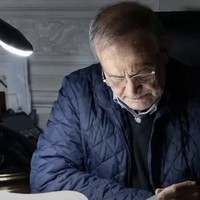
An AI-generated image of an unlicensed performance in Tehran
Tehran's art scene is moving underground with exhibitions and performances that defy pervasive censorship, turning home venues into sanctuaries for creative self-expression.
I attended one such event last week, a play I learned about through a friend. It was staged in a unit at a mixed-use building, half commercial, half residential. Not an earth-shattering show to be frank, but a unique experience worth sharing, especially the petty-crime feel of it.
This is how it happened.
The friend who told me about the play gave me the director’s number. I messaged him on Telegram. He asked for a reference and I named my friend. He sent me a bank account number to pay for my ticket: 200,000 tomans ($2.50 on the day of publication). Minutes after the transfer, I received a confirmation message and a slick brochure in PDF format, complete with cast, crew and the venue address.
I asked if I could tell others about it. “Only if they’re trustworthy,” he replied.
Underground performances in Iran rely solely on word of mouth. Public advertising is no option because an unauthorized show is not supposed to take place in the first place. Any work of art that seeks the public light—a film, a song, a book, or a play—has to be reviewed and approved by the censors at the aptly-named Ministry of Culture and Islamic Guidance.
But in the past few years, most notably since the widespread protests of 2022, more and more people refuse to submit their work to the ministry. They rather take it underground and take the financial hit than honor official red lines mandating the hijab and barring physical contact between men and women.
Resistance
"Many of us in theater work two jobs to sustain this resistance,” the director told me before the show on the condition that I protect his identity.
“The government likely knows about our performances, but as long as they’re small-scale and mired in hardship, they turn a blind eye.”
But they couldn’t turn a blind eye on Parastoo Ahmadi and her groundbreaking online concert with no hijab in a public space. The performance briefly landed her in jail.
“Her performance epitomized this movement,” the director said. “It shattered almost every taboo that’s been created by our fanatic rulers in the past four decades.”
Parasol Ahamadi and her band in an unauthorised performance in Iran, December 11, 2024
Concerts in Iran require permits. Women are forbidden from singing in public. And of course they have to cover all but their faces and hands. Parastoo performed in an old caravanserai with no hijab, filmed it and released it on YouTube. She did indeed cross all red lines—and will most likely pay for it.
Very few are that bold, of course. But they are “doing their bit in the struggle,” as the director put it.
On the day of the performance, I habitually arrived 15 minutes early. It was a building like any other in central Tehran. I buzzed the third buzzer as instructed and was let in. There was no elevator. Walking up the stairs, I heard from a unit what sounded like the playful giggle of a toddler.
On the third floor, I found a woman seated at a desk by the door. I gave her my name and ticket information. The setting resembled an arts school, perhaps one offering classes in creative writing. I was asked to wait on the roof terrace to avoid crowds forming in the hallway.
On the rooftop, six or seven others were already waiting. A small area had been enclosed with plastic sheeting, and a heater stood near a table and chairs. We huddled around the heater for warmth until we were called back inside and, to our surprise, were guided to the fourth floor instead of the third.
Doing their bit
An average-size apartment had been turned into a space for performances. A wall was removed and most others were painted black. It was a modest stage, six by eight meters perhaps. Two rows of benches faced the stage, enough for 15-20 people.
The first act had two actors, a man and a woman. The woman wore a t-shirt and no hijab. I was thrilled and nervous. Everybody was, I think. Like children in a Halloween event. For the first time in my life, I watched a man hug a woman on stage. That most ordinary of contacts left us gasping. I almost teared up pitying us for all that the Islamic Republic has taken away from us.
I’d rather not say much about the performance not to risk revealing the identities of those involved.
After the performance, I spoke with the director. “Why such a small audience?” I asked. “We can't host large audiences or perform back-to-back shows,” he explained. “After a few performances, we need breaks of several days or weeks to keep everything secure and unnoticed.”
Another reason for the small audience, he said, was the lack of advertising. “Not many hear about events like ours. Most are friends and friends of friends. Many rather not risk it, fearing police raids and arrest.”
I asked if that was a real possibility and if he was scared. “I am mostly concerned for my team," he said briefly, perhaps knowing that the subject would make him anxious.
Despite the risks and the financial losses of not having a mass audience, more and more artists ignore the Guidance Ministry and its censors. Films produced with no permit appear at festivals abroad; unlicensed music and theater performances are flourishing; and books published without license can be seen on the shelves of the odd bookstore “doing its bit” - as the director had put it.
Last but not least in doing their bit is the audiences: fed-up Iranians turning away from works of art that bear the government’s seal of approval.
It’s hard to tell if these scattered, unadvertized acts of resistance will join and grow into a social movement beyond Tehran’s art scene.
But even if they don’t, they will create—they already have—a new collective space for free expression, a new front in the war of attrition against those who would silence them.
Outside the building of the General Directorate of Prisons of Semnan Province
A Swiss citizen Iran says died by suicide in prison was a 64-year-old tourist, a Swiss foreign ministry spokesman told Iran International, adding that Switzerland is seeking more details on his arrest and death from Tehran.
The foreign ministry added on Friday that the individual had been living in South Africa for the past 20 years and was traveling in Iran as a tourist.
The email response from the ministry said that the Swiss embassy in Iran was earlier denied access to the prisoner and now wants Tehran to provide full information about his arrest and death.
"Since Switzerland was informed of the arrest, the Swiss Embassy in Tehran has been in daily contact with the Iranian authorities to obtain more information about the circumstances of the arrest and to gain access to the detained Swiss citizen," the foreign ministry said.
"However, due to the accusations (espionage – national security), the requested consular access was not granted," it added. "Switzerland is demanding that the Iranian authorities provide detailed information."
The Swiss citizen who allegedly committed suicide in Semnan Prison on Thursday had been arrested while collecting soil samples in Iran’s central desert during an Israeli airstrike, media affiliated with Islamic Revolutionary Guard Corps reported.
Meanwhile, local media quoted unnamed Iranian official as saying that person was conducting espionage when he was arrested. The name of the Swiss citizen and the circumstances of his arrest and death remain unclear.
“This individual used prior intelligence training to take their own life during a specific opportunity,” Mashregh News, a publication affiliated with the Islamic Revolutionary Guard Corps (IRGC), reported late Thursday, citing an unnamed security official.
"Switzerland is demanding that the Iranian authorities provide detailed information on the reasons for his arrest and a full investigation into the circumstances of his death," the Swiss foreign ministry said.
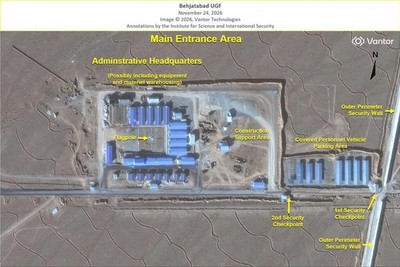
The individual, detained by the IRGC Intelligence Organization, was accused of gathering information in a sensitive area during Israel's October air attack. The media report specifically said that this occurred during the Shahroud attack, which targeted an IRGC missile facility. Satellite imagery from Planet Labs later revealed significant damage to the site, known for building ballistic missiles and launching rockets as part of Iran’s space program.
After their arrest, the person was transferred to Semnan Prison, where they allegedly revealed information about their network and communication links, according to the outlet.
A local judiciary official confirmed the death on Thursday, saying that the Swiss national, facing espionage charges, had committed suicide in their cell.
Switzerland has also confirmed the death. "The FDFA confirms the death of a Swiss citizen in Iran," spokesperson Pierre-Alain Eltschinger told Iran International. "The Swiss Embassy in Tehran is in contact with the local authorities to clarify the circumstances of the death in an Iranian prison," he added.
According to Mizan, Iran's judiciary news website, the detainee asked their cellmate on Thursday morning to purchase food from the prison canteen. While alone in the suite, the detainee reportedly took their own life. "Prison officials immediately intervened to save the individual, but their efforts were unsuccessful," Mohammad Sadegh Akbari, a local judiciary official, was quoted as saying. “Suicide has been definitively confirmed.”
Iran has arrested dozens of dual nationals and foreigners in recent years, often on charges of espionage or security-related offenses. Some of these detainees have been released in exchange for deals involving Iranians held in foreign prisons.