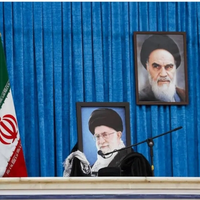
A session of the Iranian parliament, December 2024
Recent regional setbacks have further weakened Iran’s hardliners at home, with increasing criticism from within the establishment holding them responsible for mismanagement and misdirection in the country’s foreign and domestic affairs.
Having lost Syria in a dramatic and unexpected turn of events, Iran’s hardliners find themselves with little to defend their position. They have shifted their focus to heavily campaigning for the implementation of a restrictive new hijab law, while attempting to deflect blame for the insurgents' victory onto their long-time ally Assad. Some hardliners argue that Assad lacked sufficient commitment to Tehran’s “axis of resistance,” yet they struggle to explain why the Revolutionary Guard did not make greater efforts to defend him.
Supreme Leader Ali Khamenei attempted to address the issue on December 11, claiming that the United States and Israel had blocked all land and air routes to Syria. However, this explanation was widely viewed as unconvincing, particularly given Tehran’s long-standing boasts of regional supremacy.
On Saturday, the country’s national security council decided to shelve the hijab law, bowing to public opposition as well as criticism from numerous current and former officials, along with commentators permitted to speak through tightly-controlled media channels.
Despite this, hardliner Foad Izadi sparked widespread backlash on social media and Iranian news websites by arguing that the insistence on hijab enforcement serves a political purpose for the Islamic government. He claimed that supporters of the political system expect religious laws to be taken seriously by officials, warning that failing to do so risks eroding the Islamic Republic’s base of loyal supporters.
Foad Izadi
"The Islamic Republic does not see its benefit in giving in, because it believes the locomotive of the train it is riding on consists of a hard core of supporters who are loyal precisely because of these [policies]. If the Islamic Republic compromises on a few principles, this core of loyalists will be the first group to step off the train,” Izadi said during a video discussion published online.
Ironically, Izadi, who has become a staunch ideologue for Iran's hardliners, was educated in the United States from an early age and holds a PhD from the University of Louisiana. This apparent contradiction was not lost on a commentator from the reformist Aftab News website, who criticized Izadi for advocating hardline policies after benefiting from an education abroad.
Meanwhile, the relatively moderate Rouydad24 published a scathing article on Sunday targeting Izadi and his peers, accusing them of exploiting the hijab issue to tighten their control over the government. Matin Ghafarian, writing for Rouydad24, argued that these ultra-hardliners are not solely focused on enforcing stricter hijab regulations but are also intent on imposing broader counterproductive policies.
The article warned that such policies would further alienate the public, destabilize the Islamic government, and make it increasingly reliant on hardliner support. Rouydad24 wrote, "These individuals embody their own words—they are not easily satisfied. After making the establishment dependent on themselves, they begin to conquer the system step by step."
The website went even further, accusing ultra-hardliners of using political issues, such as the hijab, as a pretext to expand their influence for financial gain. By pressuring the government to adopt more extreme policies, they have exacerbated economic sanctions and deepened Iran’s isolation. This, in turn, has allowed them to leverage their influence to gain control over key economic sectors under the guise of rescuing the economy, often benefiting from government subsidies in the process.
Rouydad24 concluded, "The demands of this small group will not end until they have fully taken over the country’s economy. This group effectively traps the government in a cycle of decline—creating crises and feeding off them. In reality, we are not dealing with a fanatical and hotheaded group, but rather a cunning mafia intent on seizing control of all the country's economic resources."
Iran's vice-president announced that the administration is drafting a bill to amend the highly controversial hijab law, which the Parliament Speaker had promised would take effect on December 13.
“We will send an amendment bill to the Parliament to halt [the controversies over its implementation] now to conduct further investigations,” Deputy President in Parliamentary Affairs, Shahram Dabiri, announced Saturday.
Reformist media and politicians have extensively criticized the new hijab law, spearheaded by lawmakers of the Paydari (Steadfastness) Party and their allies in the parliament, notably the Jebhe-ye Sobh-e Iran (MASAF) that was established less than a year ago. Ultra-hardliners of the Parliament have the backing of the Constitutional Guardian Council whose approval is required for all legislation.
Both groups have close ties to the ultra-hardliner former nuclear negotiator Saeed Jalili who lost the recent presidential elections to Pezeshkian and a shadowy cleric, Ayatollah Mohammad-Mehdi Mirbagheri with an extremely radical interpretation of the Sharia.
More reformist clerics have criticized the law. “This law’s implementation is fraught with political and economic problems and [will result in] stirring up hate and aversion to religion … making it official means neglecting the country’s [serious] political, social, and cultural problems,” Ayatollah Mohammad-Ali Ayazi, a member of the reformist association of Qom Seminary clerics told the moderate conservative Khabar Online Saturday.
Ayazi also argued that ultra-hardliners’ insistence on immediate enforcement of tough hijab enforcement measures is meant to sabotage the Pezeshkian government’s efforts to remedy the more urgent problems it is grappling with. Ayatollah Ali-Akbar Masoudi Khomeini, another member of the same association, has expressed a similar view.
Despite agreeing with the hijab as a religious principle, several top-ranking clerics, including Ayatollah Abdollah Javadi Amoli, have criticized ultra-hardliners’ insistence on implementing the new law in loosely veiled terms.
“This law suggests that they [the government] want to lead people to paradise by force,” conservative cleric Mohsen Gharavian who has been an outspoken critic of the new hijab law told Khabar Online. “Maybe we don’t want to go to paradise. What should we do [if we don’t]?” he added.
On Saturday, the relatively independent Rouydad24 news website wrote: “It appears that [the delay resulted from] the administration’s negotiations [with higher entities] to postpone the implementation of the Act and make some amendments to it have been successful."
Rouydad24 added that authorities at the highest level may have agreed that the controversial legislation formulated by ultra-hardliners cannot be enforced in the current circumstances.
Ali Shamkhani, Iran’s former secretary of the Supreme National Security Council from 2013 to 2023
A powerful former security chief inserted himself anew into Iran's fraught domestic power milieu and increasingly exposed position abroad by saying he is a key decision-maker on Iran's global role and nuclear diplomacy.
"I have been entrusted with the project of determining Iran's position in the global order," Ali Shamkhani, secretary of Iran's supreme national security council from 2013 to 2023, said in an interview with Nour News.
The Iranian outlet cited him as adding that he is the official ultimately responsible for the country's nuclear diplomacy dossier and sanctions.
The assertions appeared aimed at reviving the relevance of a figure whose hardline stance on engagement with outside powers has been criticized by relative moderates as Iran's geopolitical influence wanes and economy suffers.
Shamkhani defended legislation he is widely believed to have crafted in December 2020 to boost Iranian uranium enrichment up to 20% which was blamed for harming chances for reviving a lapsed nuclear deal just as relative dove Joe Biden took office.
"The Strategic Action Plan is not a bad law; it was proposed in response to Trump's pressures, and our nuclear achievements are owed to this law," Shamkhani said.
His remarks come as Iran faces a dilemma over whether to double down on a muscular military policy in the region which has taken a severe pounding from Israel or to re-engage the West its disputed nuclear as Donald Trump's return looms.
The influential former military figure has been under intense scrutiny lately over his family's sprawling business interests.
Shamkhani's interview seems to have backfired as critics linked to the Reform camp and the government of former President Hassan Rouhani have again criticized him as a cause of Iran's woes who has been enriched by dodging sanctions which plague the livelihoods of ordinary Iranians.
His comments appear to be a deliberate doubling down on hawkish policies despite mounting domestic and international woes.
“Hardline and aggressive agents chosen by #Trump, if they learned from the past, will have no choice but to opt for rationality and respect in the face of Iranians' strong will to continue #Resistance,” Shamkhani said in a post on X last month.
Shamkhani, formerly a rear admiral in the IRGC, has in recent years become widely known for his and his sons' roles as emerging oil tycoons. They have been implicated in circumventing US sanctions and selling the Islamic Republic's oil through the use of ghost fleets. The allegation of oil dealings became a widely publicized affair in international media in 2024.
Shamkhani’s reputation as a corrupt insider extends beyond his alleged involvement in dubious oil dealings. After the collapse of a high-rise building in Abadan in 2022, which resulted in the loss of dozens of lives, accusations emerged linking Shamkhani and his associates to financial corruption and the exploitation of his influence as a rear admiral. While Shamkhani denied the corruption allegations, Iranian media remained skeptical, citing substantial evidence that cast doubt on his claims of innocence.
(From left) Former Foreign Minister Mohammad Javad Zarif, Ali Shamkhani, and former president Ebrahim Raisi
In the interview, Shamkhani criticized former presidents and claimed he had never voted for Mahmoud Ahmadinejad, Hassan Rouhani, or Ebrahim Raisi. However, critics accused him of complicity in nearly every major decision made in Iran over the past 45 years, including significant financial scandals, while attempting to shift blame onto others.
Mohammad Heydari, managing editor of the Rouydad 24 News website in Tehran, noted that Shamkhani was an integral part of the administrations led by the very presidents he claims not to have voted for. As such, he bears responsibility for their actions and decisions.
Former Reformist MP Mahmoud Sadeghi in a video posted on X accused Shamkhani of being responsible for opening fire at protesters in major demonstrations since 2018. "We never forget and never forgive that."
In another post on X, Iranian political analyst Rouhollah Rahimpour argued that since Shamkhani claims to oversee Iran's nuclear dossier, he should be held accountable for the failures of past nuclear negotiations and possibly those in the future.
Bahram Parsaei, a member of the parliament from Shiraz wrote that Shamkhani has played a major part in the failure of the Rouhani administration and in the inclusion of Iran in the FATF blacklist, which significantly restricts Iran’s international banking and trade.
Although Shamkhani may have chosen to take part in that interview was to overshadow the controversy about his oil empire linked to his family, the decision could signal renewed political ambitions.
Shamkhani has made it clear more than once that he wishes to rise to the post of the security chief again, although Khamenei has so far demurred. Former President Hassan Rouhani has said that Khamenei was against Shamkhani's appointment as security chief in his government.
Iranian-American journalist Reza Valizadeh, who previously worked for a US government-funded broadcaster, has been sentenced to 10 years in prison by a Tehran Revolutionary Court.
Valizadeh has also been banned from residing in Tehran and neighboring provinces, prohibited from leaving the country, and barred from political party membership for two years, defense attorney Mohammad Hossein Aghasi tweeted on Friday.
Valizadeh worked for Radio Free Europe/Radio Liberty's Persian Service, known as Radio Farda, for 10 years before leaving the organization in November 2022. In March, after 14 years abroad, he returned to Iran to visit his family, according to a tweet he posted. Despite receiving assurances from security officials over the phone that he would not face any problems, authorities arrested him in September.
His two court sessions, held in November, proceeded without a prosecution representative, with the judge taking on that role, according to Radio Farda.
People close to the journalist say he walked into a "security trap" after receiving informal assurances from Iranian security officials that he would not face legal issues upon returning to Iran.
According to HRANA, Valizadeh remains in Ward 209 of Evin Prison, a section run by the Ministry of Intelligence, where he lacks access to basic amenities and visitation rights.
Valizadeh’s sentence was communicated to him and his lawyer only after a delay. HRANA rights group also reported that he has not been moved to the prison’s public ward, even though investigations have concluded.
International organizations, including Reporters Without Borders and the Committee to Protect Journalists, have criticized Valizadeh’s detention. The US State Department called his arrest unjust and described it as a violation of international law.
"Iran routinely imprisons U.S. citizens and other countries' citizens unjustly for political purposes. This practice is cruel and contrary to international law," a State Department spokesperson said last month.
Before his emigration, Valizadeh was briefly detained in 2007 in Iran. His professional history includes working with outlets such as Radio France, Voice of America, Radio Farda, and Iran’s state broadcaster IRIB.
Authorities have transferred political prisoner Mohammad-Amin Mahdavi Shayesteh to solitary confinement ahead of his execution for "insulting Islamic sanctities" and "collaboration with the enemy," according to Iran Human Rights (IHR).
IHR noted that the charge of collaborating with Israel against 26-year-old Shayesteh, who was arrested last year, was based on confessions obtained under torture and used to expedite his death sentence. The human rights group emphasized the lack of evidence in the case, pointing out that "an empty handgun magazine" and "a pepper spray" were presented as proof of "possession of illegal weapons" to support the charge of "collaboration with the enemy."
"The Islamic Republic is experiencing its greatest crises in its history and, to prevent public protests and cover up its regional failures, resorts to intimidation through the execution of defenseless prisoners," Mahmood Amiry-Moghaddam, Director of IHR, tweeted on Friday.
In recent months, Iranian authorities have escalated their use of the death penalty, with human rights groups reporting that over 42 political prisoners currently face the risk of execution.
According to a November 21 report by HRANA, at least 133 executions were documented in the past month alone, averaging more than four per day. This follows data from the Iran Human Rights Organization, which recorded at least 166 executions in October.
HRANA’s reports reveal an annual average of 811 executions between October 2023 and October 2024, encompassing both political detainees and ordinary prisoners.
This surge in executions coincides with rising tensions between Iran and Israel, with some suggesting that the government is leveraging geopolitical crises to distract from its domestic repression.
A photo of Iran's late President Ebrahim Raisi before copter crash in May 2024.
An Iranian lawmaker has accused the United States, Israel, and Azerbaijan of orchestrating the helicopter crash that claimed the life of former President Ebrahim Raisi, rejecting the official explanation of a weather-related malfunction as implausible.
Kamran Ghazanfari, speaking at a conference on Thursday, said the Islamic Republic’s account was laughable and hinted at a deliberate assassination plot involving foreign powers.
“Everyone would laugh at the officials’ explanation that Raisi’s helicopter crashed due to weather conditions and dense clouds,” Ghazanfari added.
“What a smart dense cloud it must have been to specifically target the middle helicopter [out of three], which happened to be Raisi’s.”
Ghazanfari provided no evidence to support his accusation, which comes amid a turbulent political climate in Iran following its latest significant regional setbacks. The downfall of Syria's Bashar al-Assad in particular has rattled the Iranian government and its top leadership.
Ahmad Ardestani, a member of Parliament’s National Security Committee, previously speculated that Raisi’s death could be linked to the explosion of a pager he carried, referencing a string of coordinated blasts in September targeting Hezbollah communication devices in Lebanon and Syria.
The explosions, which left over 40 dead and caused numerous civilian casualties, were widely attributed to a sophisticated operation by Israel’s Mossad, though Israel officially denied involvement.
The US State Department also denied any connection to the helicopter crash, with spokesperson Matthew Miller confirming Tehran sought assistance in the crash aftermath but that logistical constraints prevented American involvement.
“We were asked for assistance by the Iranian government. We did make clear to them that we would offer assistance, as we would do in response to any request by a foreign government in this sort of situation,” Miller said in May.
“Ultimately, largely for logistical reasons, we were unable to provide that assistance.”
Leadership rivalries and theories of internal motive
Beyond accusations of foreign sabotage, some Iranians have speculated about internal political motives for Raisi’s death. Mehdi Nasiri, a former editor of the hardline Kayhan newspaper, pointed to potential rivalries surrounding Supreme Leader Ali Khamenei’s succession.
Nasiri suggested Raisi’s helicopter crash might have been orchestrated by those seeking to bolster Mojtaba Khamenei’s position as his father’s successor.
“In the last session of the previous Assembly of Experts, representatives spoke about Mojtaba Khamenei’s leadership, which was met with reactions from figures like Raisi and others,” Nasiri said.
The death of Raisi, along with the assassination of figures such as Hamas leader Ismail Haniyeh in Tehran, has fueled speculation about heightened foreign and domestic threats to Iranian leadership. Israel, while denying involvement in Raisi’s crash or other killings, has not shied away from targeting figures connected to Iran’s regional allies and nuclear program. An unnamed Israeli official told Reuters in May, “It wasn’t us.”
Despite these denials, figures like Ghazanfari continue to spotlight foreign interference as a likely cause of Raisi’s death, reflecting the tensions that define Iran’s complex relationships with its adversaries.