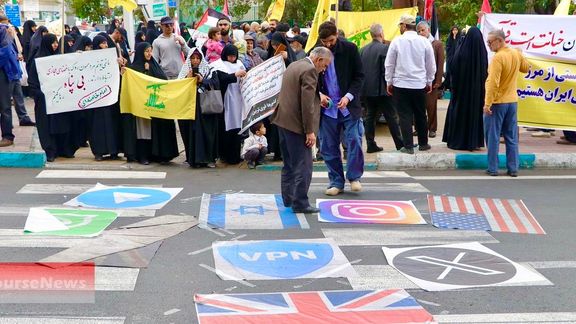
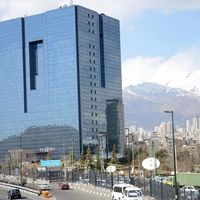
Dozens of protesters, organized by a vigilante group, gathered in Tehran on Wednesday, chanting in opposition to President Masoud Pezeshkian's remarks and the growing calls for lifting internet filtering.
On Tuesday, he reaffirmed his commitment to his promise, stating that to prevent future complications, his administration is collaborating with other government institutions, including Parliament and the Judiciary, to remove the obstacles to lifting internet restrictions.
The plan to hold the rally was announced on social media platforms Tuesday by the group calling itself the “Hezbollah umma (people)”.
The poster widely shared by the organizers on various social media platforms invited those opposed to free internet access to convene to demonstrate their opposition to the plans that allow “cultural infiltration of the Zionist regime in the country”.
Videos posted on social media show the protesters chanting and waving flags of the Hezbollah outside the building of the National Cyber-Space Center near a major square in northern Tehran.
A notorious vigilante leader, Hossein Allahkaram, used a loudspeaker to address the participants in the rally from the back of a small pick-up truck parked on the road median.
He urged the authorities not only to continue internet filtering but also to block the bandwidth allocated to Instagram, WhatsApp, and Telegram traffic so that even anti-filtering software could not provide access to them. These platforms are already blocked and people use VPNs to secure access.
“Israeli Instagram, Telegram, and WhatsApp must be shut down” and “No country allows so much freedom to enemy [social media] platforms like Iran”, some of the protesters’ banners read.
Tens of millions of Iranians must use anti-filtering software to access major international social networks, including Google Play, and tens of thousands of websites.
Moreover, millions of Iranians use social media platforms, particularly Instagram, Telegram, and WhatsApp to promote small and medium-sized businesses, particularly those run from home by women or small farms in rural areas.
A report published by the Tehran E-Commerce Association in January contended that the use of anti-filtering software makes users’ equipment more vulnerable to cyber threats and exposes online businesses to greater risks of user data leaks.
Iranian security forces will normally interfere without hesitation and suppress any “unauthorized” protest rallies, even very small, for ‘violating public peace’ but Iranian media say security forces did not interfere with ultra-hardliners’ rally on Wednesday.
Pointing out that the indifference of the security forces, the head of the Reformist Front, Azar Mansouri, asked the authorities in a tweetwhether those who oppose filtering can also enjoy such freedom in holding protests.
Pro-establishment hardliners have on many occasions held similar rallies without any trouble but an article Tuesday in Mashregh newspaper seemed to suggest that authorities are concerned that the vigilante group’s insistence on keeping internet censorship may spark a new wave of anti-government protests and unrest in the country.
Mashregh is a news website with alleged links to the Revolutionary Guard Intelligence Organization (SAS).
The article entitled “Behind the Scenes of Anti-Security Calls to Protest in Iran/ The US Plot for Simultaneous Unrest in Iran and Lebanon” alleged that those who called to protest were “groups feigning to be revolutionary” that sought to “polarize” the society in line with such supposed US plans instead of fostering unity in the face of “current threats”.
The Revolutionary Guard-linked Fars News Agency, along with other conservative outlets, published the Mashregh article in full.
Mashregh News cited the hardliners' protests against former President Hassan Rouhani's economic policies in Mashhad in December 2017 as a historical parallel.
What began as a hardliner-organized demonstration quickly spiraled out of control when disillusioned citizens joined in. This sparked spontaneous, leaderless protests across the country, targeting not just the government’s economic policies but the entire Islamic Republic and its religious authoritarianism, prompting a heavy crackdown.
A dissident cleric and former academic, once a popular figure on Iran’s state television, now asserts that the ruling clerics no longer represent the voice of the people.
Naser Naqavian, once a prominent figure on state TV, has been barred from both speaking on air and teaching at universities. He has spoken about the declining role and status of Muslim clerics in Iranian society, despite the country being officially governed by Shiite clergy.
In an extensive interview with the Khabar Online website, Naser Naqavian said that clerics were increasingly isolated from Iranian society. He remarked that some clerics are so affluent that many people believe their pockets are directly connected to the country’s oil pipelines.
Speaking about his own financial situation, Naqavian said that he had to move from the affluent Pasdaran Avenue in northern Tehran to Fardis, a district outside the industrial town of Karaj some 50 kilometers West of Tehran.
He noted that clerics who became government officials have lost their standing with the broader population, as they no longer speak for the people. He pointed to their hardline stance on enforcing compulsory hijab as a key issue, likening their position to that of the Taliban, which has further alienated them from mainstream Iranian society.
Ayatollah Nasser Naqavian. File photo
Naqavian stressed, however, that he is not a "counter-revolutionary" or a member of the opposition. "I simply oppose the policies I believe are wrong and want those policies to be corrected."
The growing divide between the Iranian public and the ruling clerics has been acknowledged by the country’s seminaries as far back as 2017. A major media outlet from the Qom Seminary, Mobahesat (Discussions), explored this issue and its underlying causes. Studies published by Mobahesat revealed that clerics' popularity has been in decline since the 1979 Islamic Revolution.
Several debates involving prominent Muslim scholars were sparked by the publication, during which high-ranking seminarians concluded that the public’s increasingly negative view of the clergy stems largely from the behavior of clerics who serve as state officials.
In 2023, following a series of physical attacks on clerics in the wake of the 2022 nationwide protests, Ayatollah Mohammad Javad Alavi Boroujerdi argued that these assaults were a direct result of the widening divide between the public and the clerical establishment. He urged officials to avoid further alienating the people by making hardline statements that fuel public resentment.
However, to shield himself from potential government reprisals, Boroujerdi also attributed the growing hostility toward clerics to foreign media "fanning the flames" of discontent.
In contrast, female religious scholar Sedigheh Vasmaghi, a vocal critic of the regime’s compulsory hijab policy, argued that it was already too late to bridge the gap between clerics and the people. She asserted that the clerics’ fundamentalist views had fostered insecurity in Iranian society, adding that they should have anticipated the consequences of their hardline stances and behavior.
In his interview, Naqavian noted that the government labels reformist clerics as counter-revolutionaries. He also revealed that, due to the public's increasingly negative perception of clerics, he often refrains from wearing his traditional clerical robe and turban when going about his daily life.
When asked about the difference in how people react to him in clerical versus non-clerical attire, Naqavian explained, "For those who know me, their reaction doesn’t change regardless of what I wear. But for others, it’s different. When they see me in my clerical robe and turban, they treat me the same way they treat other clerics."
During and for some time after the 2022 protest in Iran "turban tossing" or "turban flipping" was popular among young protesters. Young disgruntled people used to take the turban off the clerics' head and toss it in the street. Compared to violent attacks on clerics at that time, turban tossing was a light-hearted reaction.
Details of the Iranian government’s budget bill for next year show that more than half of the state’s total revenues from oil and gas exports will be allocated to the country's Armed Forces.
According to the budget bill, the Iranian government is projected to receive approximately 37.5% of the country’s total oil and gas export revenues, amounting to around €24 billion.
Of this amount, 51%—approximately €12 billion—will be allocated to military funding.
Officially known as the Islamic Republic of Iran Armed Forces, they consist of the Army, the Islamic Revolutionary Guard Corps (IRGC), and the Law Enforcement Forces (LEF).
From the remaining funds, 42.5% will go toward the government’s operating budget, and 6.5% will be earmarked for "special projects."
In the budget bill, the official exchange rate for the euro has increased from 310,000 rials this year to about 502,000 rials next year. Because of this change, the armed forces’ income from the government’s oil revenues will rise sharply. Next year, their income will exceed €12 billion, compared to €4.3 billion this year and €3 billion the previous year.
In practice, the government will provide the Armed Forces with oil valued in euros, which they can then sell to foreign buyers.
With the price of oil set at €57.5 per barrel in next year's budget, this allocation amounts to a daily delivery of 583,000 barrels to the military.
Tanker tracking data indicate that the IRGC exports around 85,000 barrels of oil per day to Syria. As a result, most of the oil allocated to the Armed Forces is expected to be directed to China – which accounts for 95% of the country’s total oil exports.
This year, the Armed Forces' share of oil exports exceeds 200,000 barrels per day, with less than half going to Syria and the remainder directed to Chinese markets.
In addition to other measures targeting the IRGC, the US has repeatedly imposed sanctions on networks affiliated with the state’s paramilitary forces for smuggling oil.
Some of these networks operate out of the UAE and East Asian countries, particularly China and Hong Kong.
In addition to the share from the government’s oil exports, the Armed Forces also receive financial resources from other lines within the total state budget.
This year, the total budget allocated to Iran's Armed Forces is estimated at around $17 billion, including $4.5 billion worth of oil cargoes.
The draft of next year's budget, made available to the media, does not mention other budget lines related to the Armed Forces.
Government's reliance on oil and gas revenues to finance budget
In total, based on figures from the budget bill, the government expects €64 billion in oil and gas export revenues for the country.
Of this amount, €4.8 billion is expected to come from gas exports (16 billion cubic meters at a price of 30 cents per cubic meter), and €59 billion from oil and petroleum product exports.
According to Iran's customs reports, the country’s total revenue from oil and petroleum product exports last year was approximately $37 billion, and in the first half of this year, it has already reached $24 billion.
The budget bill does not specify the expected oil export volume, but it indicates that the government plans to increase daily crude oil production by 350,000 barrels year-on-year, bringing it to 3.75 million barrels per day next year.
Since Iran will not be launching any new oil refineries in the next two years, the entire increase in oil production is intended for export.
The government has also stated in the budget bill that, although the National Development Fund’s share of oil export revenues is 48%, the actual share will be 20%, with the remaining 28% (€17.9 billion) loaned to the government.
As a result, next year, 65.5% of oil and gas export revenues will flow into the government budget, 14.5% will go to the National Oil and Gas Companies, and 20% will be allocated to the National Development Fund.
To cover the budget deficit, the government has borrowed over $100 billion from the National Development Fund and has been unable to repay it. This continued borrowing jeopardizes the future of the Fund’s assets, which were primarily intended for lending to the private sector.
Recently, the head of Iran's National Development Fund revealed that the foreign currency reserves of this financial institution have nearly been depleted, and the government is unable to repay its debts.
The government is also expected to earn €4.5 billion from the internal sale of petroleum products and gas.
Bottles of bootleg alcoholic beverages, file photo.
As fatalities from methanol-laced alcohol continue under the Islamic Republic's prohibition, several experts are casting doubt on the Iranian authorities' narrative that these deaths are merely isolated incidents.
Year after year, the sale of bootleg alcohol in Iran has remained a persistent crisis, with at least thousands of Iranians falling victim to poisonings.
According to Iranian medical authorities, 768 people were poisoned by methanol-laced alcohol in just one month in 2018, resulting in 96 deaths across eight of Iran’s 31 provinces.
More recently, in the first 10 days of October, 343 people were poisoned, with 41 deaths reported in the provinces of Mazandaran, Gilan, Hamedan, and Kurdistan.
Alcohol has been banned in Iran since the 1979 Islamic Revolution, with consumption, production, or sale of alcoholic beverages punishable by imprisonment, flogging, or fines. Repeat offenders can even face the death penalty. Despite this, alcohol consumption continues, with both imported and homemade drinks readily available on the black market.
This week, the state's judiciary oversaw the execution of four people, over the purported sale of alcoholic beverages laced with methanol.
Iranian authorities have labeled this incident -- and previous ones -- as a profit-driven criminal operation. The judiciary echoed that characterization, saying that the individuals executed on Wednesday intentionally sold methanol-laced alcohol for financial gain.
The judiciary-controlled Mizan outlet reported that the individuals involved "purchased methanol at one-eighth of the market price of ethanol and sold it at approximately one-third of the market rate."
Confiscated bootleg alcohol by Iranian authorities. (File photo)
That narrative was repeated by the hardline newspaper Iran, which quoted a clinical toxicology expert as saying, "No seller or ‘dealer’ deliberately endangers their customers, but when profits and higher income are at stake, such incidents become unavoidable."
However, some experts question whether this is merely a matter of greed or if more complex motives are at play.
According to Dr. Maziar Ashrafian Bonab, a PhD graduate from Cambridge University, the nature of these poisoning cases defies the notion of a random or accidental occurrence. Speaking in an interview with Iran International, he said:
"We expect to see a uniform spread of deaths across the country due to the occasional use of counterfeit alcohol. But the data reveals concentrated spikes in specific provinces at certain times, which suggests a more organized and deliberate effort rather than random errors."
Dr. Bonab, a former Director General of the Forensic Medicine Center of Iran’s Hormozgan Province, said that while small-scale producers might inadvertently mix methanol into their products, the scale and coordination of these poisoning incidents point to larger networks with access to industrial alcohol or methanol. He further argued that it's unlikely that those selling counterfeit alcohol would intentionally poison their customers:
"If anything, poisoning your customers would harm your business in the long run. This doesn’t seem like a profit-driven mistake but rather a more sinister act."
When asked who might be behind these incidents, Dr. Bonab hypothesized that some organizations involved in methanol production could be connected to powerful state institutions:
"There is reason to believe that those responsible have access to large quantities of industrial methanol, which isn’t easily available to small producers. Some of these operations could involve pharmaceutical companies or other institutions with government links. I have even heard rumors that certain networks, possibly tied to powerful entities, may be behind these poisonings, operating with a level of impunity."
The former aide to Iran's Health Ministry also highlighted the involvement of "fire-at-will" groups—radical elements that act independently or with implicit approval from factions within the government:
"Some of these groups believe it’s their duty to impose their ideological beliefs on society, even if it means using lethal force. They see alcohol consumption as a vice and might be deliberately targeting consumers."
The so-called moderate outlet Etemad similarly highlighted these suspicions in a recent report, featuring addiction specialists and alcohol distributors who questioned the scale and coordination of the methanol poisonings.
An anonymous addiction specialist from Gilan Province suggested the incidents indicate more than just a technical error:
"When poisonings occur simultaneously in four provinces, it becomes clear this goes beyond production issues. Even if deliberate poisoning is assumed, it’s unlikely that four different producers in separate provinces would simultaneously produce tainted alcohol. This raises concerns that something more organized is at play."
Likewise, Ali Salarian, an addiction specialist from Mazandaran Province and a member of the National Medical Council, echoed these concerns, stressing that the scope and frequency suggest something far more deliberate than a mere production error:
"Food and drink poisonings, whether legal or illegal, are usually due to isolated technical errors. But given the scale and impact of these cases, it’s clear this is not accidental. Malicious intent seems likely."
Police seize illegal alcohol during a raid. (File photo)
Etemad also spoke to an anonymous producer of alcoholic beverages to address the theory of rivalry-driven revenge between sellers.
The source dismissed this notion, saying, "This isn’t the work of a typical vendor. A vendor is someone who has been producing and selling for years, building a reputation for their product. They know they’re operating outside the law, as alcohol production and sales are illegal in Iran, but they’re not murderers".
"While there are dangerous criminals in the alcohol trade, none would kill their customers to outcompete others. Their livelihoods depend on keeping their customers, not eliminating them," he added.
Etemad also pointed to a past pattern, stating, "Years ago, similar incidents occurred in some provinces, where a specific group deliberately inflicted severe, irreversible physical harm on certain citizens, but the identity of these individuals was never revealed to the public."
While Etemad doesn’t specify which incidents they are referring to, it appeared to draw parallels to the school poisonings during the 2022 nationwide protests against the state -- dubbed the Woman, Life, Freedom movement.
These poisonings, which primarily affected girls' schools across Iran, began during the protests and continued until April 2023. Schoolgirls experienced symptoms like shortness of breath and lethargy.
Initially dismissed by authorities as "children's pranks" or attributed to faulty heating, the government later admitted that at least 1,200 students had been affected by mysterious fumes.
At the time, suspicions pointed toward hardliners or religious extremists, possibly punishing girls for speaking out during the protests. Other activists described the poisonings as "state terrorism" and "gender-based" -- pointing the finger at state authorities citing the organized scale of the attacks.
Prince Reza Pahlavi, the exiled son of the late Shah of Iran, receives the Nixon Foundation’s Architect of Peace Award on October 22, 2024. The image is sourced from the Nixon Foundation website.
The exiled son of the late Shah of Iran Prince Reza Pahlavi received the Nixon Foundation’s Architect of Peace Award at a ceremony in California on Tuesday evening.
“There is no one I stand more proudly side by side with than the people of Iran today. And I will stand with them until victory," Pahlavi said in his acceptance speech.
The award recognized his advocacy for human rights and peaceful change in Iran after protests since 2022 were met with violence by authorities.
During his speech, Pahlavi described his commitment to ensuring a transition from authoritarian rule to a secular democratic government.
“I will work tirelessly to oversee and ensure that Iran undergoes a peaceful and secure transition to a secular democracy—one where every citizen can live as equals, free from any form of discrimination,” he said.
Honoring the hundreds who have been killed by the Islamic Republic's security apparatus, in addition to hundreds more executed since 2022, Pahlavi paid tribute to the resilience of ordinary Iranians.
He called them the “real architects of peace” and acknowledged the sacrifices they continue to make in their quest for freedom.
Prince Reza Pahlavi, accompanied by his wife Yasmine Pahlavi, receives the Nixon Foundation’s Architect of Peace Award during a ceremony in California on October 22, 2024.
“Despite everything, they continue to rise, they continue to fight for the realization of our great civilization,” he said, referencing the widespread protests that have rocked Iran in recent years.
“It is because of them, my dear compatriots, that I have stayed in this fight. I seek nothing for myself, only to serve them. So as long as I live, I will continue my lifelong mission to free Iran from this oppressive regime. I will do everything in my power to ensure that the future of Iran is one of peace, democracy, and justice.”
Pahlavi addressed the increasing instability in the Middle East, as the Islamic Republic and its armed allies confront Israel.
“This is the war of a dictator, Ali Khamenei, who thrives on division and conflict," he said. "The Iranian people do not seek war. They seek peace, security, and a future free from tyranny,” he said, distancing ordinary Iranians from the policies of the current leadership.
Iran’s last Queen, Farah Pahlavi, former US President Richard Nixon, Mohammad Reza Shah Pahlavi, and his son, Prince Reza Pahlavi (from left to right)
Offering hope for the future as the movement against the Islamic Republic continues, he added: "We are nearing the day when the Iranian people will once again take their rightful place in the world—a free, democratic, and peaceful Iran. This is the future we seek. This is the future we will achieve.”
Over the years, the award has been presented to leaders including former Presidents Gerald Ford, George H.W. Bush, and George W. Bush; former Secretaries of State Henry Kissinger and Mike Pompeo; Senators Elizabeth Dole, Joe Lieberman and John McCain.
Some Iranian "reformists" who supported President Masoud Pezeshkian in the election are now criticizing him for breaking promises and appointing political rivals to key government positions.
The criticism also reflects growing tension, partly fueled by Israel's threats pf military retaliation in response to Iran's October 1 missile attack.
In response to Ali Asghar Shefieian, an aide to President Pezeshkian who defended the president's recent government appointments, Javad Emam, spokesperson for the Reform Front—an umbrella group coordinating over two dozen groups—posted on X: "Why did the people vote for Pezeshkian? For no change? To endorse the ultraconservative Paydari Party’s agenda? To continue the previous government's political and security policies? To prolong regional tensions? To keep filtering the Internet and maintaining the Morality Police, and to let the military steer domestic politics? Or to ignore his supporters and campaign workers?"
Meanwhile, many social media users argued that things would not have been different had Pezeshkian’s rival won the election. Mocking Pezeshkian's campaign slogans, they posted satirical comments as if hardliner Saeed Jalili were now president, saying, "If Pezeshkian were president, the shadow of war wouldn’t loom over Iran. The EU wouldn’t have called the three Iranian islands occupied, and it wouldn’t have sanctioned Iran!" Nearly all such posts emphasize the looming threat of war between Iran and Israel.
Commentator and political figure Hashemi Taba. File photo
In another development, prominent "reformist" figure Mostafa Hashemi Taba urged the government to be transparent with the public and "tell them the truth." He also called on President Pezeshkian to address discrimination and curb unnecessary government spending.
Criticizing Pezeshkian's idea of national reconciliation, Hashemi Taba said, "The president has appointed individuals with varying political affiliations to key jobs in various areas, but it seems they are not committed to their mandate. In this way, the government looks like a joint stock company that has no particular policy or methodology." Meanwhile, he pointed out that the selection of the government's middle managers has been done with a bad taste.
Stressing the need for government transparency, Hashemi Taba said President Pezeshkian could maintain public trust by keeping his promise to be honest with the people. As an example, he cited the government's claim that 20 million liters of gasoline are being smuggled out of Iran daily. He questioned the Oil Ministry's role, noting that it controls all aspects of gasoline. "How is the Oil Ministry merely watching as gasoline is imported and smuggled out of the country?" he asked.
Hashemi Taba hinted at government involvement in fuel smuggling, saying, "The government shouldn't reveal only 10 percent of the truth and remain silent on the other 90 percent." He added, "The 20 million liters of gasoline doesn’t come from gas station nozzles—it's too much, and there must be a system behind it. If they were honest with the people, they might not need further economic reforms." He also emphasized that "ending discrimination and curbing overspending should be central to the government's agenda."
Further criticizing Pezeshkian's notion of national reconciliation, Hashemi Taba remarked, "What we are witnessing is not true national reconciliation, which cannot be achieved under the current circumstances." He noted that the political rivals appointed to government positions are unlikely to change their views. "There must be a clear policy in place, and individuals from different political backgrounds should be committed to following that policy," he added.
Elaborating on the theme of honesty with the public, reformist activist and social media influencer Mehdi Mahmoudian wrote on X: "Pezeshkian is an honest man. He openly admitted that everything he did during the campaign was to win votes, and that after his victory, he would follow Khamenei's directives." Mahmoudian also accused Pezeshkian of catering to the 20 percent of eligible voters who supported him, while now showing an iron fist to the 60 percent who chose not to vote.