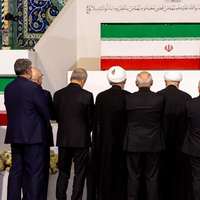
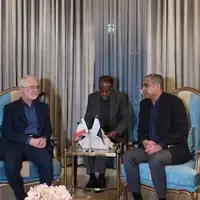
Esmail Qa'ani greeting Supreme Leader Ali Khamenei in 2021
Following Israel's October 4, 2024, strike on Beirut, which targeted Hashem Safiuddin, a potential successor to Hezbollah leader Hassan Nasrallah, speculation has also arisen regarding the status of Ismail Qa’ani, the chief commander of the Quds Force.
Although his deputy stated on Monday that Ismail Qa’ani is safe, the IRGC's public relations department has remained silent, releasing no official updates. Also, Tasnim News affiliated with the IRGC stated on Monday that Qa’ani sent a letter on the occasion of Hamas’s October 7 attack. However, according to Iran International sources, even his family was unaware of his status as of Sunday.
There are reports suggesting that Qa’ani traveled to Lebanon and was likely with Hashem Safiuddin when Israel launched its strike. Hezbollah has also stayed quiet on the outcome of this bombing, following a similar pattern as with Hassan Nasrallah, where the group only confirmed his safety 24 hours after an earlier Israeli bombardment.
Two Iranian officials told Reuters that Qa’ani traveled to Lebanon after Hassan Nasrallah was killed and has not been heard from since the recent Israeli attacks on southern Beirut. In response to a question about the status of Ismail Qa’ani, Mahmoud Qomati, a member of the political council of Lebanon's Hezbollah said: "I have no information."
Bragging vs. silence
The Islamic Republic is quick to publicize events it deems successful, often broadcasting them live. For instance, Friday prayers and war room directives to attack Israel are shown on state media, with foreign coverage re-aired on Farsi outlets. However, when incidents result in failure or embarrassment, the propaganda machine remains silent. A clear example is the conflicting reports following the crash of former President Ebrahim Raisi's helicopter, which remained unclear for 24 hours. Similarly, after the IRGC downed Ukrainian flight PS752, it took three days for officials to admit responsibility, despite their initial denials.
This model of no-information or disinformation has had a history in other totalitarian regimes. The Soviet government closed all channels of information about the Chornobyl nuclear reactor explosion for days in 1986. The Soviet government issued top-secret orders to classify all data related to the accident, especially information about the health of the affected population.
What does this behavior tell us about the propaganda apparatus of totalitarian and authoritarian regimes and even authoritarian parties in democratic systems?
People have no right to know
In authoritarian and totalitarian regimes, those in power often view government and public information as their exclusive property, treating the act of sharing information with citizens as a discretionary privilege rather than a fundamental duty. These systems routinely deny citizens the right to access details about government actions and decisions. For example, Ali Khamenei and the IRGC oversee vast economic enterprises, yet they consistently withhold financial statements, refusing to disclose their annual income and expenditures to the public.
In the Islamic Republic, people do not have the right to know what the officials do in their jobs. The Iranians have been curious why Ismail Qa’ani has been absent from the public arena, including the high-profile Friday prayer on October 4, led by Khamenei. The Revolutionary Guards did not provide any information about his whereabouts if he was with Sheikh Safiuddin during the attack on the Hezbollah building.
Internet disruption and low-quality connection in Iran, which constantly occurs in the conditions of a popular uprising, is to cut off the communication of political activists. In non-protest conditions, it is to prevent information-sharing on social networks, which today about 60 million smartphone owners use to get information. On October 6th, there was an Internet disruptionby major providers in the country.
Why the government’s non-information policy?
The Islamic Republic does not consider information a tool to gain public trust. Four reasons can be mentioned for the Islamist government’s misinformation and disinformation policy:
1. Fear of public reactions: The government is wary of public celebrations or displays of enthusiasm following certain news events. Opponents have often reacted in stark contrast to the regime's sentiments—mourning when the government celebrates, as in the aftermath of 9/11, and celebrating when the government mourns, such as during rumors of Nasrallah's death. To control public sentiment, the government delays releasing information until emotions subside. For instance, news of Raisi's helicopter crash was announced early in the morning possibly to minimize potential celebrations. It was even falsely reported that his motorcade continued to Tabriz after an emergency landing to downplay the incident.
2. Fear of rebellion: The government fears that any display of weakness could spark rebellion, knowing that millions of Iranians are ready to rise up against the government. Major events, like Mahsa Amini’s murder, or any significant blow to the government, could act as a trigger. To avoid this, the authorities suppress information that might fuel dissent.
3. Spreading rumors to pollute public discourse: By withholding information, authorities create a vacuum filled with rumors, causing confusion and distrust. This tactic is aimed at undermining the credibility of foreign Persian-language media and social networks. Over the past 45 years, public officials have not only ignored the spread of rumors but have at times actively fueled them. Some government-affiliated or pseudo-independent outlets even have dedicated "rumor" columns.
4. Overloading the media space: The Islamic Republic uses its vast network of state-controlled outlets to flood the news sphere with contradictory messages. This deliberate saturation leaves the public bewildered and uncertain, making it easier for the government to evade accountability. The conflicting narratives serve to confuse rather than inform, reducing the possibility of coherent opposition.
FILE PHOTO: An anti-Israel billboard is seen next to the Iranian flag during a celebration following the IRGC attack on Israel, in Tehran, Iran, April 15, 2024.
Iranian officials not only continued to threaten Israel on Monday but also glorified the October 7 Hamas attack as the anniversary passed without the anticipated Israeli retaliation.
Vice President Mohammad Reza Aref, in an interview with ISNA, said the threats against Iran after last week's missile barrage were "a joke" as Israel bided its time to respond.
Iranian military leaders spoke defiantly as the country prepared for certain retaliation. Abdolrahim Mousavi, Commander-in-Chief of Iran’s Army, stated that Lebanese Hezbollah, Iran's largest proxy, had inflicted “severe” blows on Israel, and further violence would lead to “harsher” Iranian responses. "If the Zionists commit a crime in response to the reply we gave them, they will undoubtedly receive a stronger and more destructive response," Mousavi said.
They did not acknowledge that Iran's response to the killing of Iran-backed Hamas leader Ismail Haniyeh was only carried out two months later, and on the back of the killing of Hezbollah leader, Hassan Nasrallah.
Meanwhile, Israel's Kan 11 reported that the United States had offered Israel a “compensation package” if it refrained from attacking specific Iranian targets. This package reportedly included comprehensive diplomatic protection and a weapons package, according to American officials involved in the negotiations.
As Israel mourned the one-year-anniversary of the October 7 atrocities, in which 251 people were taken hostage to Gaza and 1,100 mostly civilians were killed, the official X account of Supreme Leader Ali Khamenei in Hebrew stated, "The Al-Aqsa Storm operation", another name for the October 7 attack, "set the Zionist regime back by 70 years."
With the country in mourning, many Israelis felt the timing of a retaliation would be inappropriate on the day when ceremonies around the country focused on those lost and the people still held in captivity.
In an interview with Fox News on Sunday, Israeli Defense Minister Yoav Gallant stated that “everything is on the table” and that Israel would respond to the unprecedented Iranian attack "in the manner of our choosing, and at the time and place of our choosing."
Expectations of an Israeli strike grew on Sunday night as Iran locked down flight paths on the eve of the one-year anniversary of the Hamas attack, but Iran’s Civil Aviation Organization lifted flight restrictions late Sunday night.
Iran's First Vice President said that "no threat [of retaliation] can make us retreat from our plans and actions; we will continue our path firmly", as Iran's proxies around Israel continue to send missiles to the Jewish state.
Adding to the rhetoric, Iran’s National Security Commission also reviewed the country's preparedness for possible Israeli retaliation. Ebrahim Rezaei, the commission's spokesperson, noted that key Iranian military and security institutions, including the IRGC and the Ministry of Defense, presented reports on their readiness to face threats.
As tensions continue to mount, both sides seem poised for a potential confrontation amid a bitter psychological war. While Iran maintains its threats and displays of defiance, Israel's promised response remains to be seen, leaving the region on edge, awaiting the next move.
Israelis gather to mark one year since the deadly October 7 attack by Hamas, in Tel Aviv, October 7, 2024.
As Israel mourns the more than 1,100 deaths from October 7 and the 101 hostages still held by Iran-backed Hamas in Gaza, the country awaits a response to last week’s Iranian missile barrage.
While honoring the fallen, including hundreds of IDF soldiers lost in the war in both Gaza and south Lebanon in Israel’s war against Iran’s proxies, the country still wonders when Prime Minister Benjamin Netanyahu will wreak the revenge promised for last week’s 181 ballistic missiles, an underlying topic which bubbles beneath the surface.
The assassination of Hezbollah leader Hassan Nasrallah boosted the premier in public opinion amidst the country’s longest war, and now, Israelis want more. The mood was dampened soon after, however, as at least nine soldiers fell in Israel’s ground operation in southern Lebanon.
Just like Iran’s delayed retaliation to the July 31 killing of Hamas political leader Ismail Haniyeh in Tehran, Israel is biding its time, allowing the country to enjoy celebrations, albeit muted, for the new year, and now, the commemorations of October 7, in peace.
Not only is this a psychological war, but Israel must now weigh its options along with its powerful ally, the US, which has warned the response must be “proportional”.
President Joe Biden, known for his softly softly approach to Iran, still wields power over the Jewish state, with Israel’s Defense Minister, Yoav Gallant, scheduled to visit the US to discuss strategy on Wednesday.
Israelis gather to commemorate the one year since the deadly October 7 attack, in Tel Aviv, October 7, 2024.
On Monday, marking one year since the bloodshed of October 7, when Iran-backed Hamas launched an air, land, and sea invasion of Israel, Israeli media focused on those lost in the deadliest single day for Jews since the Holocaust. The attack shocked the world, targeting one of the most militarily advanced nations.
But Iran is always lurking behind the scenes. Danielle Edelstein, a mother of four who lives in Tel Aviv, told Iran International: “Of course none of us knows what’s going to happen, but something has to happen. Last week’s attack was something no state can tolerate.”
For Netanyahu, whose popularity fluctuates almost daily, the response is crucial to his political survival. With each reminder of the horrors of October 7, the growing resentment toward Israel’s longest-serving premier becomes increasingly evident.
Israel’s Maariv newspaper surveyed the country last month, finding 47% felt he was most suitable for Prime Minister, even before the assassination of Nasrallah. That was a huge boost from polls in the wake of October 7 when around 70% of the country called for his resignation.
Last week, a Channel 12 poll also showed that Netanyahu’s Likud party would win a new election.
It has been the result of a series of killings, including leader of Hamas’s military wing, Mohammed Deif, in Gaza, the brazen killing of Haniyeh in Tehran, though Israel did not admit responsibility, and most recently, Nasrallah.
The IDF has been steadily wiping out the leadership of Hezbollah as airstrikes pound the group designated in countries such as the UK, US and Europe.
“We needed to see he was doing something,” said Ruthy Tuito, whose son is in the reserves. “We had so much inaction for such a long time, that these things give us hope that the government is standing up to the threats,” she told Iran International.
On Monday morning, marking the one-year anniversary, while commemorations were held at killing sites, Hamas launched more missiles at the time of the attacks last year, sirens first heard at 06:29.
Meanwhile, Hezbollah continued its assault on Israel’s north as the IDF pounds military infrastructure and advances airstrikes in Hezbollah infrastructure in Beirut.
Iran’s proxy in Iraq also sent projectiles in the early hours of Monday morning, intercepted by the IDF, identifying the source only as “from the East”, usually reflective of those coming from Iraq.
“This isn’t going to end without some kind of more affirmative action,” said Roni Avrahami, who has been serving in the reserves since the beginning of the war. “No country can live like this. Nobody wants more war, but we need to take action and we need our allies to stand by us in the process. This is not an enemy which deals with diplomatic solutions.”
Israel is already battling threats on all its borders, the Iran-backed Houthis in the south on the Red Sea coast, and proxies in Syria, Lebanon, Gaza, the West Bank, and Iraq.
But for now, the question is when, not if, the country will retaliate for the second attack from Iran this year, and one which no nation would be able to let pass.
People try to enter Hamid Karzai International Airport in Kabul
Iran has intensified its deportation efforts, aiming to expel at least two million undocumented migrants by the end of March 2025, according to Ahmad Reza Radan, commander of Iran’s law enforcement forces.
"Our goal this year is to return and deport at least two million illegal foreign nationals to their countries," Radan said Saturday in an interview with IRNA, the official government news website.
Although Radan did not explicitly mention any nationality, the term “foreign national” is widely used by Iranian officials and media to describe Afghan nationals, who constitute the overwhelming portion of the migrant population in Iran. United Nations refugee agency UNHCR estimates that nearly 4.5 million Afghan nationals currently live in Iran. However, recent estimates mentioned in the Iranian media say the population has swelled to nearly 10 million Afghans - or more than 10 percent of the country's population.
Over 500,000 people have already been arrested and deported, and more than 250,000 have voluntarily turned themselves in, bringing the total of those deported to 750,000 according to Radan.
"We cannot allow some individuals to enter the country illegally, reside, and work. Citizens and business owners should know that employing these individuals and housing illegal foreign nationals is a crime," Radan added.
This comes as part of a broader crackdown that has seen increased deportations and stricter regulations on residency.
There has always been a steady influx of Afghans into Iran, with the migrant population estimated at around 2.5 million over the past decade. However, after the Taliban's takeover of Afghanistan, the numbers surged, with millions crossing the border. Many Iranians blame the Islamic government for not sealing the border, suspecting it of harboring intentions to use Afghans as foot soldiers—both to control the disgruntled domestic population and as fighters in Middle East conflicts.
On Sunday, Valiollah Bayati, spokesperson for the parliament’s internal affairs commission revealed that under the proposed plan, "there will no longer be provisions for permanent residency" for foreign nationals in Iran, and only temporary permits of one year, three years, or possibly seven years will be offered.
With 2 million deportations planned in the next six months, these measures look set to intensify the difficulties faced by Afghan migrants and refugees, raising concerns about the broader social and humanitarian implications for the population fleeing Taliban rule in war-torn Afghanistan.
The Taliban-controlled Bakhtar News Agency reported that 241 Afghan families were deported from Pakistan and Iran on Friday.
Many Afghan nationals who are now at risk of deportation under this plan include women and former government employees who fled fearing persecution. Under the proposed plan, it is becoming increasingly difficult for these groups to secure long-term legal status in Iran, leaving many vulnerable to deportation.
Informed sources have told Iran International that even the family of Quds Force commander Esmail Qaani remains unaware of his current status, as the IRGC has yet to release any official statement regarding his fate.
Reports emerged on Saturday that Qaani might have been in Beirut following the death of Hezbollah leader Hassan Nasrallah and continued Israeli air strikes on position of the Iran-backed group. No one has heard about Qaani since October four and there are speculations that he might have been killed or injured in Israeli air strikes.
A targeted airstrike, which aimed to eliminate Hashem Safieddine, a senior Hezbollah leader and potential successor to Hassan Nasrallah, has raised speculation about Qaani’s possible presence at the bombed location. The New York Times, citing three unnamed Iranian officials, reported that Qaani had traveled to Lebanon last week to meet with Hezbollah officials in an effort to strengthen the group.
Reuters also reported on Sunday that according to Iranian officials Qaani has not been heard from since Friday. Senior Hezbollah official Mahmoud Qmati told Reuters: "I have no information, we are also searching for the truth of this matter."
While Israel’s Channel 12 suggested that Qaani might have been injured in the attack, there has been no confirmation from Iranian authorities. A Lebanese security source told Reuters that communication with Safieddine has been cut off since the strike, further fueling concerns about high-level casualties among Hezbollah leadership.
Qaani’s absence from key government ceremonies in Iran, including an event where Supreme Leader Ali Khamenei awarded a military badge to IRGC Aerospace Forces commander Amirali Hajizadeh, has only added to the growing uncertainty. Iran has not released any recent photos or videos of Qaani.
Meanwhile, in a sign of heightened tensions and amid fear of possible Israeli retaliation for last week attack, Iran's Civil Aviation Organization has canceled all flights from Sunday evening to Monday morning, citing "operational limitations." This follows a pattern seen in April when Iranian flights were suspended for nearly 48 hours after Iran launched missile attacks on Israeli positions.
At the same time, Israeli Defense Minister Yoav Gallant responded to recent Iranian actions with a stern warning. "Whoever thinks that a mere attempt to harm us will deter us from taking action should take a look at Gaza and Beirut," Gallant stated, referring to the October 1 Iranian missile strike on two Israeli air force bases. Gallant emphasized that no Israeli aircraft or squadrons were damaged in the strike.
As tensions escalate, both sides are preparing for potential further confrontations, with Iran threatening reciprocal action if Israel launches any new attacks. Iran closed its airspace Sunday night until Monday morning.
Gasoline supply in Iran faced abrupt changes on Sunday, with new limits imposed on daily refueling and fuel station allocations, sparking concern about potential price hikes.
The government that controls fuel products announced that vehicle owners using its rationing system of smart fuel cards are now limited to fueling "twice a day," with a maximum of 50 liters per session.
The new directive reduces the previous refueling limit of 60 liters to 50, although the monthly quota of 300 liters remains unchanged. However, officials did not provide any explanation or the reason for the daily refueling reduction, a move that has alarmed the public and some media outlets.
Under a plan announced in 2023, about 70% of citizens can receive 30 liters of gasoline per refueling session in small towns and 40 liters in large cities.
However, until Iran’s second attack on Israel last week, during which 181 ballistic missiles were fired at the Jewish state, the plan had not been implemented in the capital, where Tehran residents could still refuel up to 60 liters as before.
As Israel has vowed retaliation as a national duty, Iran's critical infrastructure, including refineries are now in the firing line.
Although Iran has one of the world's largest oil reserves, it suffers from gasoline shortages due to the limited refining capacity. President Masoud Pezeshkian raised the issue of higher gasoline prices during the election campaign, but after the victory, his cabinet’s statements were contradictory.
In August, Pezeshkian said in a speech: "There is no logic in buying gasoline at the free market dollar rate and selling it to the public with subsidies."
The remarks faced negative reactions from social media users.
Economic journalist Reza Gheibi, in an interview with Iran International, warned that "increasing gasoline prices" is the government’s ultimate goal. He predicted further measures, including cutting individual quotas and raising both free market and subsidized gasoline prices in the coming years.
Gheibi emphasized that “the current restrictions are a prelude to price hikes, which could trigger social unrest akin to the 2019 protests” that erupted following a 200% gasoline price increase. Those protests saw widespread anti-government demonstrations, which were met with crackdowns, with reports suggesting over 1,500 people were killed by security forces.
The timing of the new fuel restrictionscoincides with a major energy crisis in Iran. This summer, the country faced a 20,000-megawatt electricity deficit and a shortage of natural gas, forcing power plants to rely heavily on diesel and fuel oil, both of which have seen dramatic consumption increases. Fuel oil now accounts for 25% of power plants' fuel supply, and this figure is expected to rise to 50% by winter.
According to the Ministry of Oil, Iran's strategic diesel and fuel oil reserves would last only 10 days if no additional fuel is provided for industrial or transportation purposes, raising fears of a prolonged energy crisis. The country's gasoline reserves are also critically low, with only enough fuel to cover one week of domestic demand if consumption spikes during the winter months.
Israel’s reported consideration of targeting Iran's oil refineries as part of a potential retaliation could further cripple the country's energy sector. The loss of refineries such as Persian Gulf Star or Abadan would wipe out 30% of Iran's fuel production, exacerbating the shortages. A single strike on the Kharg oil terminal could cut off 90% of Iran’s oil export capacity, dealing a blow to the economy.
A loss of refinery capacity or further cuts in fuel supplies could plunge the country into hyperinflation, driving poverty levels even higher amid an inflation rate already exceeding 40%.