Iran criticized over medical aid to injured Hezbollah members after pager attacks
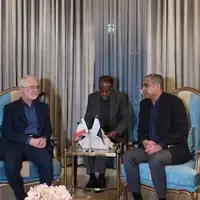
Head of the Iranian Red Crescent Society, Pirhossein Kolivand, (middle) departed for Lebanon on September 19, 2024 at the head of a medical team.
Iranians have reacted to the treatment of several Hezbollah members whose eyes were injured in explosions in Lebanon while Iran's security forces blinded hundreds of protesters during the crackdown on 2022 protests.
Several have voiced their discontent over social media to fighters being brought to Iran and Iranian doctors sent to Lebanon to treat Hezbollah operatives in the wake of two targeted attacks this week.
One citizen, in a video sent to Iran International, commented: "The Islamic Republic blinded Iranian protesters and didn't allow them treatment, but treats Hezbollah's wounded in Iran."
This week saw two separate incidents in which the communication devices of scores of Hezbollah forces exploded, leading to hundreds of casualties and multiple deaths.
The Tuesday explosions targeting pager devices belonging to the Iran-backed militant group occurred in Beirut, killing at least 12 people and injuring around 2,800 others, with 300 reported in critical condition.
The following day, more explosions targeted Hezbollah's walkie-talkie devices in various cities across Lebanon. According to Lebanon's Ministry of Health, these incidents left at least 37 people dead and many injured.
While Israel has not commented, the blame has been laid at the Jewish state. Just minutes before the attack, Israel released news of having foiled a Hezbollah plot to assassinate a former security chief in Israel.
The two countries have been involved in daily bombardments since October 7 when Iran-backed Hamas invaded Israel. In allegiance with Hamas, Iran's biggest proxy has since fired over 6,000 projectiles towards Israel, leading to a conflict displacing around 200,000 people on both sides of the border.
People walk near an ambulance outside American University of Beirut Medical Center (AUBMC) as people, including Hezbollah fighters and medics, were wounded and killed when the pagers they use to communicate exploded across Lebanon, according to a security source, in Beirut, Lebanon September 17, 2024.
In response to the explosions, Pirhossein Kolivand, head of Iran’s Red Crescent Society, announced that 95 of the injured had been transferred to Iran for further treatment.
Kolivand also confirmed that two groups of Iranian doctors, including eye specialists, had been dispatched to Lebanon. In another interview, he noted that 12 doctors, along with nurses and paramedics from the Red Crescent, were also deployed to assist in Lebanon.
The decision to treat the Hezbollah forces has been met with a flood of backlash on social media. Masih Alinejad, a prominent journalist and women’s rights activist, reacted on X: "The hypocrisy is glaring: the same regime that intentionally blinded peaceful Woman, Life, Freedom protesters in Iran is now offering medical care to Hezbollah operatives who lost their eyesight to pager explosions."
In 2022, during protests over the killing of Mahsa Amini, Iranian security forces were accused of deliberately targeting protesters’ eyes, blinding many of them, in addition to killing over 550, including women and children.
Ehsan Karami, a former TV host and actor, voiced his frustration online: "Why should the people of Iran bear the cost of transferring and treating these individuals, who will undoubtedly receive the best medical care? Rubber bullets and eye removal are the share of Iranian youth, while exclusive flights and special treatment in Tehran are reserved for Hezbollah’s freeloaders."
Sociologist Majid Mohammadi also weighed in, saying: "Netanyahu played the role of God for those seeking justice for the brutal shootings by Basij militia and Special Units that targeted the eyes, hands, and legs of protesters in the Mahsa movement. Three thousand members of Hezbollah and their associates have suffered eye injuries (with 500 blinded), and many have had their fingers and hands amputated. Netanyahu brought smiles to the faces of the families of Iran’s martyrs."
A user identified as Leadsoldier highlighted the contrast between how Hezbollah fighters are treated compared to Iranian citizens: "While our brave young freedom fighters are wandering from place to place seeking treatment for their eye injuries, Hezbollah’s freeloading terrorists receive free care in the best hospitals in the country. This injustice weighs even heavier when we witness the meager income and unbearable pressure on our nation's nurses and medical staff."
International human rights organizations have also brought attention to the issue of eye injuries sustained by Iranian protesters. The Human Rights Center at UC Berkeley earlier verified that at least 120 people had lost some or all of their vision when Iranian security agents used shotguns, paintball guns, and tear gas canisters to suppress protests in 2022. While the Center stopped short of declaring that blinding protesters was a coordinated policy, the evidence indicated that many victims were shot in the face at close range.
The Iran Human Rights Organization (IHR) also corroborated the findings, stating that security forces “systematically” targeted the eyes of protesters, particularly women, during the protests. An IHR report confirmed 138 cases of eye injuries, including eight children under 18. The majority of the injuries resulted from pellets, with others caused by paintball guns and tear gas cartridges.
Iran is also in the midst of a dire health crisis with shortages of medicine and healthcare practitioners who are fleeing the country in droves in search of better working conditions and salaries.
Iranian hackers tried to pass information stolen from former President Donald Trump's campaign to President Joe Biden's team earlier in the US election, a joint statement by top US security agencies said on Wednesday.
"The FBI has learned additional details about Iran’s efforts to sow discord and shape the outcome of U.S. elections," the statement said.
"Iranian malicious cyber actors in late June and early July sent unsolicited emails to individuals then associated with President Biden’s campaign that contained an excerpt taken from stolen, non-public material from former President Trump’s campaign as text in the emails," it added.
The investigation comprised the the Office of the Director of National Intelligence, the FBI and the Cybersecurity and Infrastructure Security Agency.
"Wow, just out! the FBI caught Iran spying on my campaign and giving all of the information to the Kamala Harris campaign," Trump said in a post on Truth Social on Wednesday evening.
"Therefore she and her campaign were illegally spying on me. To be known as the Iran, Iran, Iran case! will Kamala resign in disgrace from politics? Will the communist left pick a new candidate to replace her?"
Iranian officials have long called for revenge on Donald Trump who was responsible for the assassination of Quds Force Commander Qassem Soleimani, killed in an airstrike in Iraq.
Iran was also alleged to have meddled in the 2020 presidential election, and US investigators said two Iranian hackers stole confidential US voter information from at least one election website.
They posed as members of the Proud Boys fascist militant group to send threats to Democrats, according to the indictment documents.
Then, according to the FBI, in 2022, Iranian hackers used similar tactics to target voters in the month before the elections.
An Iranian daily has revealed that 14 paintings stolen from Tehran’s Imam Ali Religious Arts Museum have been sold in Dubai, with no information on the whereabouts of 16 other missing works.
The museum, overseen by Tehran's municipality, is now embroiled in a scandal that raises questions about corruption and negligence at the highest levels.
Naser Amani, a member of Tehran's city council, revealed the situation on Monday, estimating that just one of the missing works alone was valued at 300 billion rials (approximately $500,000).
During a city council session, he announced that 30 priceless paintings had vanished after being loaned out for a supposed exhibition—an exhibition that never took place.
Amani’s revelations have stirred outrage as the council member underscored the municipality's legal responsibility to protect public assets. Despite repeated inquiries, officials have failed to provide any explanation or accountability.
"We’ve tried to follow up on this, but not only have we not received a report, no one has provided a clear answer about where the valuable artworks are,” Amani lamented.
Imam Ali Museum
This latest scandal is far from an isolated incident. Iran has seen a pattern of negligence and outright theft involving its artistic and historical treasures under the Islamic Republic’s governance. From carpets stolen from the Sa’dabad Palace to now-missing paintings, critics argue that corruption and a lack of oversight are enabling the plunder of Iran’s cultural heritage.
The report brings further attention to the gravity of the issue, noting that while 14 of the artworks have already been sold in Dubai, home to as many as half a million Iranians, there may still be hope for the remaining 16 pieces which have not yet surfaced in any known markets. The question remains, however: where are these priceless works, and in whose hands have they fallen?
"Most of the artworks have been sold at prices significantly lower than their real value and the Iranian art market prices,” added the Sanadegi publication.
The sale of Iranian cultural artifacts in foreign markets has long been a point of contention. Many believe that these "disappearances" are not just the result of bureaucratic mismanagement but could be linked to operations involving the black market.
Some users on social media have even accused officials of profiting from the sales, suggesting a deliberate neglect of the country's cultural assets.
The fate of the 30 missing paintings is just one chapter in a broader narrative of how Iran’s cultural heritage is being systematically undermined. The theft of 48 handwoven carpets from Sa’dabad Palace between 2013 and 2016 is another glaring example of the government's inability—or unwillingness—to protect national treasures.
Israeli prime minister Benjamin Netanyahu and Defense Minister Yoav Gallant during a press conference in the Kirya military base in Tel Aviv , Israel , 28 October 2023.
Israel’s Shin Bet, the country's domestic intelligence service, has disclosed info about what it calls a thwarted Iranian assassination plot against Prime Minister Benjamin Netanyahu, Defense Minister Yoav Gallant, and Shin Bet Director Ronen Bar.
The plot escalated following the assassination of Hamas political leader Ismail Haniyeh in Tehran in July, according to Shin Bet.
The Iranian scheme also included plans to target former Prime Minister Naftali Bennett and other senior Israeli defense figures, although the details have not been confirmed.
The operation sought to exploit an Israeli businessman with extensive ties to both Turkey and Iran, leveraging his financial networks to facilitate the assassination attempts within Israel. The businessman was indicted on Thursday.
In April, Turkish citizens Andrei Farouk Aslan and Guneid Aslan contacted an Israeli businessman, involving him in financial transactions and inviting him to a meeting in the Turkish city of Samandag, according to the Jerusalem Post.
At the meeting, he was asked to travel to Iran where he met with a wealthy Iranian named Wadi and an Iranian security official named Haj. The Jewish businessman initially requested $1 million before agreeing to participate.
In August, during a second smuggled trip to Iran, he received €5,000 and was tasked with logistical and weapons-related activities for a plot, including converting a Mossad agent into a double agent and assisting in assassination plans against Israeli leaders.
He was also asked to film Israeli sites for intelligence purposes and deliver threats to Israelis working for Iran who weren't following orders.
Additionally, the businessman was approached about recruiting Russians and Americans to assassinate Iranian dissidents living in Europe and the US.
Last year, Mossad intelligence chief, David Barnea, revealed Israel had foiled multiple plots against Jewish or Israeli targets around the world but this is the highest level assassination attempt on Israeli soil.
It comes as Israel and Iran continue their shadow war, Iran's proxies surrounding the Jewish state with attacks from Yemen, Lebanon, Syria and Iraq amid the war in Gaza against Iran-backed Hamas.
For over a decade, Iran has been recruiting Israelis to carry out plots inside Israel. Most recently, in July, three Israelis were arrested for supporting a plot paid for by Iran.
Mostafa Tajzadeh asserts that Supreme Leader Ali Khamenei is responsible for Iran's problems, and that Masoud Pezeshkian’s proposed ‘reforms’ will only be a mirage unless Khamenei agrees to fundamental changes.
In his recent note from Evin Prison entitled “New Era or Mirage” , the former advisor to reformist President Mohammad Khatami has outlined a long list of fundamental political and social reforms that only Khamenei can authorize. Without these changes, he believes, no real progress is possible.
These reforms include ending the Revolutionary Guard’s involvement in politics, economy, and diplomacy and a revision of the Constitution that would limit the powers of the Supreme Leader and his appointed bodies.
“I believe that changing governments without a shift in leadership strategies will not resolve the country’s issues or ensure the welfare of its citizens,” Tajzadeh asserted in his note. He also expressed support for some of the recent steps taken by Pezeshkian’s government, including several appointments.
He also insisted that Khamenei must make peace with the United States and end proxy wars in the region and give priority to the country’s economic and technological development in the same way that the first leader of the Islamic Republic, Ruhollah Khomeini, accepted UN Resolution 598, ending an eight-year war with Iraq in the 1980s.
Khomeini famously referred to the acceptance of the Resolution as drinking a “chalice of poison”.
Tajzadeh’s note comes amid ongoing debates among Iran's 'reformists' about whether Pezeshkian’s presidency marks a ‘new era’ or if his ‘national unity’ government—which he claims has Khamenei’s approval—is merely a scapegoat that will bear the blame if the country’s deep-rooted economic issues remain unresolved.
Prominent reformist journalist and politician Abbas Abdi is the leading proponent of the idea of a ‘new era’ with Pezeshkian’s presidency. Abdi argues that Khamenei has accepted the necessity of change and insists that reformists like Tajzadeh should not make ‘radical’ demands that may put him off.
Here’s an improved version:
Last week, Abdi called on the authorities to release Tajzadeh, who has been serving an eight-year sentence for his political activities over the past two years. This appeal came after Tajzadeh was informed of a new five-year sentence. Abdi himself has been convicted of “spreading lies and writing against the Constitution” and is currently awaiting sentencing.
There are also those who argue that Khamenei did not allow Pezeshkian—endorsed by most reformists—to win the Presidency in order to usher in a new era, and that he had no intention of initiating fundamental political, cultural, and social reforms.
Instead, they believe, the Supreme Leader only wants difficult and unavoidable economic "surgeries" including increasing the prices of fuel, electricity, and other subsidized commodities and services to be carried out by Pezeshkian’s government.
According to Tajzadeh, these critics argue that everyone—especially the ruling establishment—will benefit if the new government succeeds in making and implementing "difficult economic decisions." They suggest that if the government succeeds, the Leader will avoid criticism, while reformists will bear the blame if it fails.
Tajzadeh warned Khamenei in his note that he must never think he can “survive through crises” by giving a share in government to reformists and by implementing the difficult economic reforms that he knows cannot be avoided “without fundamental political, cultural, social, and diplomatic changes.”
Protesters in Iran's 2022 uprising that was sparked by Mahsa Amini's death in police custody
The United States on Wednesday issued fresh sanctions against 12 Iranian officials accused of violating the human rights of its citizens within and beyond the countries borders.
Those sanctioned include members of the Islamic Revolutionary Guard Corps (IRGC) and officials from Iran’s Prisons Organization who played a role in suppressing widespread protests that followed the death of a young Iranian woman in September 2022.
“Two years have now passed since Mahsa Amini’s tragic death in the custody of Iran’s so-called ‘Morality Police,’ and, despite the Iranian people’s peaceful calls for reform, Iran’s leaders have doubled down on the regime’s well-worn tactics of violence and coercion,” said a senior Treasury official on Wednesday.
Top on the new sanctions list are four senior IRGC personnel who supervised crackdowns in four Iranian provinces, named as Hamid Khorramdel, Mustafa Bazvand, Ali Malek-Shahkoui and Saeed Beheshti-Rad.
“In cities all over Iran, IRGC units have used lethal force against protestors, arrested people for political expression, and attempted to intimidate the Iranian people through violence,” the US Treasury’s Office of Foreign Assets Control (OFAC) said.
Also on the list are two IRGC and intelligence officials who allegedly targeted critics of the Islamic Republic abroad and four prison officials from three other provinces where dozens of prisoners were executed for drug offenses which even per Iranian law do not rise to the level of capital punishment.
The new measure has been coordinated with Canada and Australia and builds on multiple rounds of U.S. sanctions since the 2022 protests in Iran.