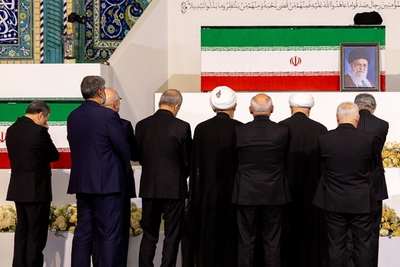
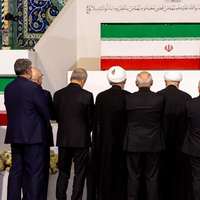
A scene from a mourning ceremony for Hamas leader Ismail Haniyeh in Tehran (August 2024)
Foreigners are often baffled by the vague, poetic, and indirect way Iranian officials speak, while Iranians, though more accustomed to this style of communication, often find it frustrating as well.
Shia Islamists, whether clerics or laymen, preachers or officials, often speak in a way that discourages critical thinking and engagement. Their audience expects serious and decisive words, as these Islamists hold significant influence over the fate of the Iranian people. However, their speeches are designed to stifle analytical thought, suppress demands, and leave listeners in a state of uncertainty. What are the characteristics of this style of communication?
The first tactic is to position oneself as a savior, effectively shutting down any demands or questions. Words from the savior are treated as invaluable treasures to be appreciated, not analyzed or criticized. For example, the head of the policy council for Friday imams across the country stated, "All people of Iran owe a national debt to the Friday prayer headquarters of Mashhad." This implies that there is no room for accountability. The authorities of the Islamic Republic see themselves as creditors to the people, rather than debtors or responders.
The second tactic is to present oneself as ascetic and devout, seemingly unconcerned with power, wealth, or status, while having unfettered access to the nation's resources. For instance, Kazem Nourmofidi, Khamenei's representative in Golestan Province, says, "The most important right of God is that His servants do not set their hearts on position, status, and wealth, but follow the path of obedience to God… Attachment to worldly matters is a sign of being distant from God's piety." Ironically, the person preaching this has a corruption case and is part of a group that controls the country’s resources. When he speaks of "servants," he refers to followers, not religious leaders.
Kazem Nourmofidi, Khamenei's representative in Golestan Province
The third characteristic is a lack of accountability. Shia Islamists tend to blame the country's problems and crises on external factors, from America and Israel to the West, modernity, and liberalism. For example, Habibollah Sha'bani, Khamenei's representative in Hamedan Province, claims that "liberal views and feminist tendencies... have created cultural problems in the country. What is presented as modernity today contributes to cultural and social issues." Given how disconnected these views are from reality, engaging in meaningful dialogue with such individuals often proves futile.
The fourth characteristic is the bold linking of unrelated matters. For example, there may be no significant connection between the decision to have children and wearing the hijab, but such a connection is nonetheless asserted, aligning support for family values with support for mandatory hijab. Hossein Seyyed Samei, head of the Islamic Propaganda Department of Dilijan, claims, "If no action is taken regarding chastity and hijab, the economy and the foundations of the family will be damaged, and society will face an aging population in the future."
Another example is linking divorce to communication tools. Hossein Hosseini Qomi, an instructor at the Qom Seminary, states, "The main reason for divorce is mobile phones, Instagram, and free and open cyberspace. If you want the foundation of the family not to be destroyed, you must first control virtual space, then control the street and market space, and take the areas of sinning seriously." These connections are made to align various social and cultural issues under a single ideological framework, regardless of the actual relevance between them.
The fifth characteristic is portraying themselves as victims. This rhetoric began when Islamists were not in power but has continued even as they hold significant authority. Despite the fact that Sunnis in Iran are denied the right to have mosques in major cities, Shia clerics frequently complain about restrictions on Shia Islamic centers in other countries, often imposed due to concerns over terrorism and the preaching of hate. For example, Hossein Nouri Hamdani, a state-sponsored religious figure, condemned the closure of the Hamburg Islamic Centerby German police in July, calling it "a great cultural injustice, a violation of the sanctities of all Muslims, and an attack on the rights of all united people who support justice, freedom, spirituality, and human rights." This narrative allows them to deflect criticism and maintain a stance of moral superiority, even in the face of legitimate concerns about their actions.
The sixth characteristic is creating an exaggerated, illusory need for the presence of Shia clerics. For instance, Mohammad Reza Modaresi Yazdi, a member of the Guardian Council, claims, "The Islamic Republic needs seminary students in various fields... The Islamic society is hungry for virtuous seminary students, and the people also need them in their lives." However, no research or surveys support such a claim.
The seventh characteristic is tautology, where clerics use circular reasoning to reinforce their points. They argue that if people engage in religious practices, they will undergo religious transformation. For example, Abdul Karim Abedini, Khamenei's representative in Qazvin province, says, "If people have a relationship with the mosque, congregational prayers, pulpits and preachers, we will witness change, and religious concerns in society will be strengthened." Essentially, this means, "If people observe their religiosity, they will become religious."
They project their own beliefs and interests onto the general public. For example, Nasser Makarem Shirazi, a state-sponsored religious figure, claims, "People still consider the clergy as a reliable authority in their religion and world, and they expect them to interpret the Holy Quran and explain the hadiths... People expect the seminaries to guide them to happiness, both in this world and the hereafter." However, no independent research or surveys support this assertion.
All the rhetoric mentioned above can be easily dismissed by the public without any real consequence. Propagandists of the Islamic Republic speak not to inform or analyze, but simply to speak. Their words neither convey valuable information, articulate policies, nor address the concerns and demands of the people. Shia Islamists essentially exploit their audience, offering nothing in return for their attention. Listening to them does little to enlighten the public about governance or spirituality. To them, speaking is synonymous with ruling and fulfilling divine responsibilities, devoid of any civil accountability.
Ali Khamenei publishes a poem from time to time to remind the Iranian people that he is not only in the business of wiping Israel off the map and slaughtering Jews and dissidents but also has a soft and mystical side. In his new sonnet, he calls himself "a guru" and "in the color of spring". He depicts himself as a flood that borrows its freshness from mountains. His mysticism is a reaction to a lack of charismatic perception in the minds and hearts of the Iranian people.
As a result, looking to their words for insights into the government’s policies, plans, or decisions is misguided. These individuals are merely propagandists of a religious totalitarian regime, and everything they say serves to bolster the authority and survival of this system. They have no red lines. Their rhetoric is filled with lies, carelessness, speculation, and conspiracy theories. They do not speak to convey facts or realistic perspectives; they speak to create illusions.
* All the quotes in this article were taken from the short news section of Iran International Persian website in July 2024.
Over 90% of Iran’s population is dissatisfied with the country’s current state, with a significant portion believing that the situation is 'beyond repair' amid authoritarian crackdowns and an economic crisis.
The revealing insight comes from a new survey conducted by a department affiliated with the Ministry of Culture, published by the pro-reform daily Ham-Mihan on Sunday.
The results, part of the Fourth Wave of the National Survey on Values and Attitudes of Iranians, offer a rare glimpse into public sentiment in a system that often avoids transparency about the true depth of dissatisfaction among its citizens.
Conducted in November 2023 by the Office of National Plans of the Research Institute of Culture, Art, and Communications, the survey polled 15,878 Iranians over the age of 51 across 15 provinces.
Iran's oil workers in a strike rally in the south of the country on December 17, 2022
While the full survey results have not yet been made public, sections of the data have been released to researchers and are slowly being published. According to Ham-Mihan, 92% of respondents expressed dissatisfaction with the country’s current trajectory, with about one-third of them going so far as to state that “the country’s situation is beyond repair.”
This figure comes as no surprise in a country that is in the midst of the worst economic crisis since the founding of the Islamic Republic, international isolation, and rising authoritarianism.
Among the most pressing issues identified by respondents were inflation and high prices (81.9%), unemployment (47.9%), addiction (26.9%), corruption (13.1%), housing shortages (12.1%), and, notably, the issue of the hijab (11.9%).
The prominence of the hijab issue, which has risen to become the sixth most important concern, reflects a dramatic shift in public sentiment following the death of Mahsa Amini in 2022 while in the custody of the morality police.
Protests that erupted after her death challenged the Islamic Republic’s dress codes and have since shifted the national debate on personal freedoms, particularly for women.
The survey also underscores the growing sense of insecurity among Iranians, with 54.8% of respondents stating that their property and belongings are not safe. Women, in particular, expressed concerns about safety, with 14% stating they feel "very little" safety in public, and 21.5% indicating they feel "somewhat unsafe."
Sociologists warn that this overwhelming sense of hopelessness could lead to greater unrest. Speaking to Ham-Mihan, sociologist Simin Kazemi pointed out the fact that 60% of eligible voters did not participate in the first round of the 2024 presidential election, a sign of widespread political disillusionment.
“If the new government fails to seize this opportunity and address the concerns, growing dissatisfaction could spiral into political and social crises larger than anything we’ve seen before,” Kazemi said.
The outlook painted by the survey echoes past studies, including a 2022 poll by the Gamaan Institute, which found that 81% of respondents inside Iran wanted an end to the Islamic Republic altogether. Similarly, a 2021 survey by the Iranian Students Polling Agency (ISPA) revealed that 59% of Iranians had no hope for the future of their country.
Iranian President Masoud Pezeshkian during a visit in Mashhad (September 2024)
A prominent centrist politician in Tehran asserts that over the years, hardliners endorsed by Khamenei, as well as reformist, conservative, and moderate governments, have all failed to deliver and the nation can hardly trust anyone.
According to Gholamhossein Karbaschi, former Tehran mayor and secretary-general of the centrist Executives of Construction Party, hardliners, reformists, and even the current Pezeshkian administration risk losing public trust unless Pezeshkian fulfills key promises. Karbaschi emphasized that Pezeshkian needs to show he is committed to changes in social media and hijab restrictions, and the release of protest leaders, as he has publicly pledged, in order to distinguish his government and gain credibility.
On foreign policy, Karbaschi emphasized that the public desires leaders to avoid creating tensions and to work on reducing existing ones. He stressed that easing relations, even with the United States, should be a fundamental principle of Iran's foreign policy, advocating for a more pragmatic and conciliatory approach to international relations.
Karbaschi also said in his interview with "reformist" Didar News: "If Pezeshkian fails to deliver, all hope will go out the window," Karbaschi warned. He added that in the recent presidential election, people were fed up by ongoing domestic and foreign policy issues, alongside economic crises. Despite their frustration, it was clear they were ready for change. However, due to past restrictions on candidates, many had lost faith in the electoral process. Karbaschi stressed that Pezeshkian must seize this opportunity to enact meaningful reforms to restore public trust.
Iranian President Masoud Pezeshkian during a visit in Mashhad (September 2024)
He pointed out that the crackdown on women defying the hijab, the poisoning of schoolchildren—allegedly orchestrated by hardline elements—along with worsening social issues and increasing economic hardship, have intensified the public’s demand for change. The stalemate in Iran’s foreign relations has further fueled this unrest. Karbaschi added that the public's reluctance to participate in recent elections reflects their disappointment with all political factions, including the "reformists," whose performance has contributed to widespread disillusionment with the political process.
During this week, Pezeshkian has said that he believes solving the country's economic problems needs an "economic surgery." However, some economists have expressed doubts that the idea which is reminiscent of an expression used by former President Ebrahim Raisi could be a prelude to a new round of price rises.
Meanwhile, National Development Fund Chief Mehdi Ghazanfari quoted Pezeshkian as having said that he will not allow the underprivileged to be crushed under the pressure of any economic reforms. He further warned the President that a less painful road to development is feasible only through oil exports, but did not offer any further explanation.
Discussing ways to address Iran's cultural and economic issues, Pezeshkian recently called for encouraging Iranian expatriates to invest in the country. "We should assure Iranians living abroad that they won’t face harm if they return to Iran," he said. However, social media users quickly questioned why this attitude doesn't start with Iranians already living in the country, suggesting that offering better internet access and social media freedoms would be a good first step in improving the domestic situation.
Karbaschi stated that Pezeshkian may not be able to solve all the problems, but he needs to show that he is doing his best. This will also encourage the people to take part in future elections.
When asked about Pezeshkian's chances of success, Karbaschi noted, "I believe he made those promises based on agreements with key individuals. However, if he fails to fulfill them—such as lifting internet filtering—it will damage his credibility, especially since internet access is crucial to many people's livelihoods." Karbaschi added that failing to deliver on these promises would not only harm public trust in the government but also further diminish hope for the future.
Hossein Shariatmadari, editor of the flagship hardliner newspaper Kayhan
The accusation of fostering political ‘polarization’ in society, leveled against Iran’s hardliner Kayhan newspaper by an influential politician and cleric, has deeply angered ultra-hardliners.
In a sermon on Wednesday, hardline cleric Alireza Panahian, who has close ties to Parliament Speaker Mohammad-Bagher Ghalibaf, called on the Speaker to ensure that Parliament passes a law to prevent state-funded newspapers from “polarizing” Iranian society. He urged that such outlets should be shut down.
Panahian's call was especially striking given that Kayhan is backed by the office of Supreme Leader Ali Khamenei. The newspaper’s firebrand editor, Hossein Shariatmadari, serves as Khamenei’s representative, making Panahian's criticism notable within hardline circles.
Alireza Panahian (left) and Supreme Leader Ali Khamenei
“Polarization is the fight in our own camp in Iran … in the middle of a full-on war with the enemy,” one of Panahian’s supporters tweeted, insisting that he was reiterating Khamenei’s warnings about divisive politics.
The demand to shut down divisive newspapers, along with the context in which it was presented, infuriated ultra-hardliners. It hinted at a potential political alliance among conservatives against them, a scenario previously considered unlikely. Also, the gathering where the sermon was delivered was attended by President Masoud Pezeshkian and Ghalibaf both of whom had traveled to Mashhad to take part in a religious ceremony.
The new president, advocating for ‘national unity’ as a solution to Iran's challenges, has grown increasingly close to Speaker Mohammad-Bagher Ghalibaf in recent weeks, forming a strategic alliance. Together, they are positioning themselves against ultra-hardliner Saeed Jalili and his supporters in the Paydari Party.
In his sermon a video clip of which has gone viral on social media, Panahian named not only the ultra-hardliner Kayhan, but also Ettela’at and Jomhouri Eslami, two conservative newspapers which are also funded by Khamenei’s office, but unlike Kayhan can even be considered as moderate when it comes to domestic politics.
Of the three newspapers, it was only Kayhan that reacted to Panahian’s sermon. As it was a public holiday, Kayhan protested in a note published on its online portal. Ultra-hardliners also took to social media to defend Kayhan.
In a note titled "Whose Side Are You Taking, Mr. Panahian," the newspaper accused him of being misled by "certain associates" and repeating "the old demands of the Revolution’s well-known enemies" against Kayhan.”
Kayhan claimed to be “always at the forefront” of ‘Vindication Jihad’ -- to counter criticism and attacks against the Islamic Republic by using “hybrid warfare” as ordered by Khamenei –and compared Panahian’s sermon to “similar propaganda of foreign media against Kayhan.”
"Is defending martyr [Ebrahim] Raisi against the cowardly attacks of so-called reformers considered polarization?" Kayhan asked, while renewing its criticism of Pezeshkian for appointing reformists to his administration. The newspaper emphasized that Khamenei has repeatedly warned, over the past two months, against employing "people of ill-repute" and those "out of touch with the Revolution." Kayhan insisted that Pezeshkian's inclusion of such figures in his government undermines the values of the Islamic Republic.
Mohammad Imani, a Kayhan columnist, took to Telegram separately to defend his newspaper against Panahian whom he said had “shot compatriots instead of the enemy.” He, too, accused Panahian of providing ammunition to the opposition media with his accusations against Kayhan.
Ghalibaf’s adviser, Mohammad-Saeed Ahadian, defended Panahian in a Telegram post, stating that Panahian was merely reiterating Khamenei’s warnings about the dangers of "polarization." Ahadian also criticized Kayhan, accusing it of targeting figures like Ghalibaf who support the Pezeshkian government, rather than challenging Khamenei's positions directly. He argued that opposing the Leader's explicit wishes is "costly," suggesting that Kayhan avoids confronting Khamenei's stance while attacking those aligned with his broader message.
An editorial in the reformist Shargh newspaper on Saturday argued that the attacks on Panahian and Ghalibaf are not about their past or current statements. Instead, it contended that powerful ultra-hardliners are frustrated because they can no longer eliminate their political rivals with the support of "certain centers of political power." These hardliners, now in a weakened position, are struggling to maintain their influence and are reacting angrily to the shifting political landscape.
Majid Eshghi, Iran’s Securities and Exchange Organization
Majid Eshghi, head of Iran’s Securities and Exchange Organization, has officially stepped down following the public outcry over the revelation of billion-rial loans granted to him and several board members at low interest rates.
The resignation came after Shargh daily, a pro-reform newspaper in Tehran, exposed the personal loans, totaling 105 billion rials ($175,000), sparking widespread outrage.
These officials, appointed during President Ebrahim Raisi’s tenure, approved the loans in the final days of his government, bypassing orders from acting president Mohammad Mokhber and president-elect Masoud Pezeshkian. Experts warn that this move undermines investor confidence and further destabilizes Iran’s struggling capital market.
Eshghi personally received the largest share of the loans—27 billion rials ($45,000)—with a lenient 4% interest rate and a 10-year repayment plan. To put this into perspective, an ordinary Iranian worker earns just $200 a month, highlighting the extreme disparity in access to financial resources.
Iran’s exchange market headquarters in Tehran
The loans, initially justified by Eshghi as being "in accordance with laws and regulations" approved by the Supreme Council of the Stock Exchange, have been met with skepticism. Eshghi defended the decision, stating, “The claim that the board of directors approved loans for themselves is a big lie." He argued that the council is responsible for determining board salaries and benefits, and the loan amounts were based on official resolutions.
Despite these defenses, critics were not convinced. The scandal has been dubbed the "Eshghi Loan" and sparked backlash across political lines. Conservative political activist Mohammad Mohajeri called out the government’s audacity, stating, “Not only astronomical loans, but also astronomical audacity; this is what corruption did to the Raisi administration!"
Alireza Salimi, a member of the Iranian Parliament, responded on the social network X, writing: "I once mentioned in parliament that Mr. Eshghi is running the stock exchange based on personal whims. He sent a legion of reporters to attack me to whitewash his performance."
Salimi added, "Now it turns out Eshqi has indeed been taking billions in low-interest loans for himself."
One user on X shared a photo of the Tehran Stock Exchange board and commented: "They ask why the stock market is always in the red. Well, maybe if they gave fewer of these loans to board members, the market might turn a bit green."
The incident has further fueled criticism of Iran's broader financial system, which is already under fire for granting exorbitant loans to bank employees and subsidiaries. A recent report by Iran’s Central Bank revealed that in 2023 alone, major banks funneled over 9,100 trillion rials ($1.5 billion) to their own employees and executives, while ordinary citizens struggle to secure basic loans for housing, marriage, or small businesses.
Iran’s Securities and Exchange Organization in Tehran
As Iran’s economy crumbles under the weight of corruption, mismanagement and sanctions, the elite continue to enrich themselves, leaving ordinary citizens to bear the burden of inflation, poverty, and unemployment. According to observers, Eshghi’s resignation, while symbolic, may do little to restore public trust in a system marred by “kleptocracy”.
This is not the first instance of Iranian officials abusing their positions or embezzling public funds. In many cases, there has been no follow-up or report on whether they were made to return their illicit gains. Similarly, in this latest case, despite widespread criticism, there has been no discussion of requiring them to repay the loan if it was unlawfully allocated.
An Iranian family during a holiday in northern Iran
A tweet from a young Iranian woman sharing images of her designer birthday gifts during a family trip to Switzerland has sparked backlash against the country's rich elite amid a dire economic depression.
A comment on the images went viral, garnering 40 million views, and quickly became an excuse for thousands of Iranians living under the country's darkest economic times to share childhood photos, pairing them with dark humor in a bid to mock the original tweet.
“Stop it you Iranians, a trip [to Europe] is nothing so special. Everyone’s been at least once to Europe as a child,” the comment protested to someone who quoted the original tweetand sarcastically said that only rich people should have children, not those who can’t even afford to buy an ice cream for their kids, a reflection of the challenges facing families in Iran.
The viral comment has been viewed nearly forty million times since August 28 and broken the record of views of any most-viewed Persian language tweet by at least 30 million more views. The original tweet’s views were under 750,000 during the same time.
“The number of this tweet’s views surpassed the total of [Masoud] Pezeshkian and [Saeed] Jalili’s votes [in the presidential elections,” a netizen posted on X.
Caption: A trip to Langjökull glacier in Iceland, one of the largest and most beautiful natural glaciers of Europe
Over 70 percent of Iranians have never traveled abroad according to Ali Mohammadzadeh who was involved in a survey by Iran's Ministry of Culture and Islamic Guidance in 2023.
Caption: Europe is a joke! On a spaceship minutes before travelling to Mars.
In response to those who accused her of “showing off”, Saba, the original tweet's author, explained that she has lived in Germany since childhood and had not meant to show off.
Most of the childhood photos other Twitterati posted showed them as children of very ordinary families in Iran in the 1980s and 90s during imaginary trips abroad.
Caption: Modeling for Gucci in Madagascar with three friends I met during my European trip
Some Iranian journalists also joined in the rich bashing. “1989, Utrecht, Netherlands. If I look angry it’s because of hearing the news of the mess [Mikhail] Gorbachev had made,” Iranian journalist and blogger Foad Shams captioned the photo that showed him as a frowning little boy in a valley of yellow flowers in Iran.
“Racing, Britain’s Grand National, Liverpool, 1975,” expatriate Iranian journalist Mehrdad Farahmand’s caption to the photoof a barefoot little boy on a donkey read.
Caption: Me and my French playmates in a village in Normandy, late 1980s.
Many netizens commented that the genre of hilarious childhood photos on Twitter showed the resilience of Iranians who display such a sense of humor despite the difficulties that they experience in life while others said the tweets evoked a sense of togetherness and nostalgia besides being fun.
A recent report revealed that almost one in every three Iranians is currently living below the poverty line as a result of extreme inflation in the past five years.
Another study by the Parliament Research Center found that families in Iran are struggling as the country's minimum wage fails to meet the poverty line. The report, which analyzed poverty trends from March 2022 to March 2023, has underscored a disparity between the minimum wage and the poverty threshold in Iran's provinces.
Incomes are inadequate to cover the living expenses for a family of three the study said.