Satellite photos show Iran expanding missile production - Reuters
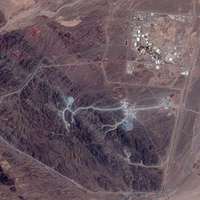
A satellite photo shows the suspected expansion of missile facilities at Shahid Modarres Garrison, near Tehran, Iran, in this handout image obtained by Reuters on July 5, 2024.
Recent satellite imagery shows major expansions at two key Iranian ballistic missile facilities that two American researchers assessed are for boosting missile production, a conclusion confirmed by three senior Iranian officials.
The enlargement of the sites follows an October 2022 deal in which Iran agreed to provide missiles to Russia, which has been seeking them for its war against Ukraine. Tehran also supplies missiles to Yemen's Houthi rebels and the Lebanese militia Hezbollah, both members of the Iran-backed Axis of Resistance against Israel, according to US officials.
Images taken by commercial satellite firm Planet Labs of the Modarres military base in March and the Khojir missile production complex in April show more than 30 new buildings at the two sites, both of which are located near Tehran.
The images, reviewed by Reuters, show many of the structures are surrounded by large dirt berms. Such earthworks are associated with missile production and are designed to stop a blast in one building from detonating highly combustible materials in nearby structures, said Jeffrey Lewis of the Middlebury Institute of International Studies at Monterey.
A satellite photo shows the suspected expansion of missile facilities at Shahid Modarres Garrison, near Tehran, Iran, in this handout image obtained by Reuters on July 5, 2024.
The expansions began at Khojir in August last year and at Modarres in October, Lewis said, based on images of the sites.
Iran's arsenal is already the largest in the Middle East, estimated at more than 3,000 missiles, including models designed to carry conventional and nuclear warheads, experts say.
Three Iranian officials, who asked not to be identified because they were not authorized to speak publicly, confirmed that Modarres and Khojir are being expanded to boost production of conventional ballistic missiles.
"Why shouldn't we?" said one official.
A second Iranian official said some of the new buildings would also allow a doubling of drone manufacturing. Drones and missile components would be sold to Russia, drones would be provided to the Houthis and missiles to Hezbollah, the source added.
Reuters was unable independently to confirm the Iranian officials' comments.
Iran's mission to the United Nations did not respond to a Reuters request for comment on the expansion of the complexes. Tehran has previously denied providing drones and missiles to Russia and the Houthis. Hezbollah's media office did not immediately respond to requests for comment.
Houthi spokesperson Mohammed Abdulsalam said a boost in Iran's weapons manufacturing would not have any impact in Yemen because the Houthis develop and manufacture aircraft independent of Iran.
Lewis analyzed the Planet Labs imagery with Decker Eveleth, an associate research analyst at CNA, a Washington thinktank, as part of a Middlebury project that monitors Iranian missile infrastructure.
"We know that Russia is on the hunt for low-cost missile capabilities, and it has gone to Iran and North Korea," said Lewis.
Moscow and Pyongyang have denied the transfer of North Korean missiles to Russia. The Russian embassy in Washington and North Korea's mission to the United Nations did not immediately respond to requests for comment for this story.
The two U.S. researchers said in separate interviews that it was not clear from the photos what kinds of missiles would be produced at the new facilities, which still appeared to be under construction.
Any increase in Tehran's missile or drone production would be concerning to the United States, which has said that Iranian drones help sustain Russia's assault on Ukrainian cities, and to Israel as it fends off attacks from Iran-backed groups, including Hezbollah.
The US Office of the Director of National Intelligence declined to comment on the reseachers' analysis.
A U.S. National Security Council spokesperson declined to confirm their assessment, adding that the United States has implemented various measures, including sanctions, intended to constrain Iranian missile and drone production and exports.
Reuters in February reported that Iran had sent surface-to-surface ballistic missiles to Russia for use against Ukraine. Iran denied providing the weapons. Washington said it could not confirm the transfers but it assumed Tehran intended to provide missiles to Moscow.
New buildings, dirt berms
Shahid Modarres and Khojir are overseen by the Islamic Revolutionary Guard Corps (IRGC), the elite paramilitary organization that plays a central role in Iran's missile and nuclear programs. It controls large segments of the Iranian economy and answers directly to Iran’s Supreme Leader Ali Khamenei.
The complexes have long been associated with the development and production of Iran's short- and medium-range ballistic missiles and rockets for the country's space program.
On November 12, 2011, a massive explosion destroyed a large swath of Shadid Modarres associated with solid fuel missiles, killing 17 IRGC officers. They includedGen. Hassan Moqaddam, regarded by Iran as the "architect" of its ballistic missile program.
Construction at Shahid Modarres, which began again after the 2011 explosion, accelerated last year, the second Iranian official said.
"I think the Iranians may have chosen not to berm the buildings (before the explosion) because they didn’t want to draw attention to them," said Lewis. "They learned the hard way."
Eveleth and Lewis said the sites' long history with Iran's missile program – Shahid Modarres is considered by some experts as its birthplace - and the numerous dirt berms support their assessment that Tehran is expanding ballistic missile production.
"When we see where you basically have an entire production line that is bermed like that, that's usually missiles," said Eveleth.
Iran has accused the United States of "interfering" with its political affairs during a weekly briefing on Monday after a US spokesman said the recent presidential elections were "not free or fair".
Foreign Ministry Spokesperson Nasser Kanaani argued that such statements, following Iran's "transparent and free elections," reveal "non-constructive and hostile policies" within US government structures towards Iran.
A US State Department spokeswoman told Iran International on Saturday that the elections will not significantly impact the US approach to Iran, citing unchanged concerns about Iran’s behavior, from its nuclear program to its ongoing proxy war in the Middle East.
The spokeswoman also remarked that the Iranian elections were "not free or fair," leading many Iranians to abstain from voting, and doubted the elections would result in significant changes or improved human rights in Iran, without specifying exactly which changes.
Kanaani countered, citing Iran’s alleged commitment to "constructive engagement" with various countries, stating that confrontational behavior by some European nations have hindered progress in relations.
However, he failed to address the issue of Iran's ongoing nuclear program or its proxy war which has driven a wedge between Iran and the West as the Islamic Republic edges ever closer to a nuclear weapon.
The first round of Iran's snap presidential election saw a 39.92% turnout, the lowest in the Islamic Republic's history. Despite a reported 10% rise in the runoff, over 50% of eligible voters boycotted the election.
Iranian opposition figures have urged Western powers not to engage with the new government. Exiled Prince Reza Pahlavi called the election a "fraudulent" attempt to legitimize dictatorship.
Workers gathered in at least ten cities across Iran on Sunday to demand better working conditions and unpaid wages as presidential elections ended amid the country's economic crisis.
HRANA, the news agency of the Human Rights Activists in Iran, reported that groups of social security retirees organized rallies in Shush, Ahvaz, Kermanshah, and Tehran.
In addition, steel industry retirees in Isfahan (Esfahan), Damghan, Tehran, and Qaemshahr, unemployed petrochemical project workers in Ilam, and coal mine retirees in Kerman also held demonstrations, demanding overdue payments and benefits.
While annual inflation hovers around 50%, the minimum wage for the current year has been set at a meager 110 million rials (about $190), making it nearly impossible for many to make ends meet.
Workers in Iran are currently grappling with the worst economic crisis since the founding of the Islamic Republic. The minimum cost of living in Tehran is estimated at 300 million rials (about $500), while in other cities it stands at 200 million rials (about $350).
Videos circulating on social media show protesters condemning the death sentence issued against labor activist Sharifeh Mohammadi and calling for the reversal of the verdict. Her punishment highlights the crackdown on dissent and its relentless persecution of those who dare to speak out.
The protesters' demands include increasing pensions to reflect the actual poverty line, providing free and quality healthcare and welfare services, correcting wage disparities, improving working conditions, guaranteeing job security, and raising salaries.
Meanwhile, contractors of the water and sewage network in Rudbar, north of Iran, have entered the twelfth day of their strike, demanding eight months of unpaid wages.
Oil and gas project workers in the south marked the eighteenth day of their industrial action. Approximately 60 of the workers, who have been striking and protesting round-the-clock, have not received their salaries since December and are facing severe financial hardships.
Their demands extend beyond immediate payment of overdue wages, including demanding permanent contracts, the formation of independent labor unions, job security, the right to protest, and timely monthly wage payments.
Additionally, the Council for Organizing Oil Contract-Workers' Protests reported that on Sunday, project workers from at least 123 southern oil and gas companies continued their strike. Thousands of oil and gas project and contract workers have joined the movement, seeking not only to improve their earnings but also to enhance their leave policies, job security, and employment status by eliminating exploitative contractors.
These protests are part of a broader wave of labor unrest in Iran, driven by delayed wages, low pay, and layoffs that have intermittently disrupted numerous industrial sectors since 2018.
Over the past decade, the oil and gas industry has been outsourced to influential government insiders acting as intermediary contractors who under pay workers and impose harsh working conditions.
Traditionally, oil workers in Iran enjoyed some of the best salaries and benefits, but exploitation has significantly eroded their standard of living.
Poisoned people rush to hospitals in Rezvanshahr, north of Iran, due to water contamination
At least 400 people in Iran's Gilan province were poisoned on June 28, the first round of the presidential elections in Iran, with allegations the news was censored by the government.
Etemad Daily reported Monday that the mixing of sewage water with drinking water caused the poisoning, but officials are trying to hide it.
On June 28, residents of Rezvanshahr visited hospitals and medical centers with symptoms such as nausea, headaches, and stomach pain. The number of hospital visitors was initially 130, but it reached 400 two days later.
The president of Gilan Medical University attributed the cause of the poisonings to water contamination. However, the Gilan Water and Wastewater Department rejected this, emphasizing that "there was no connection between the poisoning ... and the consumption of water from the distribution network."
One resident told Etemad, "My family and I visited the hospital twice with symptoms of stomach pain, diarrhoea, weakness, and loss of appetite. The cause of the poisoning is drinking water, but we don't know why the main cause is not being announced."
In May last year, 333 people were poisoned in Badreh city due to drinking tap water while in September 2021, sewage entering the drinking water tank in the village of Desheh in Kurdish Paveh County poisoned most residents.
Turkish President Recep Tayyip Erdogan expressed hopes for a positive development in Turkey-Iran relations under the new president-elect, leveraging Masoud Pezeshkian's ethnic background as a potential diplomatic bridge.
"Masoud Pezeshkian is actually a Turk," Erdogan stated. "He speaks Turkish in Tabriz, can speak Kurdish in Kurdish regions, and is also fully proficient in Persian."
Pezeshkian's ethnic background is in fact rooted in the Azeri community, a significant ethnic group in Iran, particularly in Azarbaijan province, where Turkish is widely spoken. He was born in the Kurdish city of Mahabad.
While Erdogan expressed hopes for a new era of “rapid development” in Ankara-Tehran relations, the reality on the ground in Iran remains fraught with challenges. The Turkish president's overtures, though diplomatically significant, may also be seen as an attempt to exploit Iran's internal vulnerabilities for regional advantage.
Trade between Turkey and Iran peaked in 2012 at nearly $22 billion but has since declined significantly. According to Turkish Trade Minister Omer Bolat, trade stood at $7.4 billion in 2023, down from around $10 billion the previous year.
Iran's economy has been severely crippled by sanctions imposed due to its nuclear program, although Tehran denies Western allegations that it seeks to develop nuclear weapons
Pezeshkian narrowly won a runoff race against ultraconservative Saeed Jalili on Friday, in an election marred by historically low turnout. In the first round, less than 40 percent of eligible voters participated, highlighting the growing disillusionment with Iran's clerical rule.
Yahya Hosseini Panjaki, alias Yahya Hamidi, the deputy intelligence minister for internal security affairs, has been identified as the mastermind behind Iran's overseas assassination operations.
According to information obtained by Iran International, this revelation unveils Hosseini's role in a world of international espionage and targeted killings, marking the first time his identity has been disclosed.
The Islamic Republic has been systematically planning to assassinate its opponents abroad. These plans are orchestrated by high-ranking officials within the ministry of intelligence, aiming to eliminate dissidents who pose a threat to the Islamic government.
Utilizing undercover agents stationed in embassies and operatives disguised as business people, Tehran has been able to plot and execute various attacks globally. This intricate network involves coordination with international drug traffickers and proxy forces to ensure the operations leave no trace back to Iran's intelligence agencies.
A source within the Islamic Republic's ministry of defense indicated that Hosseini is part of a new generation of intelligence managers trusted by Ali Khamenei, the Supreme Leader of the Islamic Republic. The ministry of intelligence, along with the IRGC's Intelligence Organization, has been conducting the most significant sabotage activities abroad for years. However, information received by Iran International shows that the ministry of intelligence has a more cohesive structure than the IRGC for conducting overseas operations.
Who is Yahya Hosseini Panjaki?
Born in 1975 in Karaj, near Tehran, Hosseini holds a PhD in Political Science from Azad University of Tabriz and has published two articles in academic journals. He was sanctioned by the European Union, the United Kingdom and the United States. His role in founding the "Martyr Soleimani" unit, which conducts sabotage operations worldwide in cooperation with the IRGC, marks him as a key figure in Iran's intelligence apparatus.
The Terrorist Infrastructure
The ministry of intelligence employs two main routes for deploying its agents abroad. The first involves intelligence agents under the cover of the ministry of foreign affairs, often stationed in embassies. The second route sends military-intelligence agents under the guise of commercial activities. These agents plan assassinations, kidnappings, and sabotage, typically executed by proxy forces to avoid leaving any traces back to the ministry. Major drug traffickers often serve as primary contractors for these missions.
High-Profile Operations
The ministry of intelligence has executed numerous operations on European soil. One significant plot was the attempted bombing of the MEK's conference in Paris, designed by Assadollah Assadi, an intelligence operative and an employee of the Islamic Republic's embassy in Austria. This plot was foiled, and Assadi was sentenced to 20 years in prison in Belgium but later exchanged for a Belgian citizen imprisoned in Iran.
Assadollah Assadi, Iranian "diplomat" convicted by Belgium and later released.
Another operation involved the assassination of Mohammad Reza Kolahi Samadi, a member of the MEK, in Almere, Netherlands. Two years later, Ahmad Mola Nissi, an Arab political activist, was killed in The Hague. The Times reported that Ridouan Taghi, a Moroccan-born criminal, connected the ministry to these two assassinations.
The eliminations of Saeed Karimian, director of GEM TV, and Masoud Mowlavi, director of the Telegram channel Black Box, both in Istanbul, were also carried out by this branch of the ministry. A Turkish journalist revealed that Mohammad-Javad Azari Jahromi, the then Minister of Communications, threatened Mowlavi over the phone a day before his assassination.
The Broader Impact
These operations underscore the lengths to which the Islamic Republic will go to silence its critics and maintain its power. Utilizing an intricate network of proxies, drug traffickers, and undercover operatives, Iran's ministry of intelligence has developed a sophisticated system for targeting opponents abroad. This system, managed by Yahya Hosseini Panjaki, highlights the ongoing global threat posed by Iran's intelligence operations.