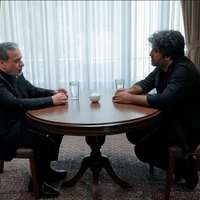
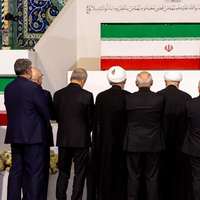
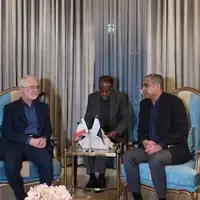
Iran’s President Ebrahim Raisi (center), Parliament Speaker Mohammad-Bagher Ghalibaf (right), and Chief Justice Gholam-Hossein Mohseni-Ejei during a meeting in Tehran on March 12, 2024
While enjoying their long Norouz holiday, politicians in Iran have been reflecting on the country's economic, social and political crises and anticipating a bleak situation in the year ahead.
Their reflections on the past are primarily centered around the recent highly controversial election, which the country sees as a nightmare that it has partially left behind. However, as the holidays conclude, the nation anticipates the continuation of this nightmare with a run-up election in May.
The heavily manipulated vote for parliament on March 1 saw hardliners barring most other regime insiders from running for office. As a result, the election experienced the lowest turnout in 45 years, with widespread public apathy keeping a large majority of voters away from ballot boxes.
Khabar Online website in Tehran conducted brief interviews with ten Iranian political figures, seeking their perspectives on the best and worst events of the Iranian year that concluded on March 20.
Among the respondents, which included former lawmakers, a former state TV Chief (Mohammad Hashemi), and various politicians from different affiliations, the overwhelming consensus identified the March 1 election as the most adverse event of the past year.
Former judiciary head Sadeq Amoli Larijani, who lost the Assembly of Experts election in Mazandaran Province, and Majles Speaker Mohammad Bagher Ghalibaf were highlighted as notable losers. Ghalibaf, who secured over 1.2 million votes in 2021, saw a drastic reduction to just over 400,000 votes in 2024. However, respondents highlighted that almost everyone in the country could be considered a loser.
Iran’s former Chief Justice Sadeq Larijani
Reformist politician Gholam Ali Rajai expressed a sentiment shared by many, stating that even a destructive earthquake would have been preferable to the March 1 election. The devastation left behind by an earthquake could be compensated, but the losses caused by this election, which brought radicals to power, will have serious long-term consequences, he said.
Additionally, concerns were raised about the ongoing economic crisis under President Ebrahim Raisi's administration, as well as security issues highlighted by terrorist attacks in Shiraz and Kerman in the past year. Only one respondent, former presidential candidate Mostafa Hashemi Taba, singled out the government's neglect of environmental issues as the most significant failure of the past year.
When asked to grade the government's performance on a scale from zero to 20, opinions varied widely. While three hardline politicians, including Islamic Coalition Party member Hamid Reza Taraqqi, awarded grades between 14 to 18, others were far less generous, with two politicians assigning grades below 10, including two zeros.
Evaluating the performance of the outgoing parliament, except three hardline former lawmakers, the other seven respondents branded the parliament a total failure.
Meanwhile, three hardliners named the launching of a satellite to the space as the country's best event in the past year. Reformist Rajaei said winning the Nobel Peace Prize by jailed activist Narges Mohammadi was the best that happened to Iran last year.
Looking at the future, in another Interview, General Hossein Alai, a former commander of the IRGC naval Force and a reformist politician, said that the Islamic Republic needs to bring about a meaningful change in its economic and political policies and conduct.
Alai reiterated that significant changes are needed in the government's domestic and foreign policies as well as in the areas of economy and the way the government appoints its managers. He added that the government should do away with the arbitrary vetting of election candidates by the Guardian Council so that the people can believe that they can determine their own fate.
Protestors in support of women in Iran hold a banner reading 'Women Life Freedom' during a protest following the death of Mahsa Amini, in Ottawa, Ontario, Canada, October 29, 2022.
Canada's Foreign Interference Commission is set to decide on adding Iran to its list of foreign governments meddling in the country's internal political affairs.
In September, Canada launched a public inquiry into the interference of foreign governments, particularly Russia, China and India, in the country’s federal electoral processes and democratic institutions.
At its meeting on Wednesday, the commission hosted representatives of the immigrant communities from Iran, Russian, China and India.
Canada-based Iranian dissident Hamed Esmaeilion warned Iran should be included in the list of the countries to be investigated by the commission.
Esmaeilion, who attended the commission’s meeting as the representative of the families of victims who perished in the downing of a Ukrainian airliner by the IRGC in 2020, said, "Although Iran’s name is not yet on the list of the commission, I attended the meeting to discuss Tehran’s attempts to interfere with Canadian affairs."
He told Iran International that there are institutions affiliated with the Iranian regime which operate in Canada, saying, "These institutions are in the minority but try to influence Canada’s macro policies."
Should Iran be added to the list, Canada’s security and intelligence agencies will be obligated to provide the commission with confidential information so that it can decide about Iran’s possible role in Canada’s domestic policies, especially 2019 and 2021 elections.
In November, Microsoft’s Threat Analysis Center (MTAC) warned that Iran, Russia and China are likely to plan to influence the upcoming elections in the US and other countries in 2024.
“Given the catalogue of malign and illegal activities committed by the Islamic Republic of Iran on Canadian soil, it would be naïve to believe that the Iranian regime has any compunction to shape public opinion in Canada,” he said in a letter to the Foreign Interference Commission, calling for soliciting testimony and relevant documentation from Iranian-Canadians and others with a substantial interest in the proceedings.
Human rights monitoring groups concur that executions in Iran have reached unprecedented levels following the widespread protests of 2022, as indicated by figures compiled by these entities.
At least 767 Iranians were executed in the year ending March 2024, according to the Human Rights Activists News Agency (HRANA). That is more than double the figure for the year ending March 2022, when 333 were executed. Some human rights reports have mentioned a slightly higher numbers.
Many human rights activists say the executions have very little to do with justice and are designed primarily to ‘set examples’ and instill fear in the wider society to make it easier to control. At least eight people were hanged over trumped-up charges related to the nationwide protests of 2022, with several more protesters currently on death row.
A recent Amnesty International report further underscored the severity of the situation, revealing that from January 1, 2012, to July 31, 2023, over five thousand individuals, including at least 57 children, were executed in Iran.
It is widely believed that most executions in Iran are drug-related. There’s little trust in official accounts, however, since there’s no transparency and no real due process. So activists say they fear that the regime may use criminal charges as cover for political cases, especially if the accused is from the ‘periphery’ and lacks support networks to follow and publicize their case.
The United Nations special rapporteur on human rights in Iran has stated that the number of executions of ethnic and religious minorities in Iran is disproportionately high.
Javaid Rehman, the United Nations Special Rapporteur on the situation of human rights in the Islamic Republic of Iran
According to human rights watchers Hengaw, in 2023, about 4 out 10 of all executions have been Baluch (183) or Kurd (151). Both ethnic groups are highly active politically, and both played parts in the most recent wave of protests (2022) that was far greater than their size in Iran’s population.
Iranian judiciary officials routinely deny any conflation of dissent with criminal activity. When questioned by Western journalists about executions or human rights abuses, Iranian officials consistently maintain the official stance that the judiciary operates independently and is not answerable to the presidential administration.
While the latter claim holds some truth, the former does not. In reality, Iran’s judiciary primarily serves as a tool to suppress dissent, a role it has fulfilled since the inception of the regime in 1979. Even constitutionally, the judiciary lacks true independence, as its head is appointed and dismissed by the Supreme Leader.
It's no surprise, then, that the judicial system tends to align closely with the desires and directives of Supreme Leader Ali Khamenei.
In July 2022, prior to the widespread protests in Iran (now better known as Women Life Freedome uprising), Khamenei made a dark reference to the notorious 1980s, when thousands of political prisoners were executed summarily, often after one or two questions, without even a sham trial.
"Our God today is the same God of the 1980s," he said.
The judiciary got the message. So did human rights organizations and activists, many of whom warned of more executions on the horizon. And they seem to have been right.
In the year and a half that followed, executions soared – from 333 in the year ending March 2022 to 617 in the year ending March 2023 and to 767 in the past year.
This sharp rise brought the total executed in Iran in the last decade to around five thousand people, according to Amnesty International, among them at least 57 children.
In his November 2023 report to the United Nations General Assembly, UN secretary general Antonio Guterres warned of an “alarming” growth in the number of executions in Iran. Many inside and outside Iran echoed this sentiment, urging the Iranian regime to stop the “state killings”, with numerous protests organized worldwide.
Last month, Khamenei dismissed the international outcry, calling it “ some noise”, and labeling those executed as "criminals." He also made the most of the Palestinians’ plight. "Westerners who make a fuss over the execution of a criminal have closed their eyes to the massacre of 30,000 people in Gaza," he said.
That’s probably not far off the total number of executions in Iran under Khamenei’s rule – since 1989.
Iranians celebrating Norouz (Nowruz) holidays in Shiraz (March 2024)
Despite the overlap of Norouz and Ramadan, many Iranians peacefully challenged the clerical regime by engaging in public celebrations, music, and dance, while also refusing to wear the hijab.
The convergence of Norouz holidays with the Islamic fasting month of Ramadan this year has heightened authorities’ frustration with celebrants. They are expected to be fasting and praying instead of participating in what is perceived as 'pagan' festivals involving song and dance.
Celebrants dance around the tomb of Cyrus the Great in Pasargadae.
Celebration of Norouz, and other ancient festivals such as Charshanbeh Souri (bonfire night before the New Year) is not officially banned. However, religious hardliners, who have complete sway over all centers of power now, consider these pre-Islamic festivals pagan and say celebrating them glorifies the pre-Islamic Persian history and paganism at the cost of Islam. For many Iranians, however, there is no contradiction between being Muslim and cherishing the country’s rich history and heritage.
Celebration of Norouz in Kurdish city of Boukan
Authorities typically attempt to prevent gatherings at ancient sites like Persepolis and the tomb of Cyrus the Great in Pasargadae during New Year celebrations and Charshanbeh Souri, often resorting to violence against participants.
This year, despite efforts by authorities, tens of thousands of Iranians headed to Persepolis and Pasargadae to celebrate the turn of the year and the Spring Equinox, which occurred at 6:36:25 local time on March 20. Officials confirmed that around ten thousand people managed to gather there, while reports on social media suggest that many others were halted on the road to Pasargadae.
This year too, tens of thousands of Iranians flocked to Persepolis and nearby Pasargadae, where the tomb of Cyrus the Great is located, to celebrate the turn of the year, the exact moment of the Spring Equinox, which fell at 6:36:25 local time on March 20 this year. Around ten thousand, according to officials, managed to gather there in time but many others were stopped on the road to Pasargadae as social media reports indicate.
Spontaneous dancing in Parsiyan
Elsewhere in Iran – including southern cities of Bushehr and Parsiyan, Shiraz and Isfahan, locals and holiday tourists staged spontaneous dances wherever possible, including at town markets and beaches.
In many other places, particularly in Kurdish towns and villages, such as Ney, a village of around 2,500 near the Kurdish city of Marivan, huge crowds of people have been celebrating Norouz outdoors, with song and dance and bonfires in the past few days.
Participants in Norouz celebrations in Ney village chant Woman, Life, Freedom
According to Hengaw Human Rights Organization, a Kurdish rights group, in Kermanshah, capital of a western province of the same name with a very large Kurdish population, security forces shot and wounded two young Kurdish men, Arman Basiri and Mohammad Ahmadian, on March 21 for merry making at a park.
Hengaw has reported that the victims who sustained serious injuries in the legs have been hospitalized and are under security guard.
Security forces attacking celebrants in Bolbolanabad village
In Bolbolanabad, a village of around 3,600 in Kermanshah Province, security forces also attacked the crowd which included hundreds of children. In a video posted on social media gunfire is also heard.
Stressing that eating and drinking in public is prohibited during Ramadan, Governor of Kermanshah Mohammad-Tayeb Sahraei on Monday said people have a right to display happiness, “but our Islamic beliefs and guarding the modesty and chastity of Kurdish women is a red-line for us,” he added, referring to women’s participation in dances.
Young people dancing on the street in Shiraz
An official of the governor’s office in the same province on Sunday claimed that “anti-Iranian and western media” and “separatists” had used the opportunity to flout “separatist flags and symbols” at Norouz celebrations, giving them “political and security” color and “seeking to cause a political deviation”.
The office of the governor issued a statement on Monday and declared that a permit is required for any large Norouz celebration as celebrations this year seem not to have remained limited to the day of Norouz and are ongoing.
Norouz celebration at village of Karzan, Ilam Province, March 28
A man works on an electrical generator board during power outages in Basra, Iraq August 21, 2021.
Iran and Iraq have signed a five-year deal that will see Iran pump up to 50 million cubic meters of natural gas per day according to the needs of Iraqi power stations in exchange for oil and gasoline.
Iraq's Ministry of Electricity Ziad Ali Fadhel and the CEO of the National Iranian Gas Company, Majid Chegeni, finalized the contract to extend Iran’s gas exports to Iraq in Baghdad on Wednesday.
After decades of electricity shortages because of war, corruption and mismanagement, oil-rich Iraq is heavily reliant on imported Iranian gas to meet its electricity needs. Iran has been supplying energy to Iraq for the past 10 years under an agreement signed in July 2013.
With an aging electricity grid unable to match the growing demand, Iraq suffers frequent power outages. However, Iran itself is in dire need of natural gas for its domestic electricity production as well as keeping its steel, petrochemical and other heavy industries afloat.
Iran’s insists on gas exports despite the huge deficit in production and growing domestic demand that has severely damaged the country’s industrial sector. Tehran might have various motivations driving this policy, including keeping Iraq dependent.
National Iranian Gas Company CEO Majid Chegeni (left) and Iraq's Ministry of Electricity Ziad Ali Fadhel signing a five-year barter deal in Baghdad on March 27, 2024
Last year, Iraq imported about nine billion cubic meters of natural gas from Iran, meaning that Tehran supplied about 25 million cubic meters per day. The new deal has envisioned twice that amount but only for periods when Iraq needs it. Iraq’s Ministry of Electricity said the deal would "ensure the sustainability of the work of power plants and keep pace with the peak loads and the increasing demand for electric energy."
Iran’s Oil Ministry’s press service, Shana, claims that Iran’s gas exports has increased to nearly 50 million cubic meters (mcm) per day in recent months after Iraq settled part of the debts it owed to the NIGC.
Over the past five years, there has been a notable disparity between electricity generation and the domestic demand in Iraq. Electricity consumption has increased by nearly 30%, outpacing the government's efforts to meet the surging demand. Imports from Iran are especially vital during the sweltering summer months when Iraqis are forced to pay for private diesel generators or suffer through temperatures that often top 50 degrees Celsius (122 degrees Fahrenheit). The crisis usually comes back amid severe cold weather in winter.
The new agreement with Iran is viewed as a stopgap solution to help Iraq fulfill its electricity requirements while it works on developing its own gas fields. Baghdad is under increasing pressure from the US to wean itself off electricity and gas imports from Iran, under US sanctions since 2018.
In addition to gas supplies, Iraq also relies on Iran for nearly a third of its electricity. However, cash-strapped Iran switches off its electricity and gas exports to put pressure on Baghdad to urge Washington for waivers. Iran only prioritizes its local consumers when Iraq seems unable to transfer the funds.
The US has issued Iraq a series of sanctions waivers to continue importing Iranian energy but has warned the waivers could end if Baghdad does not make serious progress toward finding other fuel and power sources. Although Baghdad has sought to diversify its electricity supply through overtures to countries such as Saudi Arabia, Turkey, Jordan, and Kuwait, no significant progress has been made on these fronts.
The waivers issued by the US every 120 days are reportedly limited to non-sanctioned goods, stressing Tehran could only use the funds for humanitarian trade and seeking to blunt criticism of giving Iran the money that can be used to fund terrorism. However, since July 2023, the US has started allowing Iraq not only to make payments into restricted Iranian accounts in Iraq but also for the funds to be sent to similarly restricted accounts in third countries.
In July, Tehran and Baghdad also agreed to barter oil and gas after Iran cut its gas supply by over 50% due to Iraq’s unpaid debts which worsened the electricity crisis in the country.
In late 2022, the United States tightened measures on Iraq's access to its foreign reserves held in the Federal Reserve due to suspicions of money being transferred to Iran, Syria, and other sanctioned entities.
Iran’s national currency, rial, has fallen sharply since early January, losing around 20% in less than three months, further raising the specter of higher inflation in the coming months.
The rial reached its lowest historical value during the past week, as each US dollar traded at 610,000 rials in open markets, 43% more than in March 2023.
The fall of the rial is hard to explain at the first glance as the country’s oil export volume has increased significantly. But a closer look at official statistics reveals lower growth in revenues. This can explain why the government has limited means to influence the currency market in Tehran.
According to Kpler’s statistics, Iran exported about 1.3 million barrels (mb/d) of crude oil and gas condensate in 2023, indicating a 48% growth year-on-year.
The country also exported 1.39 mb/d and 1.44 mb/d in January and February 2024, Kpler estimates.
However, the latest Iranian Customs statistics show the country’s oil export revenues increased by only 7.8% year-on-year to $32.59, during 11 months of last fiscal year, from March 21, 2023, to February 20, 2024.
The reason for the huge gap between volume and value of Iran’s oil exports remains unclear, while oil prices in international markets declined only 17% year-on-year in 2023 and remained unchanged in 1Q2024, compared to the same period of last year.
It seems the country has given further oil discounts to Chinese refineries.
When the United States withdrew from the JCPOA nuclear deal in 2018 and imposed oil export sanctions on Iran, shipments of crude dwindled to around 300,000 barrels per day, one-seventh of pre-sanction volumes. But China began increasing purchases of Iranian oil when President Joe Biden was elected and signaled his plans to revive the nuclear agreement. As the administration engaged in negotiations that ultimately proved futile, sanctions enforcement lost their momentum, allowing Iran to more than triple its oil exports.
However, customs statistics show decline in non-oil export revenues and a notable increase in imports, that has lately led to a trade imbalance.
Iran’s foreign trade between March 20,2023 to February 20, 2024 (Source: Custom statistics)
Foreign trade balance
The Custom statistics show $19 billion surplus in foreign trade in 11 months of last fiscal year, but the figure does not include Iran’s total imports, including services such as transportation of its oil exports by foreign vessels, as well as natural gas, gasoline, diesel and electricity imports.
Traditionally, Iran’s service imports are about $15 billion annually, while its service export is a half of this figure. Also, in the last three months media in Tehran report a negative trade balance.
Ali Nazi, vice-president of The Islamic Republic of Iran Shipping Lines (IRISL) announced May 2023 that Chinese independent ports, that handle most of commodity loading and unloading operations, do not allow Iranian ships to dock due to sanctions anymore. As a result, most of Iran’s energy and other trade with China are handled by Chinese or other vessels.
Iranian ships are allowed to dock only in two state-run ports, where Ali Nazi descried them “inappropriate” for commodity trade due to poor facilities as well as the increase in loading and unloading time and cost.
IRISL has faced even tougher conditions in operating elsewhere, especially European ports.
On the other hand, Iran has to use foreign tankers and ship-to-ship operations for oil exports to bypass US sanctions.
Therefore, it seems the country’s services trade imbalance has increased significantly during 2023-2024.
Iran also started natural gas, gasoline and diesel imports during last fiscal year, while its electricity imports also increased due to domestic shortages.
The Custom statistics, don’t include these items as well.
On the other hand, Iran has a huge amount of capital flight.
The Central Bank of Iran (CBI) has not published the capital outflow statistics for the past fiscal year, but it was $15 billion in the previous year (March 2022-March 2023).
Hard currency problem
Iran has negative trade balance with all of its major partners, except Iraq and China. Therefore, it can’t use, for instance, Indian rupee, Turkish lira or UAE’s dinar for covering trade with these countries.
Iran’s foreign trade in 2023 (Billion $)
Iran can use Chinese yuan for covering negative balance in non-oil trade and pay for Chinese services, but it needs hard currencies like US dollar or euro to cover negative trade balance with other partners.
It is noticeable that according to Eurostat (European statistics body), 27 EU members exported 3.934 billion euros worth of goods to Iran, while imported only 799 million euros from the country in 2023.
Iraq was the only major open door for Iran to access US dollars, but Washington in 2023 imposed tough sanctions on several Iraqi banks that were involved in USD smuggling into Iran.
The US sanctions on Iraqi banks have put Iran in a very complicated situation, because it has about $9 billion surplus commodity trade with Iraq exporting gas and electricity, while the Iraqi dinar is a useless currency for covering Iran’s foreign trade negative balance.