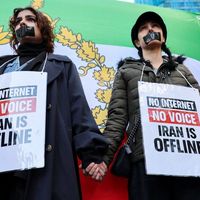
Investigation Finds Dozens Of Iranian Protesters Lost Their Eyes
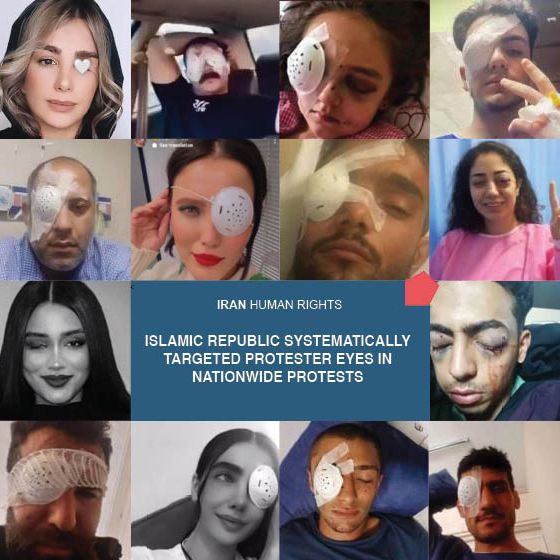
The Human Rights Center at the University of California Berkeley has unveiled findings regarding repressive measures employed by the Iranian government against protesters in 2022-2023.
The Human Rights Center at the University of California Berkeley has unveiled findings regarding repressive measures employed by the Iranian government against protesters in 2022-2023.
In a comprehensive investigation, the center confirmed that approximately 120 individuals suffered partial or total blindness due to the use of extreme force by Iranian security agents during the protests that erupted in September 2022 and continued into early 2023.
While the investigators stopped short of directly accusing security forces of intentionally blinding protesters, the evidence presented indicates deliberate targeting of individuals, including women, with close-range shots to the face using shotguns, paintball guns, and tear gas canisters.
The majority of victims were students, with many under the age of 30. Among them was a 5-year-old girl who was struck while innocently observing the demonstrations from a balcony.
Speaking on behalf of the investigative team, Melinda Zou emphasized the courage displayed by the protesters.
“I saw the bravery of people our age — university students taking to the streets and putting their lives on the line — and that really resonated with me.”
The center's faculty co-director, Alexa Koenig, highlighted the potential use of the investigation's data in international legal proceedings to hold Iranian authorities accountable.
The findings were presented during a side event at the UN Human Rights Council meeting in Geneva, Switzerland this month.
In September 2022, historic protests erupted in Iran following the arrest of Mahsa Amini, a 22-year-old woman accused of defying mandatory hijab. Amini's death, just three days after her arrest, ignited outrage.
Reports from news outlets and human rights organizations indicated that over 500 people, including women and children, were killed by security forces in the protests dubbed as Woman, Life, Freedom movement. More than 20,000 individuals were detained or imprisoned, many subjected to beatings, torture, or rape.


The two reports presented to the Council mark a watershed for Iran, giving impetus to the ending of impunity and new emphasis on legal accountability for those IR officials implicated in human rights abuses.
The sixth and last report from Javaid Rehman, the Special Rapporteur on Human Rights in Iran together with the meticulously detailed 400-page report from the Fact Finding Mission on Iran have opened a path to the formation of international tribunals and greater use of existing international jurisdiction to prosecute Iranians. Central to that is the collection of evidence which can stand up in a court.
That path is not yet named, but it has been signposted by the Special Rapporteur and the FFM. And being the UN, nothing will be speedy. But the change in direction signalled at the HRC has given a tremendous boost to the Iranian human rights activists in their many NGOs gathered in Geneva. And a unity of purpose among many of them.
Their mood is upbeat, Spring-like. In short, their hope is that if and when the current authority in Iran changes, IR officials will not be able to hide from the law, wherever they are. Flight to the West should the IR collapse would be hugely unattractive to those who might have once looked for visas to Canada and elsewhere if they face prosecution for crimes for which bodies like the FFM collect the detailed evidence. As one activist put it, “the threat of prosecution is more alarming than sanctions to the torturers and their agents”.
The Islamic Republic is on the backfoot in Geneva, as regards the HRC. The IR has always refused to recognise the UN mandate given to the Special Rapporteur since it began in 2011. And neither does it recognise the UN mandate given the FFM in the aftermath of the death of Mahsa Amini. But the protests following her death has changed everything for Iran at the UN. What was always a standoff, is now an impasse.

This mirrors the historic antagonisms between the IR and the West. Under the vast, moulded and coloured stalectite ceiling of the grandly-named Human Rights and Alliance of Civilisations Chamber where the HRC meets, Iranian diplomats sit expressionless listening to a catalogue of IR oppression, torture and killing. The standard response of IR diplomats in these sessions is to ignore the points made and attack the integrity of the Rapporteur. The IR response in this time was to veer off the subject altogether or make statements which in the circumstances could only be considered as bizarre. Thus for Somayeh Karimdoost, the IR deputy head of mission, Rehman is merely a British “pen-holder” for Western attacks on Iran. His report, she said, was not "reflective of Iran’s constant progress and promotion and protection of human rights”. Similarly, Gharib Abadi, head of Iran’s High Council for Human Rights, kicked off his response to the FFM report by singling out Germany as having supplied Saddam Hussein with the weapons to fight Iran. Germany, he claimed, was thus at the forefront of a campaign against Iran using a humanitarian veneer to cover a politically charged mechanism.
While Iran is a signatory to various international treaties which underpin international humanitarian law, it clearly does not share the same definition of human rights as understood in the Western democracies, even if the same term is used. To any observer, the lack of irony or self-contradiction in the IR response to the HRC Iran reports is striking (although not without unexpected humour. On the landing outside the 'Human Rights and Alliance of Civilisations’ chamber, right where TV. journalists do their lives, the Iranian Mission had put up an enormous banner celebrating ‘Iran: 100 Years of Multilateralism”, showing the IR flag fluttering over the Palais des Nations. Last year, the Mission put on an exhibition of headless models of women displaying Iranian national costume - headless, as that avoided the troubled issue of headgear).
Looking back at the past six years of his tenure as UN Rapporteur, Javaid Rehman told Iran International, “during those years of my tenure...we’ve gone through an unprecedented time; I hope that you and your viewers would agree that Iran and the Iranian people do not feel the same way as they felt six years ago. Iran is transforming, it’s a changing society.”
There is no going back. Rehman says that "After the Gina Mahsi Amini movement, the international community was galvanised and my mandate was very active to all perpetrators responsible for crimes. So we made a lot of effort. One of my achievements I would say is the work to establish an international mechanism.”
“Rehman put the issue of impunity and accountability on the table,” says Mahmood Amiry-Moghaddam of Iran Human Rights, a point echoed among other prominent human rights campaigners and many well-known lawyers. In that sense Rehman paved the way for the FFM, whose work he says, is to "conserve evidence for eventual accountability mechanisms and trials. I would encourage states to use universal jurisdiction wherever they find individuals who are alleged to have committed very serious crimes under international law."
What happens now depends on the votes on mandates for the post of Special Rapporteur and extending the FFM which happen on the 4th and 5th April, at the close of the 55th HRC Session. The Islamic Republic of Iran will be delighted to see the back of Rehman, but it looks unlikely that the UN will end the mandate as such for the role of Special Rapporteur for Human Rights in Iran. Speaking to Iran International, Rehman points out that anyone can apply for the job, but did not reveal whether he knew of any likely candidates. A new candidate will be selected and voted ion by the UN in July. Rehman says he really hopes the mandate is extended. “You see the seriousness of the human rights crisis in Iran, which requires a good repoprting mechanism to highlight all of this for the Iranian people,” he says. "I would love my successor to be able to have access to Iran, which the Iranian authorities denied me.”
That is unlikely. Iran will campaign hard for the vote against the mandate renewal and will have backing from such champions of human rights as the Russian Federation, Venezuela, Cuba and Zimbabwe. The FFM mandate extension is not guaranteed, as Sara Hossain, the chair of the FFM tribunal, told us, pointing out that Iran has a lot of friends. But its supporters are hopeful that there will be sufficient votes for the extension, which will allow it time to finish compiling the detailed evidence which would provide the basis of prosecutions and legal actions for redress and compensation for the victims of IR state oppression. When asked whether she would continue to serve as Chair of the FFM, Ms Hossain indicated she’d certainly consider it as she’d invested to much of herself in it so far.
The future for the IR cannot be predicted, but there is a fairly common view among the concerned UN community in Geneva that its current situation cannot continue, faced as it is with such internal opposition. Until that situation changes, the role of the HRC and its mandates for investigating human rights in Iran will remain a highly influential on the policies of the UN governments and many groups within Iran. The response of the IR at this session shows clearly the threat that poses for the IR itself.


Their defiant statements and widespread criticism of the clerical government stand in contrast to far-fetched claims by Supreme Leader Ali Khamenei and other officials of having been able to control inflation and make progress on various fronts.
Families of victims commemorated Norouz (Nowruz) by honoring the memory of those killed by security forces, gathering at the graves of their loved ones and issuing messages calling for resistance and perseverance for freedom and justice in Iran.
The mother of Reza Moazami Goudarzi, one of the victims of the November 2019 protests, wrote on Instagram that she is celebrating Norouz in memory of all the heroes who have sacrificed their lives for freedom during 45 years of Islamic rule. Goudarzi was shot in the back by security forces in November 2019 in Andisheh city, near the capital Tehran, and died at the age of 19 because hospital staff refused to treat him in fear of government reprisal.
Regime’s security forces and vigilante gunmen killed at least 1,500 citizens during a week of anti-government protests in 2019.
The father of Mehrshad Shahidi, another victim of the 2022 protests, released a video saying that he will be at his son's grave on Wednesday with other family members to celebrate Norouz.
The parents of Mahsa Zhina Amini, also took to Instagram to welcome the new year by honoring the memory of their daughter. Her death in the custody of morality police in 2022 sparked the "Woman, Life, Freedom" movement and widespread protests in Iran that continue to this day. Taking a metaphorical tone, her parents described spring as "liberation from the tyranny of winter."
Quashing the protests, government forces killed more than 550 people, including 68 children. The mother of Hananeh Kia, one of the victims, wrote in a message how she is longing for her child and expressed hope for "bright days" ahead. Hananeh Kia, 23, was shot and killed by government forces in September 2022, during the first week of the uprising.
Meysam Pirfalak, the father of Kian, a 9-year-old boy who became one of the icons of the anti-regime revolt, also released a video message for Norouz. Kian was shot and killed by government forces in November 2022, while he was in the family car with his parents and younger brother on their way back home in Izeh, in southwestern Iran.
In addition to people in Iran, several opposition figures issued Norouz messages almost with a similar theme, wishing an end to the Islamic Republic and the freedom of the country.
Iran’s exiled prince Reza Pahlavi and his mother, the last queen of Iran Farah Pahlavi, in separate messages, emphasized the importance of Iranian unity and solidarity “to overcome darkness.”
Reza Pahlavi described the new year as a year of pragmatism, “a year of rolling up sleeves of determination and putting on boots of resilience; a year of overcoming obstacles and uniting for solutions; a year of advancing from hope to belief; a year of launching a new plan."
He expressed hope that light will prevail over darkness and Iran will regain its past freedom and glory, saying, “For forty-five years, we have been in our long winter night, but today even the guards of Zahhak (a tyrannical king in Iranian mythology and a metaphor for Ali Khamenei) smell the scent of spring. The echo of Iran's footsteps towards liberation has terrified their dark hearts."

Iran’s Supreme Leader Ali Khamenei referred to the plight of recent flood victims in his New Year address but emphasized that "the most tragic of all was the tragedy that occurred in Gaza – an event that holds great importance in our international affairs. We did not experience anything more tragic than that this year.”
Iran-backed Islamist group Hamas invaded Israel on October 7 and killed 1,200 mostly civilians, taking 240 hostages. Israel's ongoing offensive to dismantle Hamas has resulted in thousands of civilian casualties in Gaza.
Many Iranians, however, oppose the regime’s support for Palestinians and other extraterritorial causes, while Iran is becoming poorer and tens of millions suffer as a result.
Despite the dire economic situation, with inflation hovering at 50 percent and the national currency in freefall, Khamenei claimed there was progress in the country. "If growth in domestic production is pursued in a suitable manner, many of the country’s key economic issues, such as inflation, employment, and the value of our national currency, will be solved in a desirable manner," he said.
Khamenei also designated the new Iranian calendar year as the year of "Surge in production through people's participation." He has been designating slogans for each year in the past 35 years, with most of the slogans focusing on economic growth which has hardly materialized. Iranian officials and organizations try to portray their activities as if they are in line with the Khamenei-designated motto. President Ebrahim Raisi delivered a New Year address, boasting that despite projections, the country's inflation rate did not surpass 100 percent.