Armed Attack On Merchant Vessel Near Yemen

Maritime security firm Ambrey reported on Thursday that a merchant vessel has been attacked off the Yemeni coast amid the Houthi terror group's Red Sea blockade.

Maritime security firm Ambrey reported on Thursday that a merchant vessel has been attacked off the Yemeni coast amid the Houthi terror group's Red Sea blockade.
No group has yet claimed responsibility for the incident, however, the Iran-backed Houthis in Yemen have since November been engaged in attacks on international vessels in the Red Sea, the Gulf of Aden, and the Bab el-Mandeb Strait, on the orders of Iran's Supreme Leader.
According to the report by Ambrey, the vessel was approached by four armed men who began shooting at the ship, though the vessel and crew sustained no damage or injury in the attack which was disrupted by a private security team aboard the ship who engaged in gun fire with the militants. The vessel managed to escape the scene.
Yemen's Houthis launched their campaign to attack international vessels to initiate a blockade of Israel which has launched a relentless retaliatory attack on Gaza since Iran-backed Hamas militia invaded Israel on October 7, killing 1,200 mostly civilians and taking more than 250 more hostage. However, not only Israeli vessels have come under fire, with international shipping falling victim to the attacks. In March, a Houthi missile attack killed three seafarers on a Greek-owned, Barbados-flagged ship in the Red Sea, the first fatalities since the start of the blockade.
On January 10, the UN Security Council passed a resolution calling on the Houthis to stop attacks on shipping immediately. Since then, US and UK forces have targeted the positions of the Iran-backed group in Yemen in preemptive attacks. Washington has also launched a multinational naval coalition in the Red Sea to protect trade vessels, but the militia, proscribed by countries including the US, has remained undeterred.
On Wednesday night, the US and coalition forces intercepted a drone and an unmanned surface vessel launched by the Yemeni Houthis. “These actions are taken to protect freedom of navigation and make international waters safer and more secure for US Navy and merchant vessels,” read a statement by the US Central Command (CENTCOM) on X.
The German Foreign Ministry has summoned the Iranian ambassador to Berlin over Tehran’s role in an attack on a synagogue in Bochum in November 2022.
According to the Düsseldorf Higher Regional Court, the attack was carried out by an Iranian state agency, read a statement issued on X by the German Foreign Ministry on Wednesday.
Berlin said it has shared the court’s verdict with its European partners and the EU institutions and is now considering “further steps” with regard to the case.
In December 2023, the Düsseldorf Higher Regional Court sentenced a 36-year-old German-Iranian, referred to as Babak J., to two years and nine months in prison for his role in the attack.
The charges against him included conspiracy to commit aggravated arson and attempted arson. Court documents reveal that Babak J. made unsuccessful attempts to recruit an acquaintance as an accomplice, who subsequently reported the matter to law enforcement authorities.
The incident in which a molotov cocktail was fired at a school beside the synagogue, resulted in only minor damage to the synagogue. German security officials linked the plot directly to the Islamic Revolutionary Guard Corps (IRGC).
Babak J. has also been linked to an earlier synagogue attack in the city of Essen. Reports indicated that he had also been planning a third attack on a synagogue in Dortmund, where he was eventually apprehended.
It is one of several Iran-backed attacks over the last year on Jewish or Israeli targets either carried out or foiled, in countries including Greece, Azerbaijan and Cyprus.
Over the past two years, many Iranian political activists and opposition figures have urged Western countries to designate the IRGC as a terrorist organization over its role in suppressing dissent in Iran and orchestrating attacks abroad.

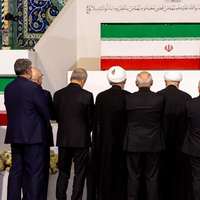
The US will have no choice but to leave the Middle East, Iran’ Supreme Leader Ali Khamenei said Wednesday, taunting the Biden administration amid a prolonged regional conflict.
“The Americans were looking to gain full control over this region,” he said, “they had this thought, mistakenly, that they’d [establish] their presence in Iraq, Syria, Lebanon, and across the whole region. The power of Resistance shattered their calculation; proved that that is not possible, and the Americans can’t stay in this region. They have no choice but to leave.”
Khamenei’s words – in his second speech on the first day of the Iranian new year– seemed to have been more public posturing, nevertheless, they did partly reflect the reality on the ground: the gradual waning of US supremacy in the Middle East, even though it’s still far superior to any other power in the region.
On the flip side, the Iranian regime has expanded its regional influence in recent years, even as it grapples with numerous, seemingly insurmountable crises domestically: a faltering economy, pervasive corruption, and a near-total breakdown in trust between the populace and the government following the unprecedented protests in 2022.
Critics of President Biden blame him for Iran’s belligerence. He has repeatedly said that his administration does not want escalation with Iran, which, according to the critics, nullifies any notion of deterrence.
“During Joe Biden’s presidency there have been more than 200 Iran-backed attacks on Americans in the Middle East – with over 170 attacks since October 7,”Congressman David Rouzer posted on X .” At the same time, Iran-backed Houthi attacks in the Red Sea are disrupting global shipping & endangering human life. Americans are less safe because of Joe Biden’s weakness on the world stage.”
In his speech, Khamenei did address the economy, the most relevant issue for Iranians. He also talked about the recent elections and political participation in Iran. But the central theme of his speech was foreign relations, and the current situation in the Middle East, in particular.
But he once again emphasized the role of the "Resistance Front" in the region, a label Tehran uses for a multitude of armed proxy groups that harass the United States, Israel and occasionally pro-West Arab states. Despite each having their specific domestic (or national) agenda, these armed groups converge on their opposition to American presence in the region and their enmity with Israel.
“It has become clear that the Zionist regime is suffering a crisis,” Khamenei said, “not only in terms of protecting itself, but also in terms of being unable to come out of the crisis. Because by entering the war in Gaza, it has become stuck in a quagmire. Regardless of whether it comes out of Gaza or not, it will have failed.”
The Israeli onslaught on Gaza is probably the biggest determinant of these groups’ actions at the moment. The Houthis in Yemen, Hezbollah in Lebanon and various groups in Syria and Iraq, have –to various extents– entered the war in support of the Palestinians,
“We are on the side and the supporter of whoever becomes involved in this great, human, Islamic jihad of principles,” Khamenei said, while calling Israel the source of “immense oppression” in the region that “must be cut off”.
Khamenei and his commanders in the Revolutionary Guards prefer to stay away from main theaters of conflict and have their proxies fight Israel.
Since last November, Hezbollah forces have been exchanging fire with Israeli forces almost daily. Armed groups in Syria have launched one-way drones against targets inside Israel. And the Houthis have all but blocked the Red Sea to all vessels with links to Israel. (direct or indirect), forcing major shipping companies to abandon the standard route and take a much longer one to the detriment of maritime trade and the consumers who eventually pay for any extra costs to businesses.
All these groups are known to be propped up by the Iranian regime. Although Iran insists that they all enjoy operational freedom and independence.
“Wherever it is in the region, be it Yemen, Iraq, Syria, or Lebanon, any measure that is taken by the fighting and brave Resistance forces, the Americans will attribute it to Iran,” Khamenei said. “In truth, it is the Resistance groups who make their decisions and take action.”
He then concluded, “The US doesn’t understand the people of the region and the brave, determined youth. This miscalculation will definitely bring the US to its knees.” Again, Khamenei's reference to the region's youth mainly involves groups under the Iranian regime's influence.

Iran may be attempting cyberattacks on US water infrastructure, the Biden administration warned state governors Tuesday, in yet another sign that US deterrence is inadequate to limit the Iranian regime's aggression beyond its borders.
In a letter bearing the names of National Security adviser Jake Sullivan and Environmental Protection Agency administrator Michael Regan asked governors to help the administration take measures to “secure water systems against the increasing risks from and consequences of these attacks.”
In the past few years, Iran has grown more aggressive in its relations with the United States, targeting American forces and bases through its proxies in the Middle East, and even plotting to assassinate former US officials on American soil.
Targeting water infrastructure is perhaps more brazen than all other actions, as it affects not just the armed forces or politicians, but ordinary Americans.
"Disabling cyberattacks are striking water and wastewater systems throughout the United States,” Sullivan and Regan wrote. “These attacks have the potential to disrupt the critical lifeline of clean and safe drinking water, as well as impose significant costs on affected communities."
The warning letter –made public Tuesday– may suggest that the administration perceives the threat to be serious and substantive. Hackers associated with Iran and China have already attacked water systems, according to Sullivan and Regan
The letter notes that Iran’s Revolutionary Guards (IRGC) “has targeted and disabled a common type of operational technology used at water facilities where the facility had neglected to change a default manufacturer password."
The letter doesn’t have much more on the specifics of those attacks, not even their nature . But it does offer an overview of the relationship between the Biden administration and the Iranian regime, which seems to be emboldened enough to attempt such an attack, potentially harming a large number of Americans on American soil.
"Drinking water and wastewater systems are a lifeline for communities, but many systems have not adopted important cybersecurity practices to thwart potential cyberattacks," Regan said in a press release announcing a virtual meeting on the subject for Thursday.
“We need your support to ensure that all water systems in your state comprehensively assess their current cyber security practices to identify any significant vulnerabilities,” Sullivan and Regan wrote in their letter to state governors.
They also demanded each state to exercise plans to prepare and recover from a potential cyber incident. The water system in the US is known to be vulnerable, lacking proper funding and facing staffing shortages.
According to Bloomberg, hackers related to the Iranian regime attacked Israeli-made digital controls in the water industries in the US last November, affecting several states without affecting water supply.
Many in Washington blame the Biden administration for not confronting Iran in a meaningful way that would establish deterrence. President Biden and his team have made it clear on several occasions, however, that they don’t want escalation with Iran, allowing the IRGC and its regional allies to plot with not much to fear.
It remains to be seen how this policy changes –if at all– during the 2024 presidential campaign and afterwards.

The United States on Wednesday imposed new sanctions on three procurement networks that are supporting Iran’s ballistic missile, nuclear and defense programs, the Treasury Department said in a statement.
It said the networks — based in Iran, Turkey, Oman and Germany – had procured carbon fiber, epoxy resins and other missile-applicable goods.
“Through complex covert procurement networks, Iran seeks to supply rogue actors around the world with weapons systems that fuel conflict and risk countless civilian lives,” said Brian Nelson, undersecretary of the Treasury for terrorism and financial intelligence. “The United States will continue to use our tools to disrupt these networks and hold accountable those countries that would help proliferate Iran’s drones and missiles.”
Germany-based dual Iranian-German national Maziar Karimi has procured epoxy resin and other items for Iran’s IRGC ASF SSJO using a complex web of intermediaries and front companies, the Treasury said. Karimi has used Oman-based Mazaya Alardh Aldhabia LLC (MAA) as a front company to facilitate procurements for Iranian defense end-users, including the IRGC ASF SSJO and Iran’s Ministry of Defense and Armed Forces Logistics (MODAFL).
Turkey-based company Gokler Dis Ticaret Limited Sirketi has facilitated procurements of carbon fiber and solvents used in the production of carbon fiber for Iran’s MODAFL and its subsidiaries. Additionally, Rostam Shahmari Ghojeh Biklo, Pishro Mobtaker Peyvand (PMP), and Mitra Inanlu were involved in the procurement of proliferation-sensitive material for proscribed elements of Iran’s nuclear and other military weapons programs through various cover companies, including `Alborz Organic Materials Engineering Company.
Last month, the Treasury announced punitive measures targeting Iran’s ballistic missile and drone procurement programs as Washington looked to increase pressure on Tehran, whose proxies in Iraq, Lebanon, Syria, Yemen and the Gaza Strip have attacked US and Israeli targets.
(With reporting by Reuters)

Iran’s Houthi militia in Yemen penetrated Israel’s air defence systems with a cruise missile landing in southern Israel on Sunday night.
While the IDF did not explicitly name the Yemeni militia, it is widely believed to be part of ongoing operations by the group in the Red Sea.
The IDF is currently investigating why the missile wasn't intercepted, citing the possibility that its flight pattern caught air defense operators off guard.
The Houthis’ maritime assaults from the Red Sea region began in November, initiated by Iran’s Supreme Leader Ali Khamenei.
After Iran-backed Hamas invaded Israel on October 7, its relentless retaliation has seen Iran’s proxies attack the Jewish state and American targets, punishing the US for supporting Israel’s right to defend itself.
Their attacks have already disrupted maritime routes, compelling vessels to opt for longer journeys bypassing the Red Sea and Suez Canal.