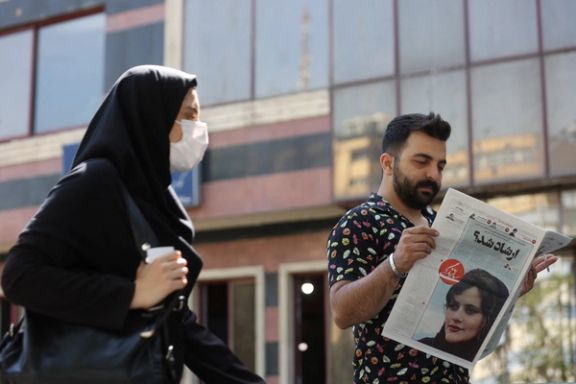
A man views a newspaper with a cover picture of Mahsa Amini, a woman who died after being arrested by the Islamic republic's "morality police" in Tehran, Iran September 18, 2022.
Hacked documents have confirm that Iranian authorities made concerted attempts to cover up the role of the morality police in the killing of Mahsa (Jina) Amini and to prevent eruption of anti-government protests.
The documents, provided to Iran International by the hacktivist group Edalat-e Ali, reveal that immediately after her death on September 16, 2022, security forces sought to coerce her family and relatives into corroborating their claim that her death in the custody of the morality police was due to an "underlying medical condition."
The 22-year-old woman, from Iran’s Kurdish populated region, sustained serious injuries after her arrest for "inadequate" hijab and died three days later after falling into a coma at a hospital in Tehran. Her death sparked several months of protests across the country that were harshly suppressed.
The documents also shed light on the various measures authorities took to silence the media, control social media, and suppress any protests with an iron fist before they could spread further.
Among the millions of files released on its Telegram channel by Edalat-e Ali are highly confidential minutes of a meeting of the National Security Council held two days after Amini’s death. These minutes indicate that despite pressure from security forces, Amini’s family refused to endorse the official account of her death and insisted on disclosing the true cause.
“It would be very effective if the father mentions the [underlying] medical condition in a short interview,” Brigadier General Mehdi Sayyari, then acting chief of the Revolutionary Guards (IRGC) intelligence organization (SAS) said at the meeting.
Brigadier General Mehdi Sayyari, the acting chief of the Revolutionary Guards (IRGC) intelligence organization (SAS) during 2022 protests
Another official said that they were going to summon a half-brother of Amini’s mother for “warning” him, presumably about the family’s statements to the media.
Mehdi Mahdavi-Azad, a journalist based in Germany, told Iran International TV that various security and judicial bodies of the regime were aware of the truth behind Amini’s death but collaborated to pressure the family into covering it up. "They also knew well that the media only sought to reveal the truth but conspired to hide it from them," he said.
"The family played a pivotal role in the expansion of the Mahsa Movement because from the outset, they sought justice for her, refused to remain silent, demanded accountability from the Islamic Republic, and did not succumb to the ongoing pressures," said Avin Mostafazadeh, a human rights activist and spokesperson for the Kurdish rights organization Kordpa.
The same document also reveals that a medical professional identified as Dr Moradi declined an interview, presumably with state media, to confirm the authorities' version of events. This may refer to Dr Behzad Moradi, a forensic scientist.
Authorities expressed significant concern about the potential escalation of protests, fearing that they would not subside anytime soon, strengthen the movement against compulsory hijab rules, and eventually pose a more serious challenge to the regime than the 2019-2020 protests.
“The security system will get involved [in quelling protests] for weeks if we allow any protests to take shape,” an official said in one of the meetings of the National Security Council and stressed that the priority at that moment was to prevent people from convening to protest.
The Ministry of Intelligence, the Revolutionary Guards' intelligence organization (IRGC), and the police force also coordinated efforts to control and contain the activities of political figures, celebrities, journalists, and athletes whose support for the protesters could bolster their morale. This included psychological operations aimed at discrediting them.
Political activist Mohsen Sazegara commented on the regime’s attempts to isolate and silence such figures, saying, "They instill courage among the people when they stand against the government, and the government does not want that."
The United States has called Iran's decision to ban the use of virtual private network (VPN) services a "reminder of how much the Iranian regime fears its people".
Spokesman Matthew Miller made the comments amid Iran's lowest ebb, when on the eve of next month's elections, turnout is expected to be the lowest in the history of the Islamic Republic.
Miller said the government fears "what they [Iranians] are capable of when they are given unfettered access to the internet and information", the 2022 uprising and its subsequent rejection of the government reflecting the power of the people in the face of the country's tyrannical regime.
Blaming Tehran for “choking off information that people need to make decisions about their lives and decisions about their futures,” Miller stressed that the regime’s policies to restrict the virtual space have harmed businesses and cost Iran’s economy billions of dollars.
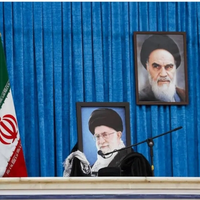
Iran’s National Virtual Space Center announced a resolution banning the use of VPNs in the country on Tuesday, approved by Supreme Leader Ali Khamenei.
Iranian President Ebrahim Raisi during a meeting with Supreme Leader Ali Khamenei
“Employing VPN devices is prohibited, except for those with a legal permit,” the resolution stated, without specifying who will be eligible for the permits and what actions and purposes will be allowed under the new law.
During the press conference, Miller also vowed that Washington will continue its support for internet freedom in Iran, an integral part of the US campaign to further the cause of human rights in the country.
“In the height of the protests in 2022 and 2023, as many as one in three Iranians used US-supported anti-censorship and digital security tools such as VPNs. There are millions of Iranians that have continued to use those tools to this day,” Miller went on to say.
Miller’s remarks come against the backdrop of mounting criticisms against US President Joe Biden over his policies regarding Tehran. Many Iranian activists and opposition figures, as well as American politicians, accuse the Biden administration of being too lenient towards Iran.
Iran's disruption of VPN networks has been coupled withan ongoing surge in internet crackdowns to silence opposition voices. The disruptions have led to decreased internet access speed, exacerbating concerns over online censorship and surveillance in Iran.
The latest bans come amid a broader crackdown on internet freedom activists. Among those detained is Youssef Ghobadi whose unofficial detention has sparked widespread outcry, along with the arrest of another activist known as "Segaro," who was active on the X platform. The two had been working to develop and distribute circumvention tools such as VPNs to help Iranians bypass internet censorship.
In last year's Freedom House report, the NGO stated "Iran experienced the worst score decline among the countries assessed, driven by the authorities’ disproportionate and violent crackdown on nationwide anti-government protests". It noted that "the government also shut down internet services, blocked WhatsApp and Instagram, and expanded its repressive surveillance apparatus".
A recently unveiled document has revealed that 16-year-old Nika Shakarami was raped by state-backed security during the Women, Life, Freedom protests.
The document, circulating on social media and seemingly discovered among a trove of files accessed after a hacktivist group breached the servers of the Iranian judiciary on Tuesday, contains evidence confirming that Shakarami had been subjected to rape amid a state sanctioned campaign of sexual violence as documented by rights groups.
The trove of documents obtained by the hacktivist group Edalat-e Ali covers a wide range of sensitive topics, spanning from internal discussions within the National Security Council following Mahsa Amini's death to efforts aimed at curbing unauthorized VPN vendors, protests against the 2020 employment examination, and cases related to economic corruption.
Abbas Masjedi Arani, head of the Forensic Medicine Organization has sent the "very confidential" letter to the Supreme National Security Council, explicitly stating, "In the genital examination, signs indicating assault or rough sexual intercourse were evident."
Nika's final communication with a friend in September detailed how security forces were pursuing her on Keshavarz Boulevard in Tehran before she mysteriously disappeared. Her family identified her body ten days later, revealing signs of torture, abuse, and beatings inflicted by security forces.
Government agents later seized Nika's body from Khorramabad and secretly buried her in a village in Lorestan, located in western Iran.
The aftermath of Mahsa Amini's death saw over 500 civilians, including children and teens like Nika, lose their lives in the ensuing uprising.
Ali Ramazani, a member of the Iranian National Team in the Microelectronics Olympiad
Ali Ramazani, a prominent figure in Iran's academic community and winner of an international Olympiad, has been sentenced to three years and seven months in prison.
Ramazani, known for his achievements as a member of the Iranian National Team in the Microelectronics Olympiad has been convicted of charges including "conspiracy and collusion against national security and propaganda against the Islamic Republic."
Ramazani was arrested on October 16 by agents of the Ministry of Intelligence at his private residence, allegedly in connection with student protests.
Despite his academic accolades, including winning the Best Bachelor Thesis Award from the Institute of Electrical and Electronics Engineers in 2021, Ramazani has been subject to what his supporters claim are fabricated charges.
The incident reflects a concerning trend in Iran, where elite students have faced unjust imprisonment. Notably, Ali Younesi and Amir Hossein Moradi, both award-winning science students from Sharif University, were arrested in April 2020. They were accused of possessing explosive devices and alleged ties to "counter-revolutionary groups." However, the claims are widely viewed as part of trumped-up charges.
Younesi and Moradi, recipients of prestigious awards including gold and silver medals at international and national Olympiads, have been subjected to severe torture and prolonged solitary confinement. Despite their academic achievements, they were both given 16 years in prison.
A demonstration by workers at Iran's Ahvaz National Steel Group
Workers at Iran's Ahvaz National Steel Group continued to strike for the second consecutive day on Wednesday over the suspension of several dissenting colleagues and the incomplete implementation of the job classification plan.
Managers of the industrial group suspended dozens of protesting workers, fueling discontent among the workforce. In September, 17 workers were sentenced to flogging, imprisonment, and fines, highlighting the authorities' crackdown on dissent, after taking part in protests.
Despite promises from management, the correct implementation of the job classification plan, pledged to be reflected in December salaries, has yet to materialize, further exacerbating tensions.
The Iranian National Steel Industrial Group, previously under the control of Amir Mansour Aria's investment firm, has transitioned to private ownership following legal proceedings and Aria's execution for embezzlement.
Workers across various industries, activists from different guilds, and retirees have been participating in numerous protests in recent months, seeking improvements in their working conditions.
The building of Iran's National Elites Foundation in Tehran
Iranian authorities have taken new measures involving the passport and immigration authority to prevent the ever-increasing emigration of experts from the country as the country’s brightest minds flee the regime.
Salman Seyed Afghahi, the deputy head of the National Elites Foundation told the semi-official Mehr news agency Monday that the foundation has made arrangements to report the entry and exit of all high level professional migrants to the police-run authority as many seek better work in areas such as teaching and medicine.
Afghahi alleged that emigration facilitation businesses were charging too little, between $1,000 or $2,000 for services that should normally cost $10,000 and claimed that “there is definitely a system that funds them”.
In a statement Tuesday, the foundation responded to the media uproar about involving the authorities, which fall under police control, claiming that this was a service “to prevent the profit-seekers’ abuse and protect the intellectual and material rights of the elites” and to “facilitate entry and exit” of the elite and their visa issues as ordered by the President.
Salman Seyed Afghahi, the deputy head of the National Elites Foundation
Denying any crisis as suggested by some medical officials, Afghahi also claimed that the rate of emigration of medical professionals from Iran has been falling and is lower than many developed countries such as Germany. However, just this month, the secretary-general of the Iranian Medical Society, Mohammed-Reza Zafarqandi, warned the medical sector was heading for a deep crisis.
He is not alone. Saeid Moidfar, chairman of the Iranian Sociological Association, recently warned that Iran is on the threshold of a very intense wave of emigration, Iranians feeling there is no future in the country with economic and social conditions only worsening and corruption and crime on the rise.
Echoing his sentiments, Mohammad-Reza Zafarghandi, secretary general of the non-profit Iran Medical Council, has repeatedly warned about the high interest in emigrationamong medical students and professionals.
He said last week that around 80 percent of medical students were thinking of leaving the country. According to Zafarghandi, medical professionals’ application to the Council for good standing certificates, required by many employers abroad, has grown by several fold compared to before.
Ali Akbar Salehi, Iran's former top nuclear official, claimeda few weeks ago that every elite’s emigration costs the country $5m in human capital. According to Salehi, 60,000 elite Iranians left the country in 2019 and the emigration of the elite in a one-year period between 2014-2015 cost the country over $38b in human capital.
In September, Dr. Saeid Moidfar, chairman of the Iranian Sociological Association, told the reformist Jamaran news website that in the wake of the Women, Life, Freedom movement, Iranians feel the future is bleak. State crackdowns on dissent, on women’s rights and an ever deepening financial depression have left many Iranians living in fear and poverty.
“You reach the point where you think this is no longer a good place to live, and you should leave as soon as you can when you feel you are in a country where you are not involved in the decision making system, the country is not being run based on sound principles, your overall economic misery is increasing by the day, and social values are being sullied,” Moidfar said in a bold stand against the government.
Iran’s economy has suffered years of mismanagement and international sanctions, which emanated from its foreign policy and ongoing nuclear program. Iran’s currency has fallen 12-fold since 2018 and more than 6000-fold since the 1979 revolution. In 1978, one US dollar would buy 70 rials and now the exchange rate is close to 500,000.
“Since 2017 the country has been in deep crisis. All prospects of change have been lost and there is no hope for the future of this country any longer,” he added.