Iranian Suicides Underscore Dire Impact Of Economic Struggles

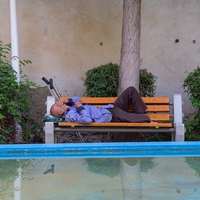
Two Iranian workers have taken their own lives in recent days, highlighting the severe impact of poor financial and living conditions.

Two Iranian workers have taken their own lives in recent days, highlighting the severe impact of poor financial and living conditions.
On Monday, Behzad Shokati, a 47-year-old park ranger in Astara County, Northern Iran, ended his life, citing "poor living conditions" as the driving factor.
Zeynab Bahraini, an environmental journalist, reported that this marks the "second suicide among foresters in Astara and Gilan province in the past year."
In a second incident, a worker at the Khaniabad fruit and vegetables market in southern Tehran took his own life on Saturday. Colleagues of the worker remain unaware of the reasons behind his actions, with the police discovering his body near the workplace.
Emtedad, a social media news channel, also covered the ongoing suicides among workers in the Chovar petrochemical complex in Ilam. An interview with the brother of one of the workers revealed that the suicides were a response to the termination of cooperation by the contracting company. Allegedly, the company's CEO stated, "We don't need the services anymore," leading to the tragic outcome.
The incidents highlight the urgent need for attention to workers' well-being, addressing financial hardships, and providing mental health support. Workers in various sectors, including the petrochemical industry, face precarious employment conditions and economic challenges, contributing to the growing crisis.
As concerns intensify, demands for improved working conditions and fair treatment echo through protests and gatherings, as witnessed with retirees and employees from the Social Security and Steel Industries, Iranian Offshore Oil Company, Aghajari Oil and Gas, and Haft-Tappeh Steel, who rallied on Sunday to draw attention to their unmet demands.
Suicide in Islam is forbidden, but death by suicide has grown by more than 40 percent in Iran over a decade, according to statistics, attributed to deepening economic, political and social upheaval. The 2022 report on “Social Justice Indicators” shows that law enforcement agencies recorded 5,085 suicide cases in 2021, compared to 3,559 in 2011, Iran Open Data reported.
Iran’s hardliners retreated somewhat last week, and authorities approved the candidacy of a few Reformists for the March parliamentary elections to save face.
As partial results of the vetting of Iran's upcoming parliamentary elections emerged, the official news agency IRNA has confirmed that the Guardian Council, which has the final say in the process of vetting, approved the candidacy of a few rejected candidates. This, however, is far from giving all regime insiders a chance to compete in the elections. Dozens of serious contenders have remained ostracized by the hardliner followers of Supreme Leader Ali Khamenei, which is expected to lower voter turnout in March.
Conservative politician Abolghasem Raoufian has argued that that most Iranians have still not come to terms with the idea of an all-conservative government and side-lining all other political groups. Raoufian said: "The turnout in Tehran was 18 percent during the previous Majles election, however, as a result of the performance of the current parliament and the government, the turnout in the upcoming election is likely to drop to 8 percent."
The government is under pressure by public opinion to open up the political atmosphere. It is currently suffering from a legitimacy crisis as the middle class, women and young voters have stopped communicating with the government particularly after the 2022 nationwide protest and the ensuing harsh crackdown.

Raofian went on to say that the Guardian Council's strategic mistakes of barring hundreds of candidates during the previous two rounds of elections in Iran “has caused irreparable damage to the Council's credibility and the reputation of some of Iran's key political figures."
The most well-known reformist figures whose qualifications have been endorsed are former vice president Mohammad Bagher Nobakht who is a key aide to former President Hassan Rouhani and the leader of his Moderation and Development Party, and Massoud Pezeshkian a lawmaker from Tabriz. Pezeshkian said on Monday that without a remark by Khamenei in his favor, his candidacy would have never been reconsidered.
Several Iranian government-owned news agencies reported the endorsement of Nobakht's qualifications. Nobakht was the head of the Planning and Budget Organization under President Rouhani.
IRNA has also confirmed the official candidacy of Gholamreza Tajgardoon, a former MP whose credentials were revoked after he was implicated in a major financial corruption case. This is yet another indication that there is no will in the Iranian government to tackle corruption.
Meanwhile, the official news agency also confirmed that the Guardian Council has endorsed the qualification of former MP Ali Motahari, a conservative critic of some the Raisi Administration's policies. Motahari's candidacy was rejected by the Guardian Council during the 2021 Presidential elections.
Most of the results of the vetting are expected to be announced during the coming days. The voting for the parliamentary election is slated for March 1. Some of Iran's Reformists have called for postponing the election to another date, but that is unlikely to be approved by the government.
Still, the presence of a few reformist and moderate candidates cannot guarantee a high turnout in the elections as those who have got through the Guardian Council's net are not among the top tier of reformist figures in Iran. Some reformists including Mohammad Ali Abtahi have pointed out that without free and fair elections and solving the country's economic problems, most of eligible voters are unlikely to show up at the polls.
Many other Iranian politicians have highlighted the nearly 80 percent turnout in the latest elections in Turkey and reminded the Iranian government that it is a shame that turnouts in the latest elections in Iran were between 20 to 40 percent.
Raoufian said that the government's poor economic performance is one of the major causes of low turnout in Iran's elections in recent years. He added that the parliament's silence in the face of the recent $3.5 billion-dollar Debsh Tea financial corruption has badly damaged the reputation of the Majles and its lawmakers.

Fingers of two prisoners who were sentenced to amputation for theft were cut off in Iran’s religious city of Qom, in contravention of international law.
Ali Mozaffari, the Chief Justice of Qom Province, said on Monday that three more men face the risk of the same punishment.
In June 2022, a prisoner in Tehran's Evin prison underwent the amputation of four fingers using a guillotine, which was allegedly installed in the infirmary a month prior to facilitate such sentences.
At the time, Amnesty International warned that the Iranian authorities were preparing to amputate the fingers of eight men and according to the Abdorrahman Boroumand Centre, since January 2000, the Iranian authorities have amputated the fingers of at least 131 people in total.
In spite of it contravening Article 7 of the International Covenant on Civil and Political Rights (ICCPR), to which Iran is a state party, Iranian law states that for certain types of theft, those convicted shall “have four fingers on their right hands completely cut off so that only the palm of their hands and their thumbs are left”.
Amnesty International claims that the Iranian authorities have consistently defended amputation as the best way to deter theft, and have expressed regret that it cannot be practiced in public because of international condemnation.
Despite calls from international bodies such as the United Nations and rights groups urging the cessation of amputation sentences and their execution in Iran, the issuance and execution of such punishments persist in the Islamic Republic, including whipping, finger amputation, stoning, and amputation of hands and feet.
The amputations come amidst Iran's surge in executions, which have gained pace since the Women, Life, Freedom uprising began in September 2022.

A recent report revealed that a staggering 99.7% of Tehran's population is grappling with depression according to The Tehran Studies and Planning Center.
The comprehensive study further discloses that a significant 80.8% of Tehran residents have reported a low quality of life. Only a modest 18.9% indicated a moderate quality of life, with a mere 0.3% reporting a high quality of life.
The pervasive depression and the undesirable living conditions have far-reaching consequences, contributing to the surge in crime, social problems, and widespread public dissatisfaction, according to the report.
An in-depth analysis of the study's results identifies at least five disruptive factors severely impacting the quality of life for citizens. The "chaotic city situation" emerges as one of the most significant obstacles affecting the well-being of Tehran residents.
In September, the reformist newspaper Ham-Mihan released a report indicating that one out of every five prescriptions issued is for either antidepressants or sleeping pills. The report establishes a connection between the mental health of Iranians and social issues, particularly referencing protests.
The newspaper underscored that, since 2022, a growing number of individuals have been contemplating migration as a potential solution to their current circumstances.
Following the Woman, Life, Freedom uprising, numerous experts, including university professors, mental health specialists, and sociologists, expressed apprehensions regarding the societal condition in Iran. Four mental health associations echoed their concerns about the mental well-being of citizens in a joint statement.

More than 600 Iranian doctors issued a joint statement urging the high judicial authorities to reconsider the "harsh and unjust" sentences imposed on a protesting couple.
Hamid Qarahassanlou, a fifty-four-year-old radiologist, and his wife Farzaneh were arrested in November during protests in Karaj, following the death of Basij militia member Ruhollah Ajamian, who was reportedly beaten to death by angry demonstrators.
The doctors, expressing their objection to the allegations against Qarahassanlou, stated, "With the close and extensive knowledge we have of Qarahassanlou, either personally or through trustworthy colleagues, we do not find the accusation of his involvement in attributed violence to be justified." They emphasized that information from the family, lawyers, and official media outlets supported their belief in the couple's innocence.
After a commemoration ceremony on November 3, 2022, for those who lost their lives in the Woman, Life, Freedom uprising, 16 people were detained in connection to the death of Ruhollah Ajamian. Two men, Mohammad Mehdi Karami and Mohammad Hosseini, were executed on January 7, 2023, while eight others faced heavy prison sentences and exile.
Qarahassanlou, initially sentenced to death, received the longest imprisonment term of 15 years in the case. The doctors, drawing attention to the couple's diseases, have called for a retrial and temporary release until the case can be reexamined in a fair court.
The plea from the medical community comes amid tensions, as the brother of Ajamian has publicly stated that their family "only wants" Qarahassanlou and his wife to be hanged. The Islamic Republic has previously executed protesters on charges of 'moharebeh,' meaning "war against God."

The Israeli army says it has found evidence in Gaza that shows Iran helped Hamas make precision-guided missiles, something the group was thought not to have.
It’s unclear what the proof was of Iranian involvement in manufacturing and operating of the missiles, although a photo has been presented along with the announcement, which Israel army says is a cruise missile produced by Hamas in the Gaza Strip.
Iran has never denied its support for Hamas and other armed groups in the region, providing funds, training, weapons and knowhow. But until now, Hezbollah in Lebanon has been widely believed to be the only group to have received precision-guided missiles (or the required technology to make it in-house).
The revelation about Hamas comes only a day after the Israeli army announced it had dismantled Hamas’s “military framework” in northern Gaza, and was now focusing on central and southern Gaza.
Israeli prime minister Benjamin Netanyahu has repeatedly said that the onslaught on Gaza will continue until Hamas is “eliminated.” On Sunday, he told his war cabinet that “the war must not be stopped until we complete all of its goals.”
Netanyahu critics say his military ambitions may be driven by political interests. TheWashington Post on Sunday quoted an unnamed US official as saying “Netanyahu’s political career will end with it, incentivizing him to broaden the conflict.”
This could mean, above all, a possible war with Hezbollah in Lebanon –which is Iran’s most powerful ally and has frequently targeted Israel during the three months since October 7th.
The Lebanese Shiite militant group launched a barrage of rockets towards Israel early Saturday in response to the killing of a senior Hamas official in Beirut Last week. Shortly after, Israel hit several Hezbollah positions in southern Lebanon.
Many –including the Biden administration– fear that the regular exchange of fire at the Israeli-Lebanese border would lead to an all-out war, especially since Netanyahu has spoken of a “fundamental change” to address the border fighting with Hezbollah.
The situation seems to be worrying enough for President Joe Biden to have sent his Secretary of State Anthony Blinken on yet another tour of the Middle East to try and prevent any widening of the ongoing conflict, which has killed more than a thousand in Israel and twenty times more in Gaza.
“We have an intense focus on preventing this conflict from spreading,” Blinken said in a meeting with Jordan’s King Abdullah.
Even more concerned than the US seems to be the European Union.
On Saturday, EU foreign policy chief Josep Borrell said it is “absolutely necessary” that Israel’s onslaught in Gaza does not drag Lebanon into a regional war.
“I am sending this message to Israel, too,” Borrell said after a meeting with the Lebanese foreign ministers, “I think that the war can be prevented, has to be avoided and diplomacy can prevail.”
Iran is also part of that conversation –behind the scenes, perhaps, with the Biden administration but publicly and openly with EU countries.
“I called Iranian Minister A Abdollahian and gave him a very clear message,” French foreign minister Catherine Colonna posted on X Saturday, “the risk of regional conflagration has never been so significant; Iran and its associates must immediately stop their destabilizing actions. No one would gain from escalation.”