Iran Reiterates Looming Death Threats To Trump Administration

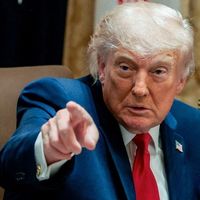
In a veiled warning, Iran says Donald Trump, Mike Pompeo, and former CENTCOM head Kenneth F. McKenzie should suffer a "lack of certainty" after the death of Qassem Soleimani.

In a veiled warning, Iran says Donald Trump, Mike Pompeo, and former CENTCOM head Kenneth F. McKenzie should suffer a "lack of certainty" after the death of Qassem Soleimani.
Named as the main suspects in the killing of slain IRGC Commander Soleimani, Kazem Gharibabadi, Deputy for International Affairs of the Judiciary of the Islamic Republic said on Sunday, "At the very least, their minimum punishment is the lack of security they feel, and you see how much is annually spent to protect them."
He outlined that three legal pursuit paths have been established within the Iranian system, the Iraqi territory, and international investigations, with the International Court of Justice recognized as the sole legitimate international authority.
“After extensive investigations, an indictment was formulated in June, charging the suspects with terrorist activities and financing terrorism. The scope of the case expands beyond American borders, involving documents from five to six other countries. The initial phase will focus on pursuing American suspects, and the UK and Germany are also implicated,” he added.
In December, an Iranian court ruling on the investigation into Soleimani's killing ordered damages of nearly $50 billion against the US government and affiliated individuals and entities. The court also demanded an official apology for the drone strike that claimed Soleimani's life in January 2020.
Former US president Donald Trump defended the action, asserting that Soleimani was actively planning attacks on American diplomats and service members.
Qassem Soleimani's role in overseeing external military and intelligence operations, including support for militant proxy forces, played a crucial part in hostilities against US forces in the region.


Iran’s clerical watchdog, the Guardian Council, has rejected the qualifications of one in every ten current lawmakers to run in the March parliamentary elections.
A report on the Etemad Online website said that out of the 290 lawmakers, 275 had registered their candidacy for the upcoming elections but the qualifications of only 26 have been rejected.
Etemad Online has published a "confirmed and verified list" of the 26 mainly conservative candidates. The names of at least two reformist figures, Jalal Rashidi Koochi and Majid Ansari both from Fars Province are also on the list.
The mass disqualification of candidates, who are considered regime insiders but relatively more moderate, is a repeat of what hardliners did in the 2020 legislative elections and in the 2021 presidential vote.
Meanwhile, verified reports from Tehran say former Intelligence Minister Mahmoud Alavi, one of the most senior officials in the administration of former President Hassan Rouhani, has been also disqualified.
Another lawmaker Qasem Saedi told reporters that he has been disqualified because he had called for the impeachment of Interior Minister Ahmad Vahidi for his poor performance. Saedi said he will definitely challenge the Guardian Council's decision.

Ahmad Alireza Beigi, an ultraconservative lawmaker close to Mahmoud Ahmadinejad, who is said to have been part of the country's intelligence apparatus before becoming a member of the parliament has also been disqualified. Beigi, representing Tabriz, is the MP who disclosed a major financial corruption case involving more than 100 lawmakers who were bribed to avert an impeachment motion against one of President Raisi's Ministers.
The bribery scandal known as SUV-Gate involved the lawmakers receiving vehicles at low prices from the minister of industry, in order not to impeach him.
The lawmaker told the press that no one has told him anything about his disqualification and that he read the news about his rejection in the press. Other reports say he might have been disqualified because of the complaint made against him by a cabinet minister.
The candidates whose candidacy has been rejected by the Guardian Council have the next four days to challenge the Council's decision.
Meanwhile, conservative commentator Mohammad Mohajeri says several candidates close to former Majles Speaker Ali Larijani have also been disqualified. However, he did not name anyone.
In another development, outspoken former lawmaker Gholam Ali Jafarzadeh Imanabadi, a staunch critic of the government and Majles Speaker Mohammad Bagher Ghalibaf has also broke the news about his disqualification. He said he will never forget this and will never forgive those who have rejected his credentials.
In yet another report, conservative politician Mansour Haghighatpour said that most lawmakers who had registered their candidacy have been barred from running for the next parliament. He pointed out that disqualifying candidates for criticizing the government is against the law. Haghighatpour further called on the Guardian Council to revise its decisions regarding disqualification of candidates.
Haghighatpour, who is close to Larijani has confirmed the disqualification of the candidates who were close to the former Majles Speaker, however, he added that his own qualification has been endorsed by the Guardian Council.
Referring to Supreme Leader Ali Khamenei's call for a high-turnout election, Haghighatpour reiterated that candidates from different schools of thought should be allowed to take part in elections “if we really want a high-turnout parliamentary election.”
Haghighatpour claimed that four of those close to Larijani who have been rejected could have won half a million votes each if their qualifications were endorsed. He claimed candidates such as: Jafarzadeh Imanabadi from Rasht, Javad Kolivand from Karaj, Nader Qazipour from Urmia, and others former lawmakers such as Javad Jahangirzadeh and former chief justice Ezzatollah Yusefian Molla, who have been barred from running, can attract some one million voters to the polls and ensure a high-turnout election.

A high-ranking commander from the Islamic Revolutionary Guard Corps (IRGC) said the latest assassination of a senior Hamas figure reflects Israel's 'ongoing defeat'.
According to Al-Mayadeen, Esmail Qaani (Ghaani), the commander of Iran's extraterritorial Quds Force wrote to political leader of Hamas, Ismail Haniyeh, that Israel 'seeks to mitigate its heavy defeat in Gaza and the occupied West Bank.
However, the results on the ground tell a different story. Israel's Defence Forces announced it has now taken out all Hamas infrastructure in north Gaza and numerous top commanders have been eliminated, with the operation predicted to last several more months as the Jewish state vows to eliminate the designated terror group.
Since the beginning of the month, Israel has also withdrawn five whole units from Gaza as the operation continues to gain pace from air, land and sea, in a bid to reduce casualties while it makes significant gains in the strip.
An airstrike in Beirut on Tuesday claimed the life of Saleh Al Arouri, Hamas's deputy political leader. Known for his close ties to the Iranian regime, Arouri had engaged with Supreme Leader Ali Khamenei and other top officials on multiple occasions. Qaani, in his message, emphasized that "the enemies and Zionists seek to mitigate their significant setbacks in Gaza by targeting the leaders of the resistance."
As a founding member of Hamas' military wing, Arouri had led the group's presence in the West Bank. Since the Hamas terror attacks of October 7 which sparked the most violent conflict since Hamas took over control of the strip, Israel also destroyed Arouri's West Bank family home.
Qaani said in the letter: "The world will witness how the brothers of the martyr Al-Arouri will turn into the nightmare of the Zionist child-killing regime."
While Iran openly supports Hamas, it denies any involvement in the Islamist militants' October 7 terror attack.

A recent spike in black market alcohol poisoning in Maku, in West Azarbaijan province, has led to the deaths of at least seven.
The Saturday edition of Etemad newspaper revealed that, alongside the fatalities, one of the consumers of the beverages has experienced vision problems. Initial reports regarding the casualties related to bootleg alcohol were released on Wednesday, with Saber Jafari, the prosecutor of Maku, confirming three deaths and over 20 poisoning cases.
Earlier, the prosecutor of Maku announced the arrest of four individuals, likely connected to the sale of the home made, black market drinks.
In late June and early July, numerous citizens in provinces such as Tehran, Alborz, Mazandaran, Hormozgan, and Qazvin were poisoned due to the consumption of what the government refers to as "counterfeit beverages" or industrial alcohol, leading to loss of life.
Reports indicate that the majority of the victims in Iran fall within the age group of 20 to 40 years old.
The sale and consumption of alcoholic beverages are illegal in Iran. The judicial system can subject consumers to initial arrests with 80 lashes and, in the case of repeated offenses, the death penalty.
According to the World Health Organization's 2018 report, Iran ranks ninth in global alcohol consumption.

Iranian authorities announced on Saturday that all individuals with possible links to the recent twin bombings in Kerman, claimed by ISIS, have been detained.
Mehdi Bakhshi, the prosecutor in Kerman, stated that "In recent months, 32 people related to the case have been arrested and are currently in the interrogation phase." He also claimed that many explosive devices were found in Kerman province prior to the deadly bombing.
Bakhsi's remarks raise questions as to why a terror group was able to pull off the January 3 attack, if security forces were so successful in arresting people before the incident.
The explosions on January 3 in a cemetery in Kerman, coincided with the fourth anniversary of the killing of the former IRGC commander Qasem Soleimani. The blasts were described as "two suicide explosions," resulting in conflicting casualty figures from Islamic Republic officials, ranging from 83-103.
The government faces criticism for failing to anticipate and prevent the attack, and officials scramble to offer all sorts of explanations.
The Islamic State group claimed responsibility for the attacks on Thursday, stating that two individuals with explosive belts orchestrated the explosions. Bakhshi, in a special news interview, disclosed that one of the suicide bombers was from Tajikistan, while the identities of the other individuals are still under investigation.
Addressing the status of the detainees, Bakhshi specified that those arrested are currently "under interrogation and in preliminary stages." He further added that "two other suicide attackers" had planned to carry out operations during the funeral procession of the victims of the Kerman explosions, and their information was discovered "before the assignment of tasks in the ceremony."

A former intelligence minister has revealed Iran's strategy of pursuing and repatriating dissidents through elaborate operations.
"Our strategy was to bring anti-security elements back into the country, using intricate intelligence tactics, to the extent possible," Mahmoud Alavi, a cleric who served as intelligence minister under President Hassan Rouhani, told the official new agency IRNA on Saturday.
Alavi mentioned the examples of Habib Asyud (also known as Habib Chaab) – an Iranian-Arab leading separatist, and Jamshid Sharmahd, a 68-year-old software developer and California resident, who was an anti-regime activist. He was abducted during a trip to the United Arab Emirates and now faces the death penalty in Iran. Asyud, who was a Swedish dual national, was put on trial in secrecy, like in most political cases, and was hanged in May 2023.
In addition to mentioning these abduction cases, the former intelligence minister also implicitly admitted of killing opponents in exile, such as another Iranian Arab separatist in Holland.

Alavi also divulged some information on how Sharmahd was abducted. From his brief remarks it can be surmised that the monarchist opposition activist was tricked into believing that he would be taken from the UAE to Pakistan.
"When he opened his eyes in [the Iranian port of] Chabahar, he realized that he was in the Islamic Republic, and the guys told him, 'Welcome to the Islamic Republic, Mr. Sharmehd,'" Alavi described.
The abducted man was put on trial on charges of plotting terror attacks in Iran and given the death sentence. In 2023, as the Biden administration was negotiating a hostage release deal with Tehran, there were high hopes that Sharmahd would be one of the prisoners to be released. However, five other individuals who were US citizens were exchanged for $6 billion of Iran’s blocked funds, and he remains in Iran facing the death penalty.
Another famous dissident who was abducted and taken to Iran where he was hanged, was Ruhollah Zam, who lived in France and engaged in media work, exposing corruption among Iranian regime officials. He was lured to travel to Iraq in 2019, where Iranian security and intelligence networks have a strong presence. Upon his arrival he was abducted and taken across the border to Iran, where after a year he was hanged.
During his incarceration, he was interviewed on the state TV and calmly and courageously stood his ground. He is remembered by his famous line during the interview when in response to the government interviewer and referring to anti-regime protests, he said, “You call them riots, we call them protests.”
The timing of Alavi’s “interview” with IRNA could be related to the internal and external pressures the Iranian regime is faced with. The public bragging about abductions could be an attempt to intimidate opponents that the regime is strong and has a long arm to reach them.
It is noteworthy that a former minister from a relatively “pragmatic” administration spoke about the intelligence operations, and not one of the hardliners who currently control the parliament and the presidency.
President Hassan Rouhani was an advocate of negotiations with the West and his government was presented as a “reformist” administration.
However, intelligence, military and nuclear matters in Iran are controlled by the core of the regime, under the direct control of Supreme Leader Ali Khamenei’s office. Changes in presidential administrations and rotation of specific officials make little difference in security matters.