Iran’s Top Sunni Leader Demands Justice For Girl In Coma

Iran's top Sunni leader Mowlavi Abdolhamid has called for an impartial probe in the case of a teenage girl who fell into a coma after a reported row with hijab enforcers.

Iran's top Sunni leader Mowlavi Abdolhamid has called for an impartial probe in the case of a teenage girl who fell into a coma after a reported row with hijab enforcers.
During his Friday prayer sermon, the outspoken cleric said those responsible for the situation of Armita Geravand, comatose since October 1, should be held accountable.
Armita was admitted to hospital in coma after falling unconscious in a train at a subway station in Tehran on Sunday.
“Now, most people in Iran and around the world have expressed concerns about Armita, and that's why a thorough investigation into her coma is necessary," he said. “The government should take action against those responsible for her condition, whether they are from the ‘morality police’ or any other entity.”
Abdolhamid emphasized that the only thing, which can bring peace to the country is justice.
Following the incident, security forces established a heavy presence at the hospital entrance, preventing visitors, and even forbidding people from recording videos with their phones. A journalist was arrested after going to the hospital to investigate. She was released on bail the same day.
On Thursday, the Guardian quoted an eyewitness as saying that soon after Armita entered the train carriage, a woman agent enforcing compulsory veiling in the subway started arguing with Armita about why she had not covered her head. “The hijab enforcer started physically attacking Armita and …violently pushed her.”
Security is still tense around the hospital, and authorities are not forthcoming about the circumstances surrounding Armita's coma. Meanwhile, the media is filled with concerns from Iranians, foreign activists, and officials, all fearing a scenario similar to Mahsa Amini's death could reoccur.
A human rights group has called for independent investigation into circumstances surrounding the case of an Iranian comatose schoolgirl amid mounting evidence of a cover up.
Amnesty International said Friday the global community must demand that the Iranian authorities allow an independent international delegation, including UN experts, to enter the country to investigate the circumstances leading up to the hospitalization of 16-year-old Armita Gervand, who fell unconscious on a Tehran subway train after an encounter with regime’s hijab enforcers.
She was reportedly pushed by a hijab enforcer recently deployed at subways stations, and has been in a coma since. Iran’s state media has aired footage showing Armita entering a Tehran subway station without covering her hair, waiting with friends, and then being carried out of a metro car unconscious by her friends. The state media have not shown any footage from inside the metro car and claim there were no CCTVs to record the incident inside the train.
Analysis by Amnesty International’s Evidence Lab reveals the video frame rate was increased in four sections and detected a gap of three minutes and 16 seconds in the footage. Two eyewitnesses have also confirmed to the Guardian that hijab enforcers were involved in Armita’s injury Sunday morning.
“Iranian authorities arrested a journalist investigating the incident and circulated propaganda videos on state media featuring Armita visibly distressed parents and friends reluctantly reiterating the state narrative that she collapsed due to low blood pressure,” Amnesty said.
“Iranian authorities are waging a concerted campaign of denial and distortion to cover up the truth about the circumstances..., chillingly reminiscent of their bogus narratives and unplausible explanations of Mahsa/Zhina Amini’s hospitalization just over a year ago,” said Diana Eltahawy, Amnesty International’s Deputy Regional Director for the Middle East and North Africa.“The international community must also demand that Armita Garawand’s relatives, friends and journalists seeking the truth are protected from reprisals and harassment."

Iran has condemned adrone attack on a graduation ceremony at a military academy in Syria, the bloodiest strikes against the military in the past decade.
At least 116 people were killed and about 100 injured Thursday when several weaponized drones hit the Homs Military Academy's courtyard where families were gathered with the new officers, minutes after Defense Minister Ali Mahmoud Abbas had left. More than 30 women and children were killed in the attack.
There have been no claims of responsibility for the attack, but Syria's defense and foreign ministries blamed what they described as “terrorist groups backed by known international forces” without specifying further, and vowed to respond "with full force".
Iranian Armed Forces Chief of Staff Mohammad Bagheri, the military commander serving at the country’s most senior military position, wrote to his Syrian counterpart Abdul Karim Mahmoud Ibrahim and Syria’s Defense Minister Ali Mahmoud Abbas to express readiness for closer cooperation with Damascus “in the fight against terrorism.”
Iran’s Foreign Minister Hossein Amir-Abdollahian also held a phone call with his Syrian counterpart Faisal Mekdad on Thursday, while President Ebrahim Raisi condemned the attack.
Sunni Islamist groups Tahrir al-Sham and ISIS as well as Islamist militias with close links to Turkey have bases in the region that is announced as the origin of the drone, pundit Ali Sadrzadeh told Iran International.
The United States on Thursday shot down an armed Turkish drone that was operating near its troops in Syria, the Pentagon said, the first time Washington has brought down an aircraft of NATO ally Turkey. Tensions have flared and there have been close calls. In 2019, US troops in northern Syria came under artillery fire from Turkish positions.
A Turkish defense ministry official said the drone that was shot down did not belong to the Turkish armed forces but did not say whose property it was. According to Turkish security source, Turkey's National Intelligence Agency carried out strikes in Syria against Kurdish militant targets after a bomb attack in Ankara last weekend.

United Nations has restated concerns regarding the human rights situation in Iran, urging the release of detained protestors and an immediate end to executions.
In a recently released report, UN Secretary-General Antonio Guterres highlighted a surge in executions, the detainment of protestors, pressures on students and educators, and gender-based discrimination. The report, submitted to the 78th session of the United Nations General Assembly in September, details the progress made in the implementation of resolution 77/228, addressing human rights in the Islamic Republic of Iran.
The report noted that Iran's engagement with UN human rights bodies remained limited, and the implementation of recommendations from international human rights mechanisms remained low.
The report raised concerns about Iran's death penalty, revealing that at least 419 people were reportedly executed, including 409 men and 10 women, between January 1, 2023, and July 31, 2023, marking a 30 percent increase compared to the same period last year.
It also highlighted the cases of seven men executed for their involvement in nationwide protests triggered by the death in custody of Mahsa Amini in September 2022. The report also mentioned, "At least seven men are allegedly considered at risk of execution, including those from minority communities connected to the nationwide protests."

The Secretary-General expressed alarm over large-scale arrests and detentions carried out by security forces targeting protesters and their supporters. It estimated that between September 17, 2022, and February 8, 2023, approximately 20,000 individuals were arrested for participating in protests, with many of them possibly children, given the reported average age of 15 among those arrested.
The report also noted overcrowding in prisons, with prisons in areas with minority populations being particularly affected.
Regarding the crackdown on dissent, the report highlighted that Iranian authorities continued to justify restrictions on the right to freedom of opinion and expression, both online and offline, using a strict national security approach. Supreme Leader Ali Khamenei's call to "eliminate dissenting voices" from online spaces raised further concerns.
The report mentioned 17 journalists (9 men and 8 women) detained in connection with the protests between September 16, 2022, and March 31, 2023.
In the section on Iran's economic situation, the UN report discussed rising poverty, inequalities, and the increased cost of living. Iran faced high inflation and a significant decrease in the value of its currency, rial, along with increased poverty and unemployment levels.
The UN report expressed concerns about Iran's new hijab law, which would further discriminate against women and girls by expanding the scope of offenses related to compulsory veiling. The bill would impose punishments such as monetary fines, restrictions on accessing banking services, confiscation of personal property, travel restrictions, bans on online activity, and imprisonment of up to 25 years for repeat offenders. It would also allow flogging for women appearing "uncovered in public."
The report concluded with recommendations for the Iranian government, which have been reiterated multiple times, yet the Islamic Republic has not heeded them.

EU foreign policy chief Josep Borrell has expressed concerns about Armita Geravand, an Iranian teenage girl who fell into a coma after an encounter with hijab enforcers.
The High Representative of the European Union for Foreign Affairs and Security Policy told Iran International that they “are following this worrying case.”
“While all the details are not yet clear, the reports indicate that her condition is the result of a confrontation with the police,” Borrell said, adding, “If confirmed this would be unacceptable and unjustifiable.”
Touching upon the issue of the human rights situation in Iran, Borrell noted that “it is something that the EU not only follows closely and raises regularly with the Iranian authorities (most recently with the Foreign Minister of Iran)," but also reacts to with public condemnation and with sanctions against those responsible.
Despite growing concerns expressed by numerous activists and officials regarding her condition, Iranian authorities have escalated efforts to suppress information about her.
Security has remained high at the Fajr hospital where Armita is receiving intensive care since the beginning of the week.
According to information obtained by Iran International, physicians and nurses entering her room are subjected to continuous physical search to ensure they do not carry mobile phones or cameras. The surveillance cameras in her room have also been disconnected to prevent hacking or leakage of images.
Authorities are not forthcoming about the circumstances surrounding Armita's coma. Meanwhile, the media is filled with concerns from Iranians, foreign activists, and officials, all fearing a scenario similar to Mahsa Amini's death could reoccur.
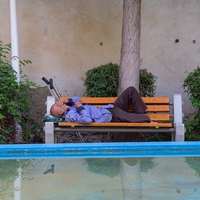
An Iranian war veteran of the Iran-Iraq war has been sentenced to a total of 13 years behind bars on several charges that include insulting the Supreme Leader.
Mohammad-Vali Heydarbeigi, who has lost both his legs, one ear, and his teeth during the eight-year war, was given the sentence by the criminal court of the city of Abhar in Zanjan province, the US-based Human Rights Activists News Agency (HRANA) reported Thursday.
His charges include five years for “collaborating with a hostile government;” one year for "propaganda against the Islamic Republic system;" two years for “insulting the Supreme Leader;” and another five years for “conspiracy and collusion against national security and membership in anti-revolutionary groups.”
Under the laws of the Islamic Republic, if this verdict is upheld by the court of appeal, he must serve the harshest punishment, which will be five years imprisonment in his case.
The war veteran was arrested on November 19, 2022, and was transferred to the Intelligence Detention Center of the Revolutionary Guards (IRGC) in Zanjan. He was released on bail several weeks later. It is not clear if he was arrested during street protests that rocked Iran last year after the death in custody of 22-year-old Mahsa Amini.