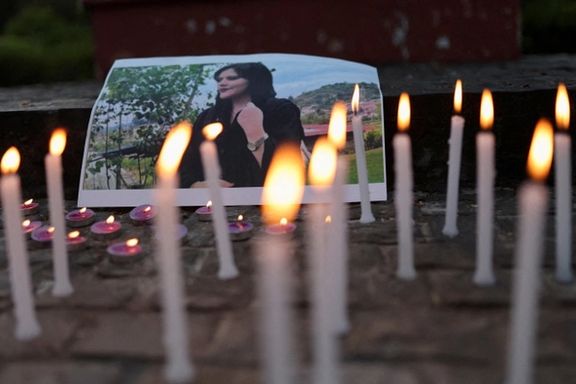
A photo of Mahsa Amini is pictured at a condolence meeting organised by students and activists from Delhi University in support of anti-regime protests in Iran following the death of Mahsa Amini, in New Delhi, India, September 26, 2022.
Security is tense in Iran in anticipation of protests on the anniversary of Mahsa Amini's death, with her parents under house arrest and the regime diverting water from a nearby dam to block access to her hometown's cemetery.
Amjad Amini, Mahsa's father, was briefly detained on Saturday and subsequently placed under house arrest with his wife. This occurred amid a heavy security presence around their home in the Kurdish-majority city of Saqqez in western Iran.
According to online footage, city authorities have opened the gates of the Cheraghveis dam, located about 17 kilometers southwest of Saqqez. This diversion allows water from the dam's reservoir to flow through a river, effectively blocking access roads to the Ayyachi Cemetery, where Mahsa is buried. Mahsa, a 22-year-old Iranian-Kurdish woman, died in hijab police custody last year, sparking Iran's largest anti-regime protests. Security forces had already sealed off the main entrance to the cemetery on Friday.
On the eve of Mahsa's first death anniversary, people chanted slogans from their windows in Tehran and many other cities across the country. However, planned street protests for the day have been scarce due to the heavy presence of security forces.
Social media has been inundated with images and reports depicting an unprecedented security presence in Kurdish provinces and major cities, including Tehran, Karaj, Rasht, and Tabriz.
Grassroots activists in Tehran informed Iran International on Saturday that the city's main squares are crowded with military and an assortment of security forces, including many plainclothes agents. Military riot control vehicles are stationed every 10 meters in some locations, with black vans positioned to contain potential detainees in between. Some neighborhoods in the capital, with limited access to main streets, such as Ekbatan, have been completely cordoned off by vehicles as security forces patrol the area continuously.
Checkpoint inspections have been established at the entrances to all Kurdish-populated cities, resulting in significant traffic congestion and thorough searches of both passengers and vehicles.
Calls for action by foreign-based activists continue, with numerous Iranian expatriates holding gatherings in several European cities, including Brussels and Paris. Rallies were held in Australia, New Zealand, and Japan earlier in the day.
However, state media claim Amini's hometown of Saqqez was "completely quiet" and that calls for strikes and protests in Kurdish areas had failed due to "the presence of security and military forces".
On the first anniversary of his daughter's death, the father of Mahsa Amini was briefly arrested, the latest in a line of arrests over recent weeks.
Amjad Amini was apprehended by IRGC agents shortly after leaving his home on Saturday and taken to an undisclosed location before he was released and put under house arrest later in the day.
"Security forces detained Amjad Amini today and returned him to his house after threatening him against marking his daughter's death anniversary," A Kurdish human rights group said.
Mahsa Amini's mother's residence is currently surrounded, resembling a military compound, and security measures have been significantly increased in Kurdish-populated regions.
Her uncle has also in recent weeks been arrested with multiple threats levied to her brother as the family is subjected to constant pressure not to gather in remembrance of her death in morality police custody hands one year ago.
Social media has been inundated with images and reports depicting an unprecedented security presence in Kurdish provinces and major cities, including Tehran, Karaj, Rasht, and Tabriz. The Kurdish human rights networks have indicated that Iranian security forces are preventing non-local individuals from entering Mahsa's hometown, including her cemetery.
Checkpoint inspections have been established at the entrances to all Kurdish-populated cities, resulting in significant traffic congestion and thorough searches of both passengers and vehicles.
Students from four universities in Tehran have released statements in support of the Women, Life, Freedom protests and to mark the anniversary of Mahsa Amini's death.
In the statements, students from Science and Technology University, Amir Kabir, Beheshti and Khajeh Nasir Toosi Universities underlined that the women's rights protests signify a "public outpouring of frustration against the Islamic Republic."
Students have been at the forefront of protests since the death in morality police custody of 22-year-old Mahsa Amini, with many students arrested and barred from continuing their studies for speaking out against the regime and refusing to wear mandatory hijab on campus.
Students at the Beheshti University reaffirmed their unwavering commitment to the cause, emphasizing their resolute support for resistance despite witnessing violence and hostility.
Students from Science and Technology University recalled the events of the past year when "innocent blood was shed, and our patience was tested," leading to a unified call for justice for Mahsa whose killers have still not been brought to justice. The regime claims she died of a pre-existing condition, but scans revealed she had suffered fatal blows to the head.
AmirKabir University of Technology students explicitly stated their opposition to various forces undermining freedom, such as “the Supreme Leader, the IRGC, paramilitary organizations, monarchy, the Mujahedin-e Khalq, centralization, and any form of tyranny or totalitarianism.”
Meanwhile, students from Khajeh Nasir Toosi University of Technology voiced their support, declaring their challenge to the system.
Western powers imposed more sanctions on Iran Friday, highlighting the brutality of the Islamic Republic on the one-year anniversary of the death of Mahsa Amini.
The United States, The United Kingdom, Canada and the European Union also issued a series of statements voicing support for the Iranian people and women and condemning the government for violence against its own population.
“Jill and I join people around the world in remembering her—and every brave Iranian citizen who has been killed, wounded or imprisoned by the Iranian regime for peacefully demanding democracy and their basic human dignity,” President Joe Biden said in a statement.
Amini, 22, was arrested because the hijab police felt her hair wasn’t covered properly. She was hit on the head in custody and died in hospital on 16 September 2022.
People took to the streets in anger and disbelief, first at Mahsa’s hometown of Saqqez in the Kurdistan province and then all over Iran. More than 500 were killed and tens of thousands were arrested in the weeks that followed, as armed police and loyal thugs joined forces to save the regime from the most serious popular challenge to its authority since 1979.
Commemorating Mahsa and the months-long anti-regime protests in Iran, the governments of US, UK and EU announced new rounds of sanctions that would target “some of Iran’s most egregious human rights abusers”, in the words of President Biden.
Those sanctioned by the US include high-ranking members of the IRGC, the head of Iran’s Prisons Organization, and officials linked to Iran’s internet blockade. The English state channel (PressTV) and two IRGC-affiliated media (Fars and Tasnim) were on the list too.
The US Treasury said in a statement that it will take more “collective action against those who suppress Iranians’ exercise of their human rights.”
Britain separately sanctioned senior officials with connection to enforcing mandatory hijab, including the minister for Culture and Islamic Guidance, who has taken action against actresses and businesses for defying the mandatory hijab. Also on the UK list are the Mayor of Tehran, and the Police Spokesman, who has threatened to impound vehicles whose driver or passengers choose to not cover their hair.
The UK Foreign Secretary, James Cleverly, commended the bravery of Iranian women and reaffirmed the UK's unwavering commitment to supporting the Iranian people's pursuit of fundamental rights.
However, the UK has refused to designate Iran's notorious Revolutionary Guard as a terrorist organization and together with the United States have not pursued the prolongation of UN restrictions on Iranian missile exports that will expire in October.
Some commentators were quick to point out, however, that the UK government's actions speak louder than their words.
Kasra Aarabi, Director of UANI (United Against a Nuclear Iran) reminded Cleverly that the UK government had refused to add IRGC to its list of terrorist organizations. He wrote on X (formerly twitter): “UK Foreign Office's explicit opposition to IRGC proscription not only puts UK lives at risk, it’s given IRGC a propaganda victory before the anniversary of Mahsa Amini’s murder.”
Similar criticisms were leveled at Biden, whose nice words for ‘courageous people of Iran’ have coincided with a secretly negotiated prisoner swap which would see $6 billion handed to the repressive regime.
Jonathan Schanzer of Foundation for Defense of Democracieswrote on X:
“US Imposes Sanctions on the Anniversary of Mahsa “Zhina” Amini’s Death — after authorizing $6 billion in ransom payments that will only serve to boost the coffers of this rotten regime. The strategic incoherence is staggering.”
The prisoner swap seems to be imminent. If it happens on or around 16 September, it would no doubt gobble up precious airtime and overshadow the ‘anniversary’.
Iran has faced growing international isolation and sanctions due to its human rights violations and the supply of UAV technology to Russia for use in Ukraine. Notably, Iran was removed from the UN Commission on the Status of Women in December 2022.
Exclusively reported by Iran International, German and Austrian firms reportedly joined the Iran Oil Show in May, run by the US-sanctioned National Iranian Oil Company.
According to the US government, the NIOC finances Iran’s Islamic Revolutionary Guard Corps-Qods Force—an entity classified as a foreign terrorist organization by America.
Fox News Digital first reported in an article titled “Skirting US sanctions, Iran earning billions from oil exports while Russia, China cash in” on the Iran Oil Show in Tehran.
Iran International has obtained the highly guarded handbook for the Iran Oil Show that lists the names of hundreds of companies allegedly present.
A sample page of a booklet featuring the participants of Iran’s oil and gas expo in Tehran
A source who attended the 27th Iran Oil Show in Tehran told Iran International that “Mainly Russian and Chinese companies” and “very few European companies, three or four,” were present at the Oil Show.
While manufacturing and engineering companies from Russia, Belarus, and China frequently violate US sanctions on Iran’s energy sector, the source listed names of Western companies who had stands at the show.
European engineering companies have shied away from conducting business with Iran since the US re-imposed sanctions on Tehran in 2018.
According to the source, the German manufacturer of turbomachines, JCL plant solutions, also had a stand at the Oil Show. Iran International spoke to a representative from JCL, who said on the phone that the firm was present for a “form of interview” at the Oil Show. Iran International written media queries to JCL went unanswered.
United Against a Nuclear Iran also sent a letter to JCL but did not receive a response about the company’s alleged presence at the Iran Oil Show.
The source said he heard people at the Oil Show speaking German. He said “There was more security than in the past” and “You could see security people with ear pieces.” The source termed the situation an “uneasy feeling” and noted that security guards were present “when the head of the atomic energy agency came in.” The source believes IRGC officials were present at the Oil Show.
The source’s information was further confirmed by the oil exhibition’s 22-page handbook obtained by the US-based organization United Against a Nuclear Iran (UANI). UANI provided Iran International with the handbook that lists Iran and foreign companies as attendees at the event.
The Austrian company Rotorise also had a physical presence at the Oil Show, the source said. Rotorise provides “parts and equipment for rotary machines,” according to its website. Rotorise did not respond to numerous written to an Iran International press query.
A view from Iran’s oil and gas expo in Tehran
Iran International spoke to a representative from StockWerk Coworking GmbH, which handles telephone and written inquiries for Rotorise. StockWerk wrote by email, “we passed forward your mail to Rotorise yesterday, despite (sic) that they didn’t respond to us.” Stockwerk declined to provide a direct number for Rotorise to Iran International.
Daniel Roth the Research Director for United Against Nuclear Iran, told Iran international “It’s astounding that European companies like JCL and (reportedly) Rotorise are still willing to take these risks. Providing assistance - and not even ‘significant assistance’ - to NIOC, the Show organizer, is a sanctionable offense. Washington has the mandate to penalize companies even outside the US through ‘secondary sanctions’ and should be closely monitoring all participants and any deals that transpire. Chinese and Russian exhibitors, the most likely to actually sign contracts, should certainly not be excluded from scrutiny.”
Roth added “Almost five years after sanctions were rightly reimposed on Iran's IRGC-dominated oil industry, there is no earthly reason for foreign companies to still be supporting this sector. To actually go to the effort of sending your own co-workers to exhibit at the Iran Oil Show beggars belief. Beyond the legal and moral hazards, it's incredibly irresponsible with respect to employees' physical safety as they man their stalls in this Lion's Den staffed and enforced by trigger-happy terrorists.”
The emblem for the German manufacturing company Heggel also appears at the end of each page of the 22-page Iran Oil Show handbook, with the company’s website and motto “You build. We Protect!”
Iran International spoke on the telephone numerous times to a representative from Heggel who said she could not answer questions about Heggel and Iran.
Iran International sent multiple email queries to Heggel, which produces industrial protective coating systems, about its logo appearing in the handbook. The Tehran-based company Kasra states it is the “Exclusive Agent of Heggel GmbH” on its website.
Roth told Iran International that the “Dusseldorf-based Heggel's pointed refusal to comment on the fact that its logo appears on almost every page of the Show Handbook - for two years running - is a major red flag. It seems unlikely that Heggel's prominence is just another case of Iran appropriating a foreign company's name to boost its legitimacy. As ever, it's hard to square with Germany's pledge last year that there would be "no more business as usual" with the Islamic Republic. “
The Iranian regime-controlled media has dubbed the “Iran Oil Show 2023,” the “biggest oil exhibition in West Asia.” There were no American companies at the Oil Show.
Iran’s Oil Show listed a Swedish participant as a presenter at the event. However, the Swedish company Atlas Copco denied its presence at the Oil Show in a letter sent to UANI.
Atlas Copco, a multinational industrial company, wrote UANI “We have banned sales to and have no operational sites or employees in Iran. Previous to May 2018, certain limited sales were made in accordance with international agreements and sanctions. We will look into why our company name was listed as a participant at the fair which we had not authorized.”
A representative from Atlas Copco confirmed to Iran International by email that it did not attend the Iran Oil Show. Iran’s regime and Iranian conventions have over the years falsely listed European countries as participants at events. When confronted by news organizations, a number of the manufactured listed denied their presence.
A view from Iran’s oil and gas expo in Tehran
The Spanish company Resistencias Tope, S.A, which designs and manufactures customized industrial electric heaters, had a stand at the event, according to the source, and was listed in the Iran Oil Show handbook. Alex Lopez, a representative for Resistencias Tope, S.A, said on the telephone that the company did not send representatives to this year’s Iran Oil Show.
Iran International sent written press queries to Resistencias Tope, S.A. The Spanish company did not respond by email.
Turkish and Japanese companies were listed as participants in the handbook but denied their attendance. The Turkish company KFT Makine sent an email that it was not in attendance. The KFT spokesperson, Volkan Kaya, wrote “Most probably someone is misusing our name and using it illegally.” He added that “KFT is an international trading company that works globally and respects and obey all international trade regulations and norms. We also follow all US and EU sanctions against Iran…”
The Japanese company Yaskawa also appeared in the handbook. In a letter obtained by Iran International to UANI, Yaskawa denied that it participated at the Oil Show.
When asked if the US government will crack down on the alleged sanction busters, a US State Department spokesperson told Fox News Digital that “The United States is closely monitoring transactions involving Iran in the global oil market and has taken numerous actions against sanctions evaders around the world under the Biden Administration. Of course, we do not preview potential sanctions or enforcement actions.”
The State Department spokesperson added, “US sanctions on Iran's petroleum and petrochemical sectors remain in place and will continue unless and until Iran’s nuclear program returns to compliance with prior commitments.”
Iran International contacted Germany’s Federal Office for Economic Affairs and Export Control (BAFA) regarding whether BAFA approved the presence of German companies such as JCL plant solutions at the Oil Show.
The spokespeople for BAFA, Nikolai Hoberg and Ms. S. Schlemmer, did not provide clarification. Schlemmer did not reveal her first name in her email.
The Russian engineering company Alfa Horizon boasted about its appearance at the Oil Show, noting on its website “Bypassing geopolitical issues, the exhibition is gaining traction from year to year and attaining a key-event status in the Middle East. This year, more than 30 thousand guests a day visited the exhibition. 200 companies from 13 countries of the world presented their products.”
The reference to “Bypassing geopolitical issues” from Alfa Horizon is probably directed at efforts by the West to punish Tehran and Moscow for the war in Ukraine.
Iran’s regime is one of Russia’s strongest allies in its invasion of Ukraine, supplying Russian President Vladimir Putin’s forces with lethal drones.
Chinese companies, who, according to UANI, have business dealings in the US, did not immediately respond to Iran International press queries. UANI’s Roth said the Chinese companies also refused to respond to UANI letters.
The following Chinese companies have US sales, according to UANI, and were listed as attendees at the Iran Oil Show, SNY VALVE - Yancheng, Jiangsu China; Lishui Ouyi Valve Co., Ltd.; Anping County Guangming Metal Products Co., Ltd; Yangzhou Lontrin Steel Tube Co., Ltd.; and Hangzhou Fortune Gas Cryogeni Group Co., Ltd.
Iranian expatriates marched in Brussels on the eve of the first anniversary of Mahsa Amini, a 22-year-old woman whose death in custody ignited Iran’s biggest anti-regime protests.
Thousands of demonstrators, holding up pictures of Amini and many others killed in the protests, called for the overthrow of Iran's theocracy and the establishment of a democratic republic.
Organizers said they had also demanded a unified European Union policy to hold Iran's Shiite clerical rulers accountable for abuses.
Iranian communities in several European cities have kept several rounds of rallies in support of protests in Iran and to demand the closure of Islamic Republic’s missions in Europe.
The protests that followed the death of Amini, arrested for allegedly flouting the Islamic Republic's mandatory dress code, spiraled into the biggest show of opposition to the Iranian authorities in years.
Over 500 people including 71 minors were killed, hundreds injured and thousands arrested, rights groups say, in unrest that was eventually crushed by security forces.
The Tehran government has accused the United States and Israel and their local agents of fomenting the unrest to destabilize Iran.
Iranians are bracing for rallies on Saturday while regime forces have been deployed at strategic regions. Heavily armed military forces have been stationed in restive areas, particularly in Kurdish majority cities, and anti-riot police forces are mushrooming on streets of major cities.
IRNA quoted an official in the Kordestan province as saying, "A number of agents affiliated with counter-revolutionary groups who had planned to create chaos and prepare media fodder were arrested in the early hours of this morning."
In the protests that followed Amini's death more than 500 people, including 71 minors, were killed, hundreds injured and thousands arrested, rights groups said. Iran carried out seven executions linked to the unrest.
Iran International covered events on Mahsa Amini's death anniversary on September 16. Below are videos and developments in Iran and abroad.
With nightfall across Iran, the number of protesters is increasing on streets. In this video from the northern city of Rasht, people are chanting “death to dictator,” referring to the Supreme Leader.
While the internet is disrupted across the country, videos of Saturday’s protests are being published in the evening. In this video from earlier in the day, security forces are seen attacking people near Enghelab (revolution) square in Tehran.
Anti-riot police on motorcycles armed with clubs and shotguns swarm the streets of Ekbatan district in Tehran. Person who posted the video says that one would think they have come to war against armed guerillas, but they have come to attack ordinary citizens.
Video from earlier in the day in Mashhad shows clashes as a man is heard claiming that protesters are beating security forces as heavy congestion prevents backup forces to reach the square.
People in the city of Mashhad, known for its religious significance, are out on streets rallying in support of the Women, Life, Freedom protests while others express support with long honks from their cars.
To prevent movement of people between Kurdish-majority cities, security forces have blocked the road from the city of Baneh to Saqqez, the hometown of Mahsa Amini, where security is intense in anticipation of large gatherings.
Security forces are quick to attack to disperse people as they gather together to form groups. This video shows regime agents clashing with several people in front of the University of Tehran.
In addition to a rally, the Iranian diaspora community in Australia held an event about the uprising in Iran where several Australian officials such as lawmaker Keith Wolahan delivered speeches about the prospects of a revolution in Iran.
Iranian expatriates in several German cities such as Heidelberg and Frankfurt have held rallies in support of the Women, Life, Freedom movement, chanting slogans against the Islamic regime and its ruler Ali Khamenei.
City authorities in the French capital Paris renamed a park to Jardin Villemin Mahsa Jina Amini during a ceremony attended by Iranian expatriates and Paris mayor, Anne Hidalgo, on the death anniversary of the main icon of Iran’s Women, Life, Freedom movement.
Iranian diaspora community in the German city of Hanover held a gathering to commemorate the death of Mahsa Amini at the hands of the Islamic Republic’s morality police and express solidarity with the Women, Life, Freedom movement.
Many journalists, lawyers, activists, students, academics, artists, public figures and members of ethnic minorities accused of links with the protest wave, as well as relatives of protesters killed in the unrest, have been arrested, summoned, threatened or fired from jobs in the past few weeks, according to Iranian and Western human rights groups.