Qatar Says Efforts Underway To Settle Iran Nuclear Issue
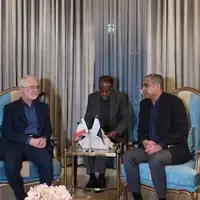
Iranian Foreign Minister Hossein Amir-Abdollahian meets with Sheikh Mohamed bin Zayed, the president of the United Arab Emirates in Abu Dhabi on June 22, 2023.
Qatar’s Spokesperson for the Ministry of Foreign Affairs says they are playing a positive role in seeking a resolution to Iran's nuclear issue.
He said the recent visit of the Minister of State Mohammed bin Saleh al-Khulaifi to Tehran during which he invited Iranian President Ebrahim Raisi to visit Qatar, were part of a series of continuous engagements between the two countries.
Al-Ansari emphasized that Qatar remains steadfast in its positive approach, offering proposals and facilitating meetings between Western and Iranian officials in Doha.
He added that the country aims to break down the overarching nuclear issue into manageable topics, addressing them separately while standing firm on certain points.
In June, Iran’s foreign minister Hossein Amir-Abdollahian met Qatar’s Emir in Doha, over what may have been related to reported indirect talks with the United States. Qatar, along with Oman, have stepped in to mediate and facilitate discussions between the US and Iran since the Vienna talks, that began in April 2021 as an attempt to salvage the nuclear agreement, have encountered obstacles and stalled last August.
A man counts Iraqi dinars on a money counting machine at a currency exchange shop in Baghdad, Iraq, January 23, 2023.
Fourteen Iraqi private banks sanctioned by the United States over allegedly helping siphon US dollars to Iran said Wednesday they were ready to face audits.
US financial authorities last week barred 14 Iraqi banks from conducting dollar transactions as part of a wider crackdown on dollar smuggling to Iran via the Iraqi banking system, Iraqi central bank officials have said.
The sanctioned banks have asked for assistance from the government. Iraqi central bank (CBI) Governor Ali al-Allaq said on Wednesday the institution was following up on the issue and he had no indication the US would sanction more Iraqi banks.
He also noted that other banks were able to cover the market's needs for dollar transactions, with the 14 sanctioned banks representing just 8% of external transfers.
Allaq said the transactions tied to the sanctions took place in 2022, before the CBI enforced tighter regulations on dollar transfers.
Those measures are in line with US regulations aimed at curbing the illegal siphoning of dollars to Iran and applying pressure on Tehran along with US sanctions imposed over its nuclear program and other disputes.
Haider al-Shamma, speaking on behalf of the 14 sanctioned banks, said on Wednesday the sanctions could further weaken Iraq's currency.
The latest US sanctions, along with previous ones on eight banks, have left nearly a third of Iraq's 72 banks blacklisted, two Iraqi central bank officials said.
"Forcing sanctions on a third of the Iraqi private banks from conducting dollar transactions will have negative consequences not only on the value of the Iraqi dinar, but it will have a very big impact on foreign investments," al-Shamma said.
"Our banks have nothing to do with political tensions but are independent financial institutions."
In a recent report, Amnesty International has expressed concern over Iranian authorities' intensifying oppression of women and girls who defy compulsory hijab.
The human rights organization is calling for international communities to stand by Iranian women who choose not to wear headscarves in public and has published detailed analysis of police patrols enforcing the veiling and threatening legal action against those who defy it. They have said it signals a resurgence of Iran’s morality police. Agnès Callamard, Amnesty International’s Secretary General, commented, “Morality policing in Iran is back. The authorities are not fooling anyone by removing the insignia of the ‘morality’ police from uniforms and patrol vans… while emboldening the enforcers of the Islamic Republic’s oppression.”
The report coincided with videos circulating on social media showing women being violently assaulted in Tehran and Rasht and security forces using teargas against people trying to help women escape arrests.
Callamard added, “Today’s crackdown is intensified by mass surveillance technologies capable of identifying unveiled women in their cars and pedestrian spaces.”
According to official announcements from Iran's Police Force spokesman, since April 15, 2023, more than a million women have received text messages warning that their vehicles could be confiscated after being caught on camera without their headscarves. Additionally, numerous women have been suspended or expelled from universities, denied access to banking services and public transport, and hundreds of businesses have been forcibly closed for not enforcing compulsory veiling.
Amnesty International has repeatedly called for the abolition of compulsory hijab, the quashing of all convictions and sentences related to defying veiling laws, and the unconditional release of all detainees. Furthermore, the organization urges the international community to take strong action, including legal pathways, to hold Iranian officials accountable for the human rights violations perpetrated against women and girls.
USA and Iranian flags are seen in this illustration taken, September 8, 2022.
A former Iranian diplomat says Washington’s contacts with Tehran show that the Americans have separated their ways from the Israelis regarding Iran's nuclear issue.
Abdolreza Farajirad told Entekhab news website in Tehran that the United States and Iran are exchanging messages through Oman and Qatar and this shows they are discussing deals.
Farajirad referred to US Secretary of State Antony Blinken's July 23 statements about Iran where he said, "it was a terrible mistake for the Trump administration to pull out of the nuclear deal reached with Iran in 2015," and commented that "I did not see any threats in that statement, although Blinken had also made it clear that "US officials are currently not talking about an agreement with their counterparts in Tehran."
The former Iranian diplomat argued that "What he said means that the US side is prepared for negotiations with Iran on the condition that Tehran does not threaten US interests and security in the Middle east."
He continued: "Blinken's remarks were positive. If Qatar and Oman also carry positive messages, this will mean that perhaps we are getting closer to a solution."
Former Iranian diplomat Abdolreza Farajirad
Entekhab wrote that other observers believe there might be a threat hidden in Blinken's statement. In effect, if US concerns about Iranian intentions to build nuclear weapons are not addressed, Washington might toughen its position.
Faraji Rad however argued that it was a positive point that Blinken was not focused on the nuclear issue in his remarks, although the United States naturally pursues its national interests.
Meanwhile, in reviewing signals Tehran and Washington have been sending to each other, proreform website Farau wrote: "Governments in Iran, regardless of their political affiliation, find out about the perils of sanctions after holding the presidential office for a few years. That is when rationality becomes prevalent."
The website was referring to hardliners currently controlling all branches of Iran’s government, who were staunchly opposed to the 2015 JCPOA nuclear accord, but now, facing harsh economic realities, realize that they have to find a way to have US sanctions lifted.
According to Fararu, the announcement by the State Department about transferring part of Iran's frozen assets in Iraq to Oman and renewed talks about US prisoners in Iran are positive developments, although some observers assess the removal of pro-Iran Robert Malley from the post of US special envoy for Iran could be a negative development for Tehran.
Fararu quoted former diplomat Fereydoun Majlesi who disagreed saying that regardless of recent developments, "there is no positive change under way!" Majlesi continued: "No positive change is likely for at least seven to 10 years. What is going on currently, will only increase the pressures on both sides.
Majlesi added that no positive change of attitude has been observed in Tehran or Washington during the past months to improve relations between the two sides although there have been opportunities for rapprochement."
Another observer, Omid Dabiri-Mehr also told Fararu that the Joint Comprehensive Plan of Action (JCPOA) is no longer on the agendas of the United States and Iran. There is no prospect for a rapprochement although a tendency is visible in Tehran to reduce the tensions with the United States.
He explained that economic problems including budget deficit and inflation and the destructive role of sanctions have finally made Iran aware of the cost of being at loggerheads with the United States.
Behrouz Mokhtari, a 72-year-old US citizen, and a native of Iran received a 41-month federal prison sentence for conspiring to violate sanctions.
US District Judge Lydia K. Griggsby also ordered him to forfeit approximately $2.8 million in criminal proceeds and a property in California worth over $1.5 million.
In January, Mokhtari pleaded guilty to two counts of conspiracy to violate the International Emergency Economic Powers Act ("IEEPA") – that restricts the exportation, re-exportation, sale, or supply, directly or indirectly, of any goods, technology, or services to Iran. He was sentenced this week to 41 months in federal prison, followed by three years of supervised release.
United States Attorney Erek L. Barron said, "This defendant knew that he was prohibited from engaging in business with Iran but did so anyway and attempted to conceal his actions through his control of businesses and financial entities in Iran and the United Arab Emirates. Now, he will not only serve time in federal prison, he will forfeit cash and property purchased with his ill-gotten proceeds."
The charges against Mokhtari involved two separate conspiracies. In one, he engaged in prohibited business activities on behalf of Iranian entities, evading sanctions from March 2018 to September 2020.
The second conspiracy spanned from February 2013 to at least June 2017. Mokhtari and Iranian nationals conducted illicit shipments of petrochemical products to and from Iran, using the US financial system to facilitate the shipments.
Mokhtari transferred ownership of the vessels to other entities to hide their financial interests. He used the United States financial system for related transactions, including the sale of one vessel for over $3.1 million, from which he received approximately $2.8 million. Mokhtari used these proceeds to purchase a residence in Campbell, California.
Iranian Defense Minister Brigadier General Mohammad Reza Ashtiani and his Bolivian counterpart Edmundo Novillo Aguilar during a meeting in Tehran in July 2023
Bolivia's Defense Minister has expressed an interest in Iranian drones for what he called boosting border security and combating drug smuggling.
Edmundo Novillo Aguilar said that Iranian high-tech drones are capable of monitoring mountainous regions and providing real-time imagery which would greatly aid the Latin American country’s armed forces.
The announcement came amidst rising security concerns in Latin America, triggered by an agreement reached between Iran and Bolivia last week, which has drawn scrutiny from neighboring countries, notably Argentina.
However, Novillio dismissed the Argentinian concerns saying that they are exaggerated and that they might be politically motivated. "The concerns raised by a certain Argentine lawmaker, whom I understand has Israeli origins, are unfounded and appear to be a political show, possibly related to the upcoming elections in Argentina,” he said.
Responding to opposition lawmakers' requests for information on an alleged defense and security memorandum of understanding with Iran during his visit to Tehran, Novillo claimed that no formal memorandum was signed. The minister also refrained from specifying whether the drones would be purchased or provided as a donation.
According to the Institute for the Study of War (ISW) in Washington, Iran has been keen on expanding the number of countries using its drone technology. Venezuela had earlier acknowledged collaborating with Iran in developing drones.
Iran's defense partnerships in the region raise concerns due to its opaque international behavior. Fears include exporting radical ideologies and unconventional arms, potentially interfering in South American affairs, and troubling the US.