Belgian Foreign Minister Faces Turmoil Over Tehran Mayor Visa
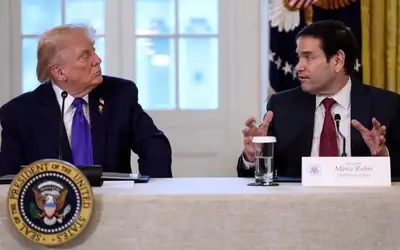
Tehran's mayor Alireza Zakani, a hardliner who was invited to Belgium
Belgian foreign minister Hadja Lahbib is facing calls for resignation after granting visas to delegations from Iranian and Russian cities to attend a mayors convention in Brussels last week.
Vandecasteele, 42, was arrested on a visit to Iran in February 2022 and sentenced in January to 40 years in prison and 74 lashes on trumped-up charges including spying.
He was freed last month in a prisoner swap with an Iranian diplomat who had been convicted in Belgium for a terror bombing plot in France.
The "Brussels Urban Summit," which took place last week, saw the mayors of more than 300 international cities including Tehran, and also members of the European Commission and the European Parliament, gathering to discuss challenges cities are facing.
Tehran's mayor, Alireza Zakani is a hardliner who was a leader in the Basij student militia.
State secretary for external relations & foreign trade of the Brussels government Pascal Smet resigned on Sundayover the all-expenses paid trip.
Belgo-Iranian lawmaker Darya Safai, from opposition party N-VA, said on Monday the party is asking for Lahbib's resignation.
"We need a minister who accepts her responsibility," Safai told Matin Premiere radio.
"The pending question is why did she agree to give these visas? Why only three weeks after the release of Olivier Vandecasteele, she accepts that terrorists come to Brussels? And why must the name of Belgium always be sullied by foreign relations which it cannot manage to control?" she said.
Belgian lawmakers will meet on June 21 to discuss the issue.
The number of deaths from consuming bootleg alcohol in Alborz Province west of Tehran has reached 12, medical officials say.
A total of 155 people in the province have also been referred to medical centers for alcohol poisoning symptoms, said Shahram Sayadi, Dean of Alborz University of Medical Sciences.
Meanwhile, five people are hospitalized in the intensive care unit.
Alborz authorities said the alcohol was sold by a body spray factory.
There is a possibility that this number of the deaths will go up as some of those who consumed the poisoned alcohol may have died in their homes, according to a judicial official in the province.
There are reports that some others have lost their vision and kidneys due to the consumption of poisonous alcohol.
Last year, at least eight people died in southern Iran after drinking toxic homemade alcohol.
Alcohol poisoning also caused the deaths of more than 44 people in Iran at the start of the Coronavirus outbreak in March 2020.
Iran has banned alcohol since 1979 and punishes those who violate the ban with floggings and fines. On the black market, however, there are a lot of foreign and homemade alcoholic beverages available.
Despite the Islamic regime’s ban, half of all adults regularly consume alcohol, according to a survey by Iran Open Data. Moreover, the majority prefer homemade beverages.
In 2018, a report by the World Health Organization (WHO) ranked Iran ninth among 189 countries for alcohol consumption per capita.
Mohammad Jaffar Mahallati who teaches religion at Oberlin College
Dr Fieda Fuchs, independent scholar and former visiting professor at Oberlin College, calls for a full investigation of an Iranian faculty member suspected of covering up mass executions in 1988.
On March 3, 2023, Ray English, the former Director of Libraries at Oberlin College, responded to our co-authored op-edpublished on February 24, 2023 in which English disagreeswith our claim that Oberlin College Professor of Religion Mohammad Jaffar Mahallati played a role in covering up the mass execution of political prisoners in his country (the 1988 “prison massacres”) during his tenure as Iran’s UN Ambassador (1988-89). Rehearsing Oberlin’s official response (published on the college website on October 28, 2021), English argues that the allegations against Mahallati are unsupported by evidence. Mahallati’s defenders rest their case on the top-secret nature of the massacres, which allegedly made it impossible for him to have “real time knowledge” of the events.
We do not doubt that Mahallati’s geographical distance from Iran made it difficult for him to know all the details. However, the international press and Amnesty International began reporting about the massacres already in summer 1988. We know that Mahallati officially claimed that these reports were exaggerated or false. We also know that Mahallati went to Iran in late August 1988 where he met with Hashemi Rafsanjani (the second most important political leader after Ayatollah Khomeini).
Mahallati also misled his UN colleagues by claiming that the massacre’s victims were battlefield casualties. The truth is that most of them had been in prison for years prior to their execution. Finally, Mahallati argued that reputable sources with a long history of professional journalism and human rights investigations (The Financial Times, The New York Times, and The Guardian, and Amnesty International) were misled by left-wing guerrilla fighters based in Iraq who were peddling false information.
Families laid flowers at unknown graves of prison massacre victims in a site in Tehran
Ray English highlights Mahallati’s role as a peace broker in the Iran-Iraq war. He argues that Mahallati’s humanitarian impulses are evident from his effort to set up a UN human rights delegation to investigate claims about possible human rights violations. English also tells us that Mahallati was briefly detained after his official term expired because he fell in disfavor with regime hardliners.
A more careful look at the evidence calls into question these claims. In 2018, Mahallati wrote a letter to the President of the Majlis (Iran’s parliament) in which he denied that he had been detained. Instead, he claimed that these rumors were spread by regime hardliners who branded him as an American spy. Mahallati’s proposal to create a UN delegation to investigate the prison massacres was not necessarily borne of humanitarian impulses either. Rather, it was based on a quid pro quo, whereby Iran’s government would agree to the committee if the UN dropped a censure motion against the country for human rights violations.
According to a New York Times article from 26 November 1988, Mohammed Jafar Mahallati told the General Assembly's Third Committee that “Iran would admit a United Nations human rights investigator and cooperate if the resolution is watered down” and that “the committee has to choose between a confrontation or a cooperative approach.” Thirty-seven UN records and international media reports show that Mahallati conditioned visits to Iran by the UN Special Representative on the removal of critical references to the mass executions from the December 1988 resolution of the General Assembly.
When the UN proceeded to censure Iran for human rights violations anyway, Mahallati rescinded his offer. It was only in 1990, a whole year after Mahallati left his post, that Iran finally allowed UN officials to conduct the investigation. However, the three visits UN officials paid to Iran between 1990 and 1992 were highly staged occasions, as often happens in authoritarian regimes.
As internationally renowned human rights lawyer Geoffrey Robertson noted, Iran denied the UN delegation independent access to prisons, prisoners, and potential witnesses. We also know that Mahallati used diplomatic immunity to defend himself against any allegations of wrongdoing, as he did when he attacked minority Baha’i communities or supported the fatwa against Nobel Prize-winning author Salman Rushdie.
Iran’s leaders have deliberately obfuscated the country’s abysmal human rights record for decades now. In this case, the goal is to demonize the 1988 prison massacre victims as violent left-wing terrorists aligned with Israel and American imperialism. Just how plausible is a conspiracy theory in which Islamic Marxist revolutionaries serve as stooges of Zionism and American power? Oberlin College’s administration should not play the role of a fellow traveler for a dictatorship that systematically violates human rights, not the least of Iran’s women who have stood up against dictatorship so bravely in recent months. Nor should it obfuscate, rather than honestly investigate, the role of a professor in covering up the crimes of Iran’s authoritarian and misogynist regime.
(Note: Dr Frieda Fuchs was mistakenly introduced as "Assistant Professor at Oberlin College" when this article was published. Consequently correction was made.)
Opinions expressed by the author do not necessarily reflect the views of Iran International
Russian and Iranian foreign ministers in Moscow in March 2022
A free trade zone deal between Iran, Russia and several countries in the vast Eurasian region is possible by the end of the year, Russia's TASS news agency reported on Monday.
Russian Deputy Prime Minister Alexei Overchuk told the state TASS agency that talks between the Eurasian Economic Union - which comprises Armenia, Belarus, Kazakhstan, Kyrgyzstan and Russia - and Iran are in their final stages.
"We are moving forward," Overchuk said. "We very much hope that such an agreement can be signed by the end of the year."
Both the region and Iran have taken on additional significance for the Kremlin after Western sanctions over Moscow's invasion in Ukraine limited Russia's foreign trade routes and forced it to look for markets outside Europe.
However, despite tighter ties between Moscow and Tehran since Russia invaded Ukraine in February 2022 and began big purchases of Iranian-made drones to attack the country, trade between the two markets have grown only moderately.
Russian-Iranian commodity turnover rose 20% in 2022, according to government data, but the monetary value of bilateral annual trade was less than $5 billion, negligible by international standards.
The regional agreement with Iran would replace and expand an interim pact that already provides a reduction in customs duties on hundreds of categories of goods.
In November 2022, Russia started swapping oil products with Iran and in March, Tehran said it counts on "huge volumes" of both oil and gas swaps with Moscow.
Overchuk also told TASS, without providing much detail, that negotiations among the Eurasian Economic Union countries on creating a common gas market continue.
The guarded entrance to Tehran's University of Arts, June 18, 2023
Various civic and popular organizations in Iran are joining the chorus of support for students in Tehran who have been staging protests against stricter hijab.
Support for defiance of stricter hijab by students who staged a sit-in against wearing a hood-like head covering Wednesday and condemnation of violence against them is growing.
Students in several other universities across the country and various social and political groups have expressed solidarity with the students at University of Art in Tehran.
A statement released by a group of Tehran University students Saturday told the authorities that "the policy of maximum repression” they have adopted in universities will ultimately fail “like other forms of repression” used against Iranian people.
Protesting students at the University of Art and their supporters released a short statement Sunday, which addressing the authorities, said students had “nothing to tell them except one word: NO!” and insisted that they would continue “to fight for freedom”.
Male and female plainclothes agents abducted at least ten students from the campus on Saturday and took them to an unknown location without any interference from police special forces who were present around the university. Student sources said all but two of the detained students were freed Sunday.
Students had been protesting new rules that require women to wear a pullover headscarf with stitched front (called Maghna’e in Iran) which is like a nun’s coif, completely covering the head and the neck. Failing to comply, the university has said, would result in suspension.
According to the popular Telegram channel of the National Student Unions Council, at about 2:30 am Thursday, Hamzeh Borzouei attacked a group of about fifty students who had begun a sit-in protest.
Iranian Writers’ Association in a statement published Friday supported the students’ action and said authorities and those who carry out their orders of repression will be responsible for any harm to the students.
In recent months, security and intelligence organs have increased pressure on students for hijab, presumably to stop the growth of the anti-compulsory hijab movement in universities across the country and suspended dozens of students.
In June Sepideh Rashno, a 29-year-old anti-compulsory hijab activist, said in an Instagram post that Al-Zahra University of Tehran had suspended her for two semesters. Rashno was tortured in detention into making a televised “confession” and condemning other activists as well as expressing regret for her confrontation with a hijab enforcer on a city bus in July last year and posting a video of the incident on social media.
Authorities have also been trying to isolate artists who supported the Woman, Life, Freedom movement or defied hijab rules.
Entekhab news website Saturday published the image of a letter from an official regulating the film industry, Habib Ilbeigi, to the chairman of film producers’ union in which filmmakers are ordered not to employ actors and others who have defied the hijab “or personally face the consequences” including refusal of a screening permit.
Police chief, Ahmad-Reza Radan, said earlier this week that the government of President Ebrahim Raisi has approved extra funds to install more hijab surveillance cameras and that four special task groups have been launched to continue the war against hijab rebellion including one that will monitor social media platforms to identify those who publish photos of themselves without hijab.
Anti-hijab and anti-regime protests erupted in Iran in September 2022 after Mahsa Amini, a young woman was arrested in the street by the notorious ‘morality police’ and received fatal head injuries during here detention and later died in hospital.
Drones are seen at a site at an undisclosed location in Iran, in this handout image obtained on April 20, 2023.
Documents leaked by a hacktivist group shows that Iran was expecting Ukraine to severe diplomatic ties over Tehran's supply of weapons to Russia.
Confidential letters published by the group Uprising till Overthrow revealed that the regime officials are aware their support for the Russian invasion of Ukraine may lead to criminal cases against Tehran for its involvement in the war.
Referring to the annulment of at least five agreements between Iran and Ukraine over the issue, the documents pointed out that Kiev has also sanctioned a large number of Iranian officials and also rejected calls for negotiations by the Islamic Republic.
The point that comes across in the hacked letters by General Staff of the Armed Forces of the Islamic Republic of Iran and the foreign ministry sent to the president’s office is that they know very little about the military cooperation with Moscow, suggesting that it is handled by the Revolutionary Guards, most probably with the approval of Supreme Leader Ali Khamenei.
Drones are seen at a site at an undisclosed location in Iran, in this handout image obtained on April 20, 2023.
Rolling with the punches, the organizations offered a number of suggestions to compensate for the “loss of dignity” by making demands from the Russian government.
In the documents, the General Staff asked the government not to deny Iran’s involvement in the war and its supply of drones to Moscow because the European and other Western countries are evidently sure about the military support.
Among the ways to dampen the effects of Iran’s support for the Russian invasion of Ukraine is holding talks with Kyiv officials to keep the channel of interaction open between the two countries.
The correspondence with the president’s office shows the regime’s concerns over the Ukrainian government downgrading relations with the Islamic Republic, calling for planning for such a scenario through preparing the regime’s embassy in Moldova to handle consular matters.
The Ministry of Foreign Affairs emphasized that the diplomatic missions of the regime in European countries should become more active so that they can be aware of the possible plans of European countries for any possible legal action against Iran, implying that they are aware that regime officials can be prosecuted for their involvement in the war.
Noting that 37 countries have filed lawsuits against Russia at the International Criminal Court, the ministry said that such a lawsuit can also be filed against the Islamic Republic.
The hacktivist group ‘Uprising till Overthrow -- affiliated with the Albania-based opposition Mojahedin-e-Khalq (MEK) group -- produced documents in May showing that it breached 120 servers of the presidential office, getting access to internal communications, meetings minutes, President Ebrahim Raisi’s online conference platforms and about 1,300 computers inside the offices. The MEK-affiliated group has been releasing the documents on its social media accounts.
Iran has repeatedly denied sending armed drones to Russia after Moscow launched its invasion in February 2022, claiming that any shipments occurred before the war.
However, Russia has used hundreds of Iranian-made drones to attack Ukrainian infrastructure and civilian targets, with Kyiv reporting more supplies in December as Moscow’s stocks were used up.
Western powers have strongly objected to Iran's decision to arm Russia with Kamikaze drones, and possibly other weapons and ammunition.