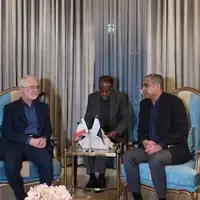
Venezuela's President Nicolas Maduro meets with Iranian President Ebrahim Raisi, at Miraflores Palace, in Caracas, Venezuela June 12, 2023.
The regime is relishing a sense of undermining its arch rival, the US, as Iran’s President Ebrahim Raisi tours fellow sanctioned nations Cuba, Nicaragua and Venezuela, flexing its muscles on Washington’s doorstep.
In a show of unity with the regime allies who also share the anti-US animosity, a raft of so-called economic agreements were announced as a show of force as Iran rattles its saber.
IRNA, the Iranian government official news agency, published an article on the eve of Raisi’s visit, titled “Why Iran's president is welcomed with open arms in America's backyard?”, a celebration of what it hailed as a diplomatic coup de force.
“The political atmosphere and political attitude of the people of this geographical area can be defined in opposition to the US,” read the article, citing Raisi as saying: “The common position between us and these three countries is standing against the regime of domination and unilateralism."
Venezuela's President Nicolas Maduro and Iranian President Ebrahim Raisi look on as Iranian Defense Minister Mohammad Reza Ashtiani and Venezuela's Minister of Agriculture Wilmar Castro sign agreements during a meeting at the Miraflores Palace, in Caracas, Venezuela June 12, 2023.
Although Iran and Venezuela signed over two dozen memoranda of understanding during Raisi’s extravagant visit to his comrade Nicolas Maduro’s land and voiced willingness to increase bilateral trade to $20 billion, up from a self-proclaimed figure of $3 billion, both countries are so broke that can hardly keep themselves afloat.
“The level of economic cooperation was at a level of $600 million two years ago but today this has increased trade and economic cooperation to more than $3 billion,” Raisi said in Caracas.
During the signing ceremony, Maduro said the countries had signed a whopping 25 agreements “during this historic visit of President Raisi” stating there was more to come with investments in the pipeline across industries from oil and gas to gold and iron, though no details were provided regarding the agreements.
In a hopeful spirit, he said: “We are signing an agreement to establish a joint shipping company Iran-Venezuela that allows us to raise trade to the levels that President Raisi is pointing out.”
People hold flags as Venezuela's President Nicolas Maduro meets with Iranian President Ebrahim Raisi, at Miraflores Palace, in Caracas, Venezuela June 12, 2023.
On a more serious note, there is concern over The Monroe Doctrine, a foreign policy position that states any intervention in the political affairs of the Americas by foreign powers is considered a potentially hostile act against the United States.
Raisi’s two-day visit to Venezuela this week along with a huge entourage and scheduled trips to Cuba and Nicaragua -- all sanctioned by Washington – seems like an effort to encroach on the region, especially following similar inroads by Tehran’s allies China and Russia.
Over almost two centuries, the Monroe doctrine has protected the US from unwanted foreign influence in the region. Most recently, it was invoked in the 1962 Cuban missile crisis when Kennedy gave an ultimatum to the Soviets to pull out their missiles. The last time the doctrine made headlines was in March, when two Islamic Republic’s warships docked in Brazil.
Experts wonder if such a historic foreign policy principle could be the answer to the threat of Iranian encroachment.
In an opinion piece for The Wall Street Journal this week, Walter Russell Mead, a fellow in Strategy and Statesmanship at Hudson Institute, said that Raisi’s visit is also a chance for Latin American politicians to gain solace from fellow opponents to the US, blaming capitalism and the US for the otherwise inexplicable failure of their policies, and roll out the red carpet for America’s opponents.
He pointed out that ties with Russia and China are booming, as Moscow has resumed its Cold War efforts to subsidize a Cuban economy and China is offering Cuba billions of dollars in exchange for the construction of a sophisticated intelligence facility to be used against the US.
“But Moscow’s efforts are dwarfed by Beijing’s. Chinese trade with Latin America and the Caribbean rocketed from $18 billion in 2002 to $450 billion 20 years later and is projected to reach $700 billion by 2035,” he said.
“The steady incursions of US rivals into the Western Hemisphere would have touched off a political firestorm at any time since James Monroe issued his famous doctrine,” Mead argued, adding: “But Latin America and the Caribbean are the last remaining places where the American foreign-policy establishment appears to cling to post-Cold War complacency about America’s rivals.”
Iran’s new Education Minister Reza-Morad Sahrai, who is reportedly mired in numerous cases of plagiarism
A plagiarism epidemic is sweeping across Iran's universities according to a damning new report.
Research released by Iran’s parliament claims that as many as half of the postgraduate theses produced between 2019 and 2022 have been fraudulently written.
Etemad daily presented the details of the report on Monday, saying that a total of 72,0057 doctoral dissertations were submitted during the mentioned years, out of which 21,264 (29%) had more than 30% similarities with other scientific texts.
In the same period, 675,713 master's theses were uploaded, out of them 311,648 (46%) were copied with more than 30 percent similarity.
Previously, in January 2016, it was reported that the Dutch Elsevier publishing house removed 26 papers by Iranian authors who were affiliated with Azad University due to fraud in the referencing of the outsourced journals.
Even though various experts in Iran have repeatedly emphasized the need to raise the quality of scientific production in Iran instead of mass production of articles and dissertations, Ali Khamenei, the Supreme Leader of the Islamic Republic, has always boasted of the high number of productions of scientific papers in Iran, calling it a sign of power.
Last week, the results of the Progress in International Reading Literacy Study (PIRLS) test showed that Iranian students are among the weakest in the world in terms of educational abilities.
A view from the town of Sarvabad in Kordestan province
Iranian forces bombarded several Kurish regions on Monday, terrorizing residents of nearby villages.
France-based Kurdistan Human Rights Network (KHRN) said the heights of Kosalan mountain near the city of Sarvabad in Kordestan province were shelled while IRGC forces were deployed to the region in the latest attacks against Iran's Kurdish population.
Villagers told the rights group that the heights of Razab village were bombarded, and in the afternoon, IRGC forces were sent to the area along with bulldozers.
According to the report, explosions were also heard at night, but the reason or motive remains unknown.
Last week, IRGC forces were deployed to the cities of Ravansar, Paveh and Sarvabad in the provinces of Kermanshah and Kordestan, bombarding the areas with drones.
On June 5, Hengaw Human Rights Organization, a Kurdish rights group published the images of the deployment of government forces to Kordestan while the internet was disrupted in some cities in Kurdish regions.
The Islamic Republic calls Iranian Kurdish armed groups "terrorist groups" while these groups say that the goal of their armed campaign is "defending the rights of the Kurds".
Late last year, the Islamic Republic intensified its repression on Kurdish-majoritycities and towns in western provinces of the country following reports that parts of some small towns have fallen into the people’s hands.
The majority of Iran's 10 million Kurds live in the western parts of the country. It has also launched repeated attacks against Iranian Kurds sheltering in Iraqi Kurdistan.
Twenty-two US servicemen were injured in a helicopter "mishap" in Syria on Sunday, the US military said late Monday, without disclosing the cause of the incident.
The US military's Central Command said 10 service members were evacuated to higher-level care facilities outside the region, without detailing the severity of the injuries.
Central Command, which oversees US troops in the Middle East, said no enemy fire was reported but added that the cause of the incident was under investigation.
There are about 900 US personnel deployed to Syria, most of them in the east, as part of a mission fighting the remnants of Islamic State. American troops there have come under repeated attacks in recent years by Iran-backed militia.
While Islamic State is now a shadow of the group that ruled over a third of Syria and Iraq in a caliphate declared in 2014, hundreds of fighters are still camped in desolate areas where neither the US-led coalition nor the Syrian army, with support from Russia and Iranian-backed militias, exert full control.
Thousands of other Islamic State fighters are in detention facilities guarded by Kurdish-led Syrian Democratic Forces, America's key ally in the country.
US officials say that Islamic State could still regenerate into a major threat.
The threats from Iran-backed militia to US forces are a reminder of the complex geopolitics of Syria, where Syrian President Bashar al-Assad counts on support from Iran and Russia and sees American troops as occupiers.
Iraqi Foreign Minister Fuad Hussein attends a meeting with US Secretary of State Antony Blinken in Riyadh, Saudi Arabia, June 8, 2023.
The United States is said to have given Iraq permission to pay $2.7 billion of its debts to Iran but the mechanism by which the money would be released remains murky.
The Iraqi foreign ministry source said that the funds will be transferred through the Commercial Bank of Iraq and Iranian officials have confirmed that the money will be used for Iranian Hajj pilgrims' expenses and foodstuffs imported by Iran.
Iranian officials have claimed that the money in Iraqi banks could be as much as $10 billion or more. Yahya Al-e Eshaq, the head of the Iran-Iraq chamber of commerce, was quoted as saying by the local media Saturday that the Iraqi debt is between $7 to $8 billion but only $2.7b has been agreed to be released and that part of the funds has been earmarked for pilgrims and another portion has been used to purchase basic goods.
On Monday, Iranian lawmaker Hassan Norouzi claimed that the money will be provided to the Hajj pilgrims in forms of subsidies to buy dollars at a slightly lower rate than free market. However, he criticized the decision, saying that the money belongs to all Iranians and not a small number of affluent individuals, who can afford the Hajj pilgrimage in the first place.
Lawmaker Hassan Norouzi
Norouzi, who is the vice-chairman of the Judicial and Legal Committee of the parliament, pointed to the country’s dire economic situation, calling the scheme "a definitely wrong move."
"This money belongs to the entire nation and should be spent for the sustainable goals of the Iranians,” he said. It is better “to spend the money on Tehran’s water, so that residents of the capital would not have to drink water contaminated by nitrate.”
The annual Islamic pilgrimage to Mecca, Saudi Arabia -- the holiest city for Muslims -- is a mandatory religious duty that must be carried out at least once in their lifetime by all adult Muslims who are physically and financially capable of undertaking the journey. This year Hajj ceremonies will be held around late June through early July and the average price for Iranians to go to the journey is about $5,000, a rate set by the host country Saudi Arabia.
The key condition for the pilgrimage is physical and financial ability of the applicants. If the government is supposed to subsidize the journey, then it is not a real pilgrimage.
Muslim pilgrims perform Tawaf around Kaaba during the annual Haj pilgrimage in the holy city of Mecca, Saudi Arabia, July 31, 2020.
The Iranian government organizes and controls the Hajj pilgrimage, including paying Saudi Arabia in US dollars for the expenses of each traveler, and providing dollars to pilgrims to spend during their journey. But instead of charging each pilgrim the full amount based on high free market exchange rate, it provides these dollars at a low preferential rate, in effect subsidizing the pilgrimage.
However, the total amount of the subsidy would still be a tiny fraction of the $2.7 billion that is reportedly about to be unblocked, considering that the number of the pilgrims is at most 80,000 people. The total subsidy the government would spend on pilgrims this year will be around $200 million.
The question is how Iraq plans to release the $2.7 billion including whatever has been designated for pilgrims. Officials of all three countries are silent on the issue. If a few hundred million dollars is set aside for pilgrims, would it be transferred to Saudi Arabia as payment for expenses? Or cash dollars will be provided to the Iranian government, which would violate the purpose of US banking sanctions to begin with.
Multiple reports this week suggest the US is offering financial incentives to the Islamic Republic in exchange for Tehran slowing its production of enriched uranium. Late in May, Iran International ported that the United States was offering to release Iran’s funds held in Iraq and South Korea in exchange for Tehran to show more flexibility on issues related to its nuclear program, and the release of American dual nationals held hostage in Iran.
A week later, on June 7, Haaretz confirmed the report saying that the United States was offering to release $20 billion in frozen Iranian funds — currently held by South Korea, Iraq, and the International Monetary Fund — in exchange for Iran limiting further production of high-enriched uranium.
Another report on June 8 by Middle East Eye (MEE) echoed much of Haaretz’s reporting but added that the administration would allow Iran to export an additional one million barrels of oil per day, which would likely require the president to issue a national security waiver.
Iranian and American officials have rejected the reports, but –according to The Foundation for Defense of Democracies (FDD) -- questions remain about whether an agreement may proceed without official text or notification to Congress, as required under existing law.
The head of the FDD, Mark Dubowitz, says: “The Biden administration hopes that Tehran will be more amenable to a ‘longer and stronger’ deal after getting major nuclear and economic concessions in exchange for a ‘shorter and weaker’ arrangement. This is an illusion. Iranian leaders understand power and leverage better than President Biden and his team do. The emerging ‘less for more’ deal is the worst deal of all.”
“The administration may be looking to evade congressional review by trading billions of dollars to Iran in exchange for a temporary halt to higher levels of enrichment, all without a written agreement or public acknowledgment. Paying Iran to sit patiently on the nuclear threshold won’t stop Iran from developing nuclear weapons, but it will subsidize attacks against Americans, Israelis, Ukrainians, and Iranians," said Richard Goldberg, a senior advisor at the FDD.
Atomic symbol, US and Iranian flags are seen in this illustration taken September 8, 2022.
A former senior Iranian lawmaker says Tehran and Washington have agreed to a non-written deal giving Iran some sanctions relief but capping its nuclear program.
Heshmatollah Falahatpisheh, the former head of the Iranian Parliament's Foreign Policy and national Security Committee who often commentates on nuclear-related issues, claimed that Tehran and Washington are willing to agree to an “unwritten deal”.
“This means that the American side will no longer enforce the ‘maximum pressure’ policy [of the Trump administration], close its eyes to some of Iran's energy deals, and [allow] the release of Iran's frozen funds in return for Iran refraining from expanding its nuclear program more than the current level,” he told Khabar Online in Tehran.
Falahatpisheh also said a return to the JCPOA is no longer desired by either of the sides because both know that it can no longer be revived.
A return to the 2015 deal, he said, will force Tehran to give up much of the advancements it has made in its nuclear program at a very high cost, that is, giving up its new and more advanced centrifuges and a stockpile of 60-percent enriched uranium, banned under the JCPOA.
Former lawmaker Heshmatollah Falahatpisheh
Also, the pressure of public opinion in the US has made a return to the deal impossible for the Biden administration, he argued.
Falahatpisheh also said the US may agree to Iran selling one million barrels of oil per day.
Referring to Supreme Leader Ali Khamenei’simplicit endorsement of some kind of agreement, the moderate conservative former lawmaker told Khabar Online that Khamenei’s stance was “close to the views of moderates such as Mohammad-Javad Zarif, the former foreign minister who was the lead Iranian person in the 2015 deal.
Addressing a group of Iranian nuclear scientists and officials in Tehran Sunday, Khamenei said a deal with West can be accepted if it does not impact Iran’s nuclear infrastructure and insisted that Iran will not opt for nuclear weapons simply because of Islamic principles, “otherwise, they could not have prevented us.”
Many in Iran interpret Khamenei’s remarks as endorsement of an deal, similar to his 2013 implicit endorsement of talks that led to the signing of the JCPOA. This interpretation was reflected by a slight drop in forex rates: The dollar which stood at 490,000 rial against the rial Sunday dropped to 470,000 on Monday.
"I'm not opposed to the right diplomatic moves. I believe in what was described years ago as heroic flexibility," Khamenei said in a September 17 speech to Revolutionary Guards (IRGC) commanders.
“Heroic flexibility” in dealing with the West regarding the nuclear issue, he said, was similar to a wrestler exercising flexibility as a tactic to overcome his adversary, but insisted that Iranian diplomats had to remain faithful to the Islamic Republic’s principles. "A wrestler who exercises flexibility for a tactical reason should not forget who his rival is and what his goal is," he said.
Iran's foreign ministry spokesman, Nasser Kanaani, however, on Monday rejected speculations about an interim deal with the US. “We confirm no such thing as negotiations for an interim agreement or new arrangements to replace the nuclear deal,” he told reporters at his weekly press conference.
While confirming that Tehran and Washington had held talks in Muscat, Oman, in the past few weeks, he also denied that the talks had been held secretly as alleged by the media.
Kanaani also said Monday that Tehran and Washington could be “very close to exchanging prisoners” without giving any details.
On Saturday a senior Iraqi official was quoted as saying that his country has acquired a sanctions waiver from the US to pay $2.7 billion of its debt for gas and electricity to Iran. The release of Iranian funds in Iraq could be the price for the release of American, and possibly other western hostages, held by Iran.