Taliban Holds War Games Near Border With Iran

Amid rising tensions between Iran and Afghanistan, Taliban forces carried out a military drill near the border with Iran on Thursday.

Amid rising tensions between Iran and Afghanistan, Taliban forces carried out a military drill near the border with Iran on Thursday.
According to the state-run Bakhtar News Agency, the Taliban military held a war game in Nimruz,located in the southwestern part of the country and to the east of Iran’s Sistan and Baluchestan province.
The drills came amidst growing tensions, fueled by a decades-old water dispute. Iran has accused Afghanistan's Taliban of violating a 1973 treaty by restricting the flow of water from the Helmand River to Iran's parched eastern regions, an accusation denied by the Taliban.
During May, a series of incidents escalated to bring tensions between the two countries to their worst in years, the deadliest of which seeing two Iranian soldiers and one Taliban fighter killed after shooting broke out near a border post.
Iranian President Ebrahim Raisi had earlier warned the Taliban over disregarding Iran's water rights under the 1973 treaty while the Taliban rejected the perceived threat, with a former Taliban official mocking the president in a video that went viral.
Evidence also surfaced late last month showing a convoy of Taliban tanks deployed from Herat to Islam Qala on the border with Iran with forces seen stationed in the region with heavy military equipment, suggesting a more heavily armed presence than before the water dispute escalated.

In a brazen move, Iran’s Red Crescent Society has offered to help Ukrainians who are hit by floods after Russia blew up Kakhovka dam in southern Ukraine.
The head of Iran’s Red Crescent, Pir-Hossein Kolivand, sent a letter to the president of the Ukrainian Red Cross Society, Mykola Polishchuk, expressing readiness to send relief teams and humanitarian aid to the flood-hit regions in what could be perceived as a move to save face in the wake of revelations that Iranian drones and weaponry has been sent to Russia for its invasion of Ukraine.
The destruction of the facility by Russian forces on Tuesday unleashed mass flooding, forcing thousands of residents to flee and wreaking environmental havoc.
Audaciously, Kolivand even described the destruction of the dam as a “tragic incident” as he downplayed the devastation Russia continues to deal to Ukraine's civilians. The latest attack on the dam affected the lives of a large number of innocent people, forcing the evacuations of residents of surrounding villages.
Kolivand claimed that the Islamic Republic's principled policy is to help other countries based on humanitarian grounds to protect the lives of innocent people and reduce their suffering, the gesture unlikely to be taken seriously amidst months of uprising which has seen hundreds of civilians killed by the regime's security forces and tens of thousands more arrested.
It is likely to anger Ukraine’s President Volodymyr Zelensky who said last month that “thanks to the sanctions, the number of missiles they [the Russians] produce has decreased several times. However, there are such challenges as Iran which has sold them [Russia] more than 1,000 Iranian-made drones and other weapons.”
Iran first denied it had supplied drones to Russia but in early November foreign minister Hossein Amir-Abdollahian admitted the deliveries, while claiming they were sent before the Russian invasion. Recent intelligence reports suggest that Tehran may also be planning to supply long-range missiles to Russia.

The Commander of Iran’s Revolutionary Guards’ Navy says the Persian Gulf belongs to regional countries and the presence of other countries' militaries there is illegitimate.
During his visit to Iranian islands in the southern waters of the country on Friday, Commodore Alireza Tangsiri said: “Establishing security in the Persian Gulf and the Strait of Hormuz is done with the synergy and convergence of the countries of this region, and there is no need for the illegitimate presence of extra-regional countries."
He did not explicitly mention any country, but the presence of US and Israeli forces has been a thorn in the eye of the Islamic Republic.
His remarks came a few days after US and UK navies acted when a merchant ship was being harassed by IRGC’s fast-attack boats in the Strait of Hormuz. Over the past two years, Iran has now harassed, attacked or interfered with the navigational rights of 16 internationally flagged merchant vessels in regional waters.
The recent incident in the Strait of Hormuz took place against the backdrop of reports about the formation of a new naval alliance in the region with Iran being a main force. The US says it “defies reason” for Iran to be part of a regional naval alliance while the Islamic Republic is the main reason for maritime insecurity in the Persian Gulf region.
Iranian media claimed in recent days that a regional naval coalition is in the offing though this was not confirmed by any mentioned parties. Iran's navy commander officially announced that his country and Saudi Arabia, as well as the United Arab Emirates, Qatar and Bahrain, plan to form a naval alliance, that would include Iraq, India and Pakistan.

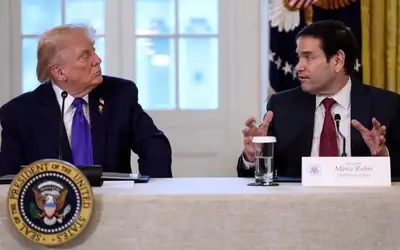
US Secretary of State Antony Blinken highlighted the threats posed by Iran for the security of the region during his trip to Saudi Arabia.
During a joint presser with Saudi Foreign Minister Prince Faisal bin Farhan Al Saud on his last day his visit on Thursday, Blinken said Washington and Riyadh, together with the GCC, are “focused on Iran’s destabilizing influence in the region, including its support for terrorism and violent militia groups, the seizure of tankers transiting international waters, and nuclear escalation.”
While the United States and Iran both denied reports that they were nearing an interim deal Thursday, Blinken added that “the United States continues to believe that diplomacy, backed by economic pressure, by deterrence, and by strong defense cooperation, is the best way to avoid and counter these dangerous actions.”
He noted that the US supports efforts by Saudi Arabia to de-escalate tension and stabilize relations, without elaborating on details.

Among the main points on agenda in Blinken’s trip was pushing Riyadh for normalize ties with Israel, about which his Saudi counterpart said that “it’s quite clear that we believe that normalization is in the interest of the region, that it would bring significant benefits to all.”
However, he added “without finding a pathway to peace for the Palestinian people, without addressing that challenge, any normalization will have limited benefits.”

Canada's Senate has passed a non-binding motion to designate Iran’s Revolutionary Guards as a terror organization.
Fierce campaigner Senator Ratna Omidvar who has been leading the charge, stressed that “the crimes of the Islamic regime and the IRGC go beyond the borders of Iran", citing the contribution of the IRGC to Russia's brutal invasion of Ukraine, for which Iran has supplied kamikaze drones.
“They [the IRGC] have been deployed more than 90 times against a civilian population,” added Omidvar --who experienced the turbulence of Iran’s Islamic Revolution while living there before moving to Canada -- highlighting that “Iran and the IRGC fund and support Hamas and Hezbollah, creating significant regional instability".
In June 2018, the Canadian parliament passed another similar motion, introduced by MP Garnet Genuis, to designate the IRGC but the government did not follow up on the action.
So far, Canada has only designated the Quds Force, the extraterritorial arm of the IRGC, but has been reluctant to list the IRGC as a foreign terrorist group.
Canadian officials said last year that the designation would be too much of a “blunt instrument” that could punish innocent people in Canada who were conscripted into the IRGC as part of their mandatory military service.
In November, Prime Minister Justin Trudeau said Canada has designated Iran's IRGC leadership, adding that “we will restrict financial transactions with the Islamic Republic of Iran associated with the IRGC and the proxies that support them. These actions are some of the strongest measures anywhere against Iran.”

Former political prisoner Hossein Ronaghi says the intelligence ministry has requested the Prosecutor's Office to issue an order to send him into exile.
He further noted in a tweet that he has found out that based on the order his bank accounts will be blocked and he will be deprived of his citizenship rights.
Ronaghi is an Iranian blogger, human rights activist and political dissident who was arrested on September 24. 2022, along with his lawyers in front of the Evin Prison prosecutor's office and transferred to jail where he was tortured.
In protest, Ronaghi went on a hunger strike after his arrest amid antigovernment protests and refused liquid nourishment and water.
Tehran residents rushed to the hospital in November after his brother wrote in a tweet that security agents had moved Ronaghi from prison to a hospital. He said his brother “got on an ambulance fully awake after talking to his mother,” adding “whatever happens to Hossein is nothing more than a pre-planned scenario because they intend to kill him.”
Ronaghi, 37, a contributor to The Wall Street Journal, has for years been one of the most fearless critics of the Islamic Republic who has stayed in the country.
Iranian authorities on November 26 released Ronaghi on bail.
In previous rounds of torture, the dissident has lost one kidney and his second kidney is functioning at 60 percent, according to human rights sources.
Hossein Ronaghi has been arrested and jailed several times in the past 13 years. He was detained in 2009 for his role in the post-election protests. Ronaghi was arrested again in February 2022 after criticizing a bill that would limit internet access in Iran.