Israel Claims Interim Deal With Iran Does Not Roll Back Nuclear Enrichment

Israel's UN ambassador says Iran's nuclear weapons program is in the process of being negotiated under an interim deal that does not roll back uranium enrichment.

Israel's UN ambassador says Iran's nuclear weapons program is in the process of being negotiated under an interim deal that does not roll back uranium enrichment.
On Tuesday, Gilad Erdan told The Jerusalem Post Annual Conference in New York that “the real bad news is that apparently there is an interim agreement that is being discussed these days with Iran.”
It “would put the Iranian nuclear program on hold but won’t roll back the enriched uranium or the nuclear facilities of Iran and in exchange, they will get economic benefits,” he stressed.
He made the comments a few days after National Security Advisor Tzachi Hanegbi and Strategic Affairs Minister Ron Dermer met with the US National Security Advisor, Jake Sullivan at the White House to discuss Iran's pursuit of atomic bombs at a time when Tehran has enriched uranium close to weapons-grade levels.
There is concern in Israel that Washington will attempt to revive the defunct 2015 nuclear pact between the six world powers and Iran.
Moscow's military ties to Tehran, as well as its use of Iranian-made drones against Ukraine, have led the Biden administration not to discard that possibility.
“The international community has failed, totally failed to block Iran from advancing itself to becoming a nuclear threshold state,” Erdan noted.

IAEA Director General on Monday presented the latest report on Iranian verification and monitoring.
“Iranian enriched uranium stockpiles have risen by more than a quarter in three months, according to Rafael Grossi.
He reminded the Board that in March this year, Iran and the IAEA agreed to take additional appropriate measures for monitoring and verification. “Some progress has been made but not at the level, pace and sustained rhythm that I would expect,” Grossi said.
“The inventory of enriched uranium is growing at a very fast pace, and the activities are also growing. So, the presence of the IAEA should be commensurate with that,” added Grossi.
The Israeli UN ambassador reiterated this Tuesday, saying “what we have been seeing in the last year proves that everything that Israel has been saying has been proven correct,” Iran only becoming more bold.
“I do not see any sanctions that are being discussed and might be imposed against the nuclear program of Iran,” he said, claiming there is no deterrent against the regime’s capability building.
“We always believed that the only formula to deter Iran’ which is a rogue and ruthless regime, is through a credible military threat,” he reiterated.
Iran has unveiled what it describes as its first domestically made hypersonic ballistic missile, while available facts about the weapon cast doubt on the claim.
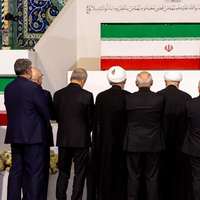
A ceremony to present Fattah missile on Tuesday was attended by President Ebrahim Raisi, Revolutionary Guards Chief Commander Major General Hossein Salami, and IRGC Aerospace Force Commander Brigadier General Amir Ali Hajizadeh as well as a dozen other senior officials.
Boastful statements by IRGC commanders about the unprecedented level of cooperation between the Raisi administration and the IRGC, which – given the occasion it was announced – will work as a prod to heighten Western concerns about Iran's missile capabilities.
Iran claims its hypersonic missile has a range of 1,400 kilometers, can breach and overcome all anti-missile shields, and hits speeds of Mach 13-15, which means about 13 to 15 times faster than the speed of sound -- known as Mach 1.
Currently available technology perhaps support hypersonic missiles flying at 5-8 Machs, so Iran's claim of 15 mach speed seems an exaggeration.

For a missile to be called hypersonic, it should fly at least five times faster than the speed of sound. The threshold of Mach 5 is used because a range of physical effects start becoming a significant engineering challenge at that speed.
In addition, a true hypersonic missile should also be maneuverable to be useful, which poses a significant challenge not only to Iran but even for great military powers, such as the United States, which still has not fielded such a weapon.
The term is also used generally to refer to two types of weapons that are being developed through contemporary defense programs: Hypersonic glide vehicles (HGVs) and hypersonic cruise missiles (HCMs). It is not clear which type Fattah is. However, since Iran described it as ballistic, it is most probably an HGV.
But even that description is misleading. An HGV is a relatively large projectile lifted by a ballistic missile into the atmosphere, which at a certain point begins gliding toward its target.
An HCM is a cruise missile, which means it does not glide but is self-propelled at a hypersonic speed.

No Iranian official has elaborated on when Fattah would hit hypersonic speed: during its first phase of flight powered by a ballistic missile, or when it is gliding toward the target.
Unless Iranian authorities say at what altitude the missile will hit Mach 15, the claim is not even verifiable.
The IRGC claims that with a solid fuel propulsion system and a second-stage mobile nozzle, the missile has the ability to reach very high speeds and perform various maneuvers in and out of the Earth’s atmosphere in order to overcome all types of air defense systems. Hajizadeh saying Iran is now among only four countries that have the technology to manufacture hypersonic missiles. He did not name the countries he had in mind.
According to Stockholm International Peace Research Institute (SIPRI), the reports about such missiles demonstrate how confusing -- and potentially distorting -- the term ‘hypersonic’ is, noting that some of the news coverage of similar events have indicated “a lack of understanding of the different types of ‘hypersonic missiles’, the role of their speed and maneuvering capabilities, the physics behind them, and their military capabilities and missions.”
Hajizadeh added that unlike other types of missiles, Fattah cannot be countered by any defense system, noting that the hypersonic missile cannot be destroyed by any missile due to its cross-range maneuvers, meaning movement in various directions and heights.
However, a Brookings Institution report in May– titled ‘Don’t believe the hypersonic hype’ -- , debunked several such claims, and mentioned the case of the Russian Kinzhal missile, which President Vladimir Putin had announced in 2018 as a “hypersonic” weapon that could overcome all existing air defense systems. However, in May, Ukraine used US-supplied Patriot batteries to down several Kinzhals, shattering the myth of a Russian hypersonic weapon.
SIPRI says that the questioning why certain actors adopt this terminology – given a lack of understanding of the limitations of this descriptor -- can “help reveal motivations and vested interests in the hype around hypersonic missiles, i.e. to appear threatening.”
Highlighting that Supreme Leader Ali Khamenei has supported and approved the missile activities and even has chosen the name 'Fattah’ -- which means ‘the opener,’ Hajizadeh said “Our activities in this field do not end with the manufacturing of this missile. We will continue this path so that no enemy even imagines attacking Iran.”

Four people, including a Mossad agent, died when a small yacht capsized in a lake in northern Italy late last month with new information coming to light suggesting it was more than a freak accident.
The Mossad agent who drowned in Lake Maggiore -- identified with the cover name Erez Shimoni – was one of the 21 Italian and Israeli intelligence agents who were apparently celebrating on the vessel -- named the Gooduria -- before a sudden storm capsized the boat.
Initially, the Italian media said the agents were having a birthday party, but Israeli media said they were celebrating the success of a mission, which was later revealed as an operation against deals between Iranian and Russian officials to provide drones for President Vladimir Putin’s invasion of Ukraine.
The story is still shrouded in mystery and unanswered questions but during the past few days more and more pieces of the puzzle are coming together.
All 21 passengers -- 13 of whom were Israelis -- on the 52-foot houseboat were currently or formerly tied to Israeli and Italian defense and intelligence work. Two of those who died had worked for the Italian intelligence authority.
The fourth was the Russian wife of the boat's skipper, who was the only other crew except for her husband, Carlo Carminati, the only one under suspicion of negligent homicide, as the vessel had 23 people on board when it was only allowed to carry 15. The captain’s wife, Anna Bozhkova, had a residency permit to live in Italy indefinitely, reportedly to serve as a translator in monitoring the Russian oligarchs’ dealings with Iran.
The passengers who survived swam a short distance – about 150 meters (about 490 ft) -- to reach the shore, where they were promptly rescued. The Israeli agents were flown home on a plane that picked them up in Milan the following day.

One of the main bits of information that was the fact that the Mossad agent was a veteran agent and was operating in the area -- along with the other Israeli agents and Italian intelligence personnel on the yacht -- as part of a mission to target Iranian weapons capabilities, specifically to prevent Tehran from obtaining advanced weapons, according to a report by the Italian newspaper La Repubblica.
The collaboration of Italian and Israeli agents followed reports of Russian oligarchs in the area taking part in transferring Iranian-manufactured UAVs to Moscow.
According to the New York Times, the spies had been scoping the lake for Russian magnates living nearby, while other reports in the Italian press claimed that the group had met "to exchange information and documents." There are also reports that theorized that the Israeli agents were monitoring contacts between Iranian and Italian firms.
Italian daily Corriere della Sera alleged that the Russian oligarchs used their Swiss bank accounts to transfer funds to Iranian companies in order to bypass the sanctions against Moscow and Tehran. The newspaper also highlighted the joint operation conducted by the Mossad and Italian intelligence, saying the operation targeted the proliferation of non-conventional weapons and their potential transfer to a “hostile Middle Eastern country.”
Italian newspaper La Repubblica confirmed that the intelligence operation sought to obstruct the arrival of weapons of mass destruction to Iran as well as preventing the acquisition of "dual-use" items that could serve both civilian and military purposes.

Lake Maggiore or Verbano, the second largest lake in Italy and the largest in southern Switzerland, is a large lake located on the south side of the Swiss Alps -- between Italy's Lombardy region and the Swiss canton of Ticino. Several companies that produce both military and civilian technology use are located in Lombardy, the BBC reported, adding that Switzerland is considered a transit country for those working in intelligence.
An Italian police source played down the intrigue. “Anyone can write what they want to, they could even say the boat was targeted by aliens. But what happened is that there was an accident caused by a weather event... it's not your typical 007 occasion," they said.
However, there are very few ways you can make a story that involves Israel’s Mossad, Italian military officials, Russian oligarchs and Iranian weapons and a picturesque location like Lake Maggiore that would not make a good spy flick.

A day after the US Navy reported that Iranian military speed boats were "harassing" a commercial vessel in the Strait of Hormuz, the IRGC claimed to have assisted the vessel.
Admiral Abbas Gholamshahi, an IRGC commander, claimed Monday that the boats were civilian and when the Command-and-Control Unit of the Strait of Hormuz learned about a distress call from a merchant ship with the flag of the Marshall Islands they tried to ease the worries of its captain.
US and UK navies acted when a merchant ship was being harassed by Iranian forces in the Strait of Hormuz, the US Navy said Monday.
The vessel sent a distress call on June 4 while transiting the straits, a relatively narrow waterway controlled in the north by Iran but considered international waters for commercial and naval traffic.
Iran has hundreds of fast attack boats that for years not only have harassed civilian vessels but, on many occasions, have come dangerously close to US and other warships in a show of force.
"The issue of providing security and aid to the vessels traveling in the Strait of Hormuz and the Persian Gulf is not something new, and it will definitely continue," added Gholamshahi, who appeared to be trying to back peddle the crisis.
US Navy guided-missile destroyer USS McFaul and UK Royal Navy frigate HMS Lancaster both received the distress call, and Lancaster launched a helicopter to provide surveillance. The US 5th Fleet also directed a P-8A Poseidon maritime patrol aircraft to monitor the scene, the Navy said.
However, the Iranian admiral called this narrative "absolutely false" saying that "when the commercial ship requested help, no extra-regional vessel was present" and basically the purpose of this narrative is "to justify the presence of extra-regional countries in the Persian Gulf".
As talks seem to be progressing with the US on Iran’s nuclear program, it would be extremely harmful to relations for the latest crisis to stand in the way.

The US State Department responding to reporters on Monday did not deny that its special envoy for Iran had secret meetings with Tehran’s ambassador to the UN.
The Financial Times last week reported that the special envoy Robert Malley met with Iran’s UN ambassador in New York several times to negotiate over American citizens held hostage by Iran.
A reporter asked State Department deputy spokesperson Vedant Patel during his regular briefing on Monday to confirm the report.
“I don’t have anything to announce on this front,” Patel responded.
He added, “As you’ve heard me say previously, we have the means to communicate with Iran and deliver messages to them that are in America’s interest to do so. We’re not going to detail the contents of those messages or the means of those deliveries. I don’t have anything additional to add there.” He refused to comment further.
There were many unconfirmed reports in May that Tehran and Washington were engaged in talks over releasing American hostages in exchange for some of Iran’s frozen funds abroad.
Iran International in January had reported the secret meetings and the State Department at the time did not deny or confirm the report using the same language Patel used on Monday.

Former spokesperson Ned Price in response to a question by Iran International said on January 18, “We have the means to deliver specific and firm messages to Iran when it is in America’s interest to do so.”
Iran International had asked the DoS that according to information it obtained, US Malley had met with Iran’s UN ambassador, Saeed Iravani, “at least three times in the last two months.”
“But we're not going to get into details about how we deliver these messages, except to say that we do so in close coordination with allies and partners.”
Regarding the content of these messages, Ned Price had said, “We have consistently conveyed three messages: stop killing peaceful protesters, stop selling weapons to Russia to kill Ukrainians, and release the Americans you’ve wrongfully detained. We also use any available opportunity to make clear that we will take necessary steps to protect American citizens.”
On the issue of American dual-nationals held hostage in Iran, no breakthroughs took place even if Malley met and negotiated with Iravani in the end of 2022 or even later. Three individuals, Siamak Namazi, Emad Sharghi and Morad Tahbaz have spent years in Iranian prisons charged with bogus accusations, without due process of law.
If Malley did meet Iravani face-to-face, it would be the first reported direct meeting between US and Iranian diplomats since the Biden administration assumed office and offered talks to revive the 2015 JCPOA nuclear deal. Iran has consistently refused direct talks with the United States, as a direct order by Supreme Leader Ali Khamenei.
During 11 months of nuclear negotiations in Vienna from April 2021 to March 2022, the United States was engaged on the side-lines. Messages were being carried by European Union representatives, as well as by Russian diplomats between the US and Iranian delegations.
In recent weeks, several politicians and pundits in Iran, allowed to speak in the local media, have urged direct talks with Washington to resolve the nuclear and other disagreements and relieve the pressure of US sanctions but so far Khamenei has not relented.
In an address to the pro-Israel advocacy group AIPAC on Monday, Secretary of State Antony Blinken said, "If Iran rejects the path of diplomacy, then, as President Joe Biden has repeatedly made clear, all options are on the table to ensure that Iran does not obtain a nuclear weapon."

US Secretary of State Antony Blinken has reiterated that “all options are on the table” to prevent the Islamic Republic from acquiring a nuclear weapon.
In his address to the pro-Israel advocacy group AIPAC on Monday, he said, "If Iran rejects the path of diplomacy, then, as President Joe Biden has repeatedly made clear, all options are on the table to ensure that Iran does not obtain a nuclear weapon."
He did not elaborate on what Iran should do exactly that can be construed as rejecting the path of diplomacy as Tehran has been enriching uranium to over 60% purity and its proxy militia have attacked US forces in the region at least 83 times since 2021.
Admitting that there was no danger that Israel faces "that is graver than the one posed by the Iranian regime,” Blinken voiced Washington's "iron-clad" commitment to Israel's security.
“That regime routinely threatens to wipe Israel off the map, continues to provide weapons to terrorists and proxies like Hezbollah and Hamas, who reject Israel's right to exist,” he said, adding that the Islamic Republic “exports its aggression throughout and even beyond the region, including by arming Russian forces with drones that are being used to kill Ukrainian civilians and destroy its infrastructure.”
Blinken also highlighted the US “three-pronged approach of diplomacy, economic pressure, and deterrence, which also includes strengthening Israel's military capabilities,” saying that “it puts us in the strongest possible position to address the Iranian nuclear threat just as we take on the many other challenges posed by the Iranian regime.”